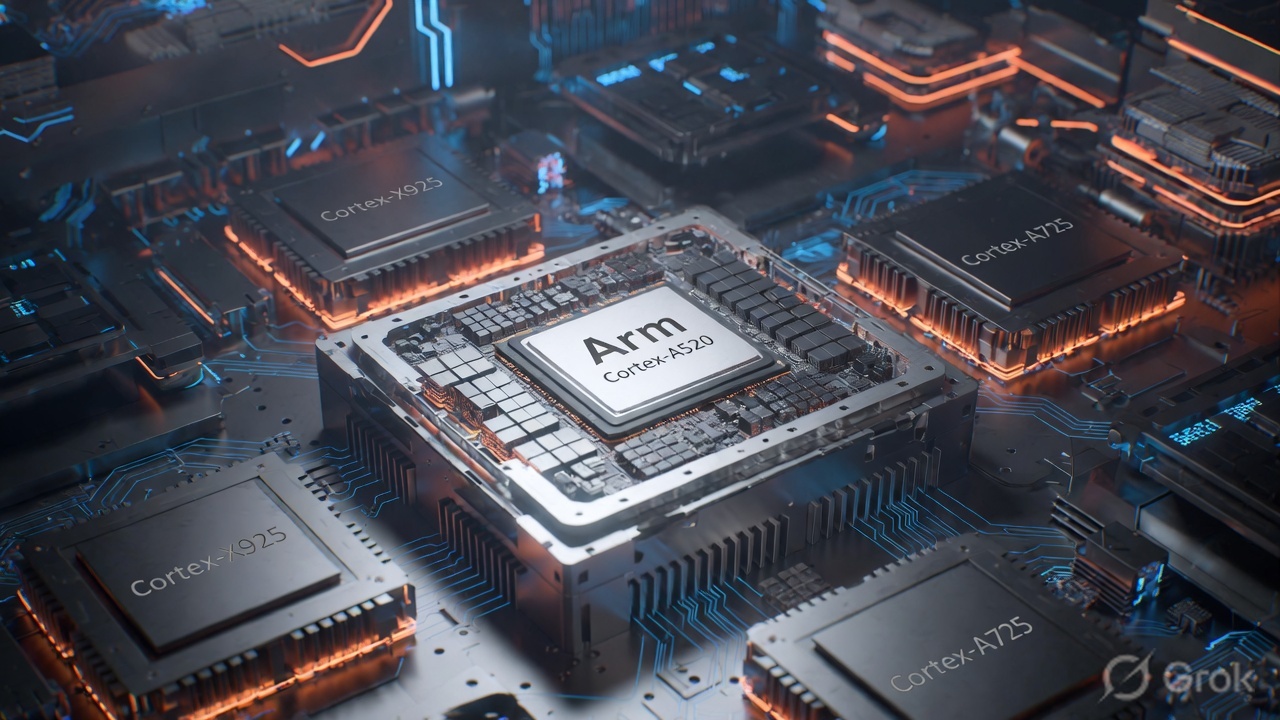
Introduction to the Arm Cortex-A520
The Arm Cortex-A520 is a high-efficiency microprocessor core designed by Arm Holdings, specifically tailored as a “LITTLE” core in heterogeneous computing configurations like big.LITTLE. Introduced as part of Arm’s Total Compute Solutions (TCS) in 2023, it represents the second-generation LITTLE CPU in the Armv9 lineup, building on the merged-core microarchitecture first seen in its predecessor, the Cortex-A510. This core prioritizes power efficiency for background and lightweight workloads, making it ideal for extending battery life in mobile and embedded devices while supporting scalable performance across various consumer electronics. It is fully compatible with Arm’s DynamIQ Shared Unit (DSU-120) and can be clustered with higher-performance cores like the Cortex-X925 (prime core) and Cortex-A725 (mid-core) to form dynamic CPU clusters that balance power, performance, and area constraints. The Cortex-A520 adheres to the Armv9.2-A architecture, which extends the Armv8-A foundation with enhancements for security, machine learning, and vector processing.
As of March 2026, the Cortex-A520 and its minor iterations remain widely adopted in system-on-chip (SoC) designs from partners like MediaTek, Samsung, and Qualcomm. It powers a range of devices from premium smartphones to wearables, laptops, and even automotive systems in its Automotive Enhanced (AE) variant. While the core itself saw minor updates in Arm’s 2024 announcements—primarily process optimizations for 3nm nodes yielding about 15% better efficiency—its core design has stayed largely consistent, focusing on evolution rather than radical changes. This stability allows for broad compatibility and cost-effective implementation in cost-constrained markets.
Architecture and Microarchitecture
The Cortex-A520 implements a 64-bit-only AArch64 execution state under the Armv9.2-A architecture, dropping legacy 32-bit support to optimize for modern applications and improve security. It uses an in-order execution pipeline, which contrasts with out-of-order designs in higher-performance cores but enables lower power consumption and smaller die area—key for efficiency-focused roles. The pipeline is 3 instructions wide for decode, with execution units including 3 ALUs (arithmetic logic units), 1 branch unit, and specialized units for floating-point and vector operations.
Key microarchitectural features include:
- Merged-Core Design: Introduced in the A510 and refined in the A520, this allows pairs of cores to share resources like L2 cache and front-end logic, reducing area by up to 20% while maintaining performance for low-intensity tasks.
- Cache Hierarchy: Each core has configurable L1 caches (32/64 KiB instruction cache with parity and 32/64 KiB data cache), with shared L2 cache up to 512 KiB per cluster. This setup supports low-latency access for efficiency workloads.
- Pipeline Stages: The core features a compact pipeline optimized for power, with improvements in branch prediction, instruction fetch, and load/store units to minimize stalls in lightweight scenarios.
- Supported Standards: Compliance with Armv9.2-A includes extensions like SVE2 (Scalable Vector Extension 2) for variable-length vectors up to 2048 bits, enhancing ML and multimedia processing; Arm Neon for SIMD (Single Instruction, Multiple Data) operations; and the new QARMA3 Pointer Authentication Code (PAC) algorithm, which reduces overhead for security features like pointer authentication.
In automotive variants like the Cortex-A520AE, additional features support functional safety (e.g., ASIL D compliance) and scalability for applications like ADAS (Advanced Driver-Assistance Systems) and digital cockpits.
Key Features
The Cortex-A520 incorporates several technologies to enhance efficiency and functionality:
- DynamIQ Technology: Enables seamless integration in big.LITTLE clusters, allowing dynamic switching between cores based on workload demands for optimal power-performance balance.
- Power Management: Advanced features like adaptive voltage scaling, fine-grained clock gating, and low-power states reduce energy use during idle or light loads. The core supports Arm’s big.LITTLE heterogeneous processing, where it handles background tasks to conserve battery.
- Machine Learning and AI Support: Built-in support for Armv9-A’s 128-bit fixed-length vectors and SVE2 enables efficient on-device AI inference, contributing to up to 46% better AI performance in clusters with companion cores.
- Security Enhancements: Includes Memory Tagging Extension (MTE) for detecting memory safety issues and the aforementioned PAC for protecting against return-oriented programming attacks.
- Configurability: Clock speeds typically range from 1.8 GHz to 2.27 GHz, with options for cache sizes and cluster configurations to suit different market segments.
These features make the A520 versatile for sustained performance in power-constrained environments, such as always-on features in smartphones.
Performance Metrics and Power Efficiency
Performance-wise, the Cortex-A520 offers modest uplifts focused on efficiency rather than raw speed. It provides up to an 8% performance increase over the A510 in similar workloads, with peak clock speeds around 2.0 GHz. In benchmarks like SPECint or Geekbench, clusters incorporating A520 cores excel in multi-threaded efficiency tasks, but the core’s strength lies in its energy profile.
Power efficiency is the standout aspect:
- Up to 22% power reduction compared to the Cortex-A510 at iso-performance.
- Additional 15% efficiency gains from 3nm process optimizations in later iterations.
- In real-world scenarios, this translates to longer battery life for devices handling background processes, with microarchitectural tweaks like improved instruction throughput and reduced leakage current contributing to these savings.
For example, in a typical big.LITTLE setup (e.g., 1x X-series + 3x A7xx + 4x A520), the A520 handles up to 80% of light workloads, allowing big cores to remain powered down.
Comparisons to Previous Generations
Compared to the Cortex-A510 (its direct predecessor, introduced in 2021):
- Efficiency: 22% lower power consumption, thanks to refined merged-core architecture and process improvements.
- Performance: 8% uplift in lightweight tasks, with better scalability across segments.
- Area: Similar die size but optimized for denser integrations on advanced nodes like 3nm.
- Architecture: Both use merged-cores, but A520 adds Armv9.2 enhancements for better ML and security.
Relative to earlier LITTLE cores like the A55 (from Armv8.2), the A520 offers over 30% performance uplift in efficiency scenarios while consuming significantly less power, marking a shift toward Armv9 benefits. In clusters, it pairs well with the Cortex-A720/A725 (20-35% more efficient than prior mid-cores) and X-series primes for overall 15-46% better system performance per watt.
Some designs, like MediaTek’s later Dimensity chips, have begun replacing A520 with custom equivalents like the C1 Nano for even greater battery focus, indicating the core’s influence on evolving efficiency strategies.
Target Applications and Devices
The Cortex-A520 targets power-sensitive applications where sustained low-intensity performance is key:
- Mobile Devices: Premium to entry-level smartphones, tablets, and AI PCs for background tasks like notifications, sensors, and AI assistants.
- Wearables and XR: Low-power operation for extended wear time in smartwatches, AR/VR headsets.
- Home Electronics: Digital TVs, set-top boxes, and smart home hubs.
- Automotive: In AE variants, for ADAS, infotainment, and zonal controllers.
- Networking: Supports 5G for efficient connectivity in modems and edge devices.
Notable SoCs and devices using Cortex-A520 cores as of 2026 include:
- Samsung Exynos Series: Exynos 2400 (1x X4 + 5x A720 + 4x A520) in Galaxy S24 series; Exynos 2500 (1x X925 + 2x A725 + 5x A725 + 2x A520) in Galaxy Z Flip 7 and other 2026 models.
- MediaTek Dimensity Series: Dimensity 9300/9400 (various configurations with 4x A520 or equivalents) in devices like Oppo Find X9 Pro; some 2026 flagships like Dimensity 9500 use it or custom replacements.
- Qualcomm Snapdragon Series: Snapdragon 8 Gen 3 (possible 2x X4 + 4x A720 + 2x A520 variants); mid-range like Snapdragon 6 Gen 4 (1x A720 + 3x A720 + 4x A520) in budget Android phones.
- Other Devices: Various Android flagships in 2025-2026, including those from Samsung, Oppo, and Red Magic, leverage A520 for efficiency in AI-enhanced features.
In summary, the Cortex-A520 exemplifies Arm’s efficiency-first approach, enabling devices to deliver longer battery life and better AI capabilities without compromising on cost or scalability. Its ongoing use in 2026 underscores its enduring relevance in the mobile ecosystem.
1) Arm Cortex-A520: Architecture
The Arm Cortex-A520 implements the Armv9.2-A architecture profile and serves as Arm’s second-generation high-efficiency “LITTLE” core in the Arm Total Compute Solutions lineup. It builds directly on the microarchitecture foundation established by the Cortex-A510 (introduced in 2021), with targeted refinements emphasizing power efficiency, reduced area, and compatibility with modern security and machine learning features. Below is a detailed breakdown of its architecture and microarchitecture.
Instruction Set Architecture (ISA)
The Cortex-A520 is the first Arm CPU core to be AArch64-only, meaning it exclusively supports the 64-bit execution state and drops all 32-bit (AArch32) compatibility. This design choice enables several benefits:
- Simplified hardware implementation (no need for legacy 32-bit decoding and execution paths).
- Reduced silicon area and power consumption.
- Up to ~20% faster application loading and more responsive user experiences in 64-bit-optimized software ecosystems.
- Full compliance with the Armv9.2-A architecture, which extends Armv8-A / Armv9.0-A with mandatory and optional extensions.
Key Armv9.2-A features implemented in the Cortex-A520 include:
- Memory Tagging Extension (MTE) — Hardware memory safety mechanism to detect invalid memory accesses and reduce exploits from memory corruption bugs.
- Scalable Vector Extension 2 (SVE2) — Variable-length vector processing (up to 2048 bits) for advanced machine learning, signal processing, and multimedia workloads.
- Neon / Advanced SIMD (ASIMD) — Fixed 128-bit vector operations for legacy vectorized code.
- Pointer Authentication (PAC) with the new QARMA3 algorithm — Provides significantly lower overhead (<1% performance cost) and reduced latency compared to previous PAC implementations, making hardware-enforced control-flow integrity more practical on efficiency cores.
- Cryptographic extensions, TrustZone support, and other Armv9 security and debug features.
These architectural advancements make the Cortex-A520 particularly well-suited for secure, ML-accelerated background and lightweight tasks in modern smartphones, wearables, and embedded systems.
Core Organization and Merged-Core Design
The Cortex-A520 uses a merged-core microarchitecture, originally introduced in the Cortex-A510. In this design:
- Cores are grouped into complexes containing up to two cores.
- Within each dual-core complex, certain resources are shared to reduce silicon area and power:
- Vector Processing Unit (VPU) — Handles Neon/SVE2 vector operations (shared between the two cores).
- L2 Translation Lookaside Buffer (TLB).
- L2 cache logic and the L2 cache itself (configurable shared L2).
- This sharing enables denser integration and lower area overhead compared to fully independent cores, while still allowing independent operation when only one core is active in the complex.
- The core integrates into DynamIQ Shared Unit (DSU-120) clusters, supporting heterogeneous big.LITTLE configurations (e.g., pairing with Cortex-X925 prime cores and Cortex-A725 mid-cores) and up to 14 cores per cluster.
Typical implementation frequencies range from 1.8 GHz to ~2.27 GHz, depending on process node, thermal/power budget, and SoC partner choices (commonly ~2.0 GHz in mobile devices).
Pipeline and Execution Model
The Cortex-A520 is an in-order superscalar core, meaning instructions are executed strictly in program order without dynamic reordering or register renaming (in contrast to out-of-order designs in big/mid cores). This choice prioritizes:
- Extremely low power consumption.
- Small silicon area.
- Predictable, deterministic behavior suitable for efficiency-focused workloads.
Key pipeline characteristics:
- In-order execution — No out-of-order mechanisms; stalls occur if an instruction depends on a prior result.
- Decode width — Up to 3 instructions per cycle (handles common instruction patterns efficiently).
- Issue / dispatch width — Effectively dual-issue (2-wide), meaning up to two instructions can be dispatched and executed in parallel per cycle in most cases.
- Execution units:
- 3× integer ALUs total, but only two ALU pipelines available for issue (one ALU was removed compared to the Cortex-A510 to save power in issue logic, result forwarding, and bypass networks).
- 1× dedicated branch unit.
- 1× load/store unit (handles address generation and memory operations).
- Shared floating-point / Neon / SVE2 vector unit (VPU) per complex.
- Branch prediction — Hybrid predictor supporting direct and indirect branches, with miniaturized structures optimized for power-constrained environments; includes mechanisms to reduce misprediction penalties.
- Pipeline optimizations focus on reducing stalls in lightweight workloads via improved branch prediction, better data prefetching, and streamlined load/store handling rather than widening the pipeline or adding out-of-order capability.
The removal of the third ALU pipeline (present in the A510) is a deliberate efficiency-first trade-off: it saves power across the issue, rename, and forwarding stages while recovering most lost performance through other microarchitectural tuning.
Cache Hierarchy and Memory System
- L1 caches (private per core):
- Instruction cache: 32 KiB or 64 KiB (with parity/ECC options).
- Data cache: 32 KiB or 64 KiB.
- L2 cache — Shared within the dual-core complex, configurable sizes: 128 KiB, 192 KiB, 256 KiB, 384 KiB, or up to 512 KiB (larger options support better sustained performance in efficiency clusters).
- Caches include ECC/parity protection on critical paths for reliability.
- The design connects to the DSU-120, which provides optional system-level L3 cache and snoop control in full DynamIQ clusters.
This hierarchy minimizes latency for background tasks while keeping area and power low.
Efficiency-First Philosophy
Arm describes the Cortex-A520 as an “efficiency-first” core. Microarchitectural changes (e.g., ALU reduction, shared resources, improved predictors/prefetchers, QARMA3 PAC) deliver:
- Up to 22% lower power vs. Cortex-A510 at iso-performance.
- Up to 8% performance uplift in lightweight/background workloads.
- Better area efficiency on advanced nodes (e.g., 3nm/4nm processes used in 2025–2026 SoCs).
In practice, the Cortex-A520 handles the majority of always-on, low-intensity tasks (notifications, sensors, background AI) in big.LITTLE systems, allowing higher-performance cores to power down more often and extend battery life.
In summary, the Cortex-A520’s architecture combines the Armv9.2-A ISA with a refined in-order, dual-issue (with 3-wide decode) pipeline, merged-core sharing, and targeted efficiency optimizations to deliver class-leading power efficiency for sustained low-to-medium workloads in mobile, wearable, and embedded applications.
1.1) Arm Cortex-A520: Merged-core microarchitecture
The merged-core microarchitecture is a defining feature of the Arm Cortex-A520, inherited and refined from its predecessor, the Cortex-A510. Introduced with the Cortex-A510 in 2021, this design represents Arm’s approach to maximizing power efficiency and minimizing silicon area in high-efficiency (“LITTLE”) cores, while still delivering acceptable performance for background, always-on, and lightweight workloads in mobile, wearable, and embedded devices.
Core Concept of Merged-Core Design
In traditional CPU designs, each core is fully independent, with its own dedicated front-end (fetch/decode), execution units, vector/float units, and private cache structures. This independence provides maximum flexibility but incurs significant area and power overhead—especially for resources that are infrequently or only partially utilized in efficiency-focused scenarios.
The merged-core approach changes this by grouping cores into complexes (also called dual-core blocks or pairs). Specifically:
- A single complex contains up to two Cortex-A520 cores.
- Certain high-area, high-power, or infrequently contended resources are shared between the two cores in the complex, rather than duplicated for each core.
- The cores remain functionally independent—they can execute separate threads, power-gate individually, and operate at different frequencies if needed—but they benefit from resource sharing to reduce overall silicon footprint and dynamic/leakage power.
This design is particularly effective for efficiency cores because:
- Background and light workloads rarely saturate vector units, crypto engines, or large translation buffers simultaneously across multiple cores.
- Sharing these resources saves die area (often 15–25% reduction per core pair compared to fully independent designs) and lowers power without substantially impacting real-world performance in typical use cases.
Specific Shared Resources in the Cortex-A520 Merged-Core Complex
According to Arm’s official documentation and technical descriptions, the following key components are shared within each dual-core complex:
- Vector Processing Unit (VPU) This handles all Neon (128-bit fixed SIMD), SVE2 (Scalable Vector Extension 2, variable-length up to 2048 bits), floating-point operations, and related vector/crypto instructions. Sharing the VPU avoids duplicating large, power-hungry execution logic. In practice, most lightweight/background tasks use vector units sporadically, so contention is minimal.
- L2 Translation Lookaside Buffer (TLB) The L2 TLB caches virtual-to-physical address translations for the second level of page table walks. Sharing this structure reduces area while still providing sufficient TLB coverage for typical efficiency workloads.
- L2 Cache Logic and the L2 Cache Itself The L2 cache is shared between the two cores in the complex (configurable sizes: typically 128–512 KiB per complex, e.g., 256 KiB shared). This means both cores access the same unified L2 instance, with arbitration handled transparently. Sharing the L2 tag/data arrays, control logic, and error-correction circuitry significantly cuts area and power compared to private L2 caches per core.
- Optional Shared Cryptographic Logic (in some configurations) Certain cryptographic extensions (e.g., AES, SHA) can be implemented as shared hardware, further reducing duplication when crypto acceleration is needed but not heavily contended.
Importantly:
- Integer execution pipelines, branch predictors, L1 caches (instruction and data, 32/64 KiB each), and most front-end logic (fetch/decode/issue) remain private per core.
- Each core retains its own independent integer ALUs (reduced to effectively dual-issue capability in A520), load/store units, and rename/issue logic.
- The design allows mixed operation: a complex can run with one core active (the other power-gated) with virtually no penalty, or both cores active with shared-resource arbitration.
Integration with DynamIQ Shared Unit (DSU-120)
The merged-core complexes connect to Arm’s DynamIQ Shared Unit (DSU-120), which provides:
- System-level cache coherence (via ACE/CHI interface).
- Optional shared L3 cache (system-level, per cluster).
- Power management, clock gating, and voltage/frequency scaling across the entire cluster.
- Support for heterogeneous big.LITTLE topologies (e.g., 1× Cortex-X925 + 3–5× Cortex-A725 + 2–4× Cortex-A520 complexes).
This allows SoC designers to deploy odd numbers of A520 cores (e.g., 3 or 5) by combining paired complexes with single-core ones, while still benefiting from merged-core savings where possible.
Benefits and Trade-offs of the Merged-Core Approach
Advantages:
- Significant area reduction — Up to 20–25% smaller footprint per core pair compared to independent cores, critical for cost-sensitive and area-constrained mobile/embedded SoCs on advanced nodes (4nm/3nm).
- Improved power efficiency — Lower leakage (fewer transistors) and reduced dynamic power (shared logic not duplicated). This contributes to the Cortex-A520’s claimed up to 22% power reduction vs. Cortex-A510 at iso-performance.
- Maintained or slightly improved performance for target workloads — Arm reports up to 8% performance uplift over A510 in lightweight tasks, thanks to other microarchitectural refinements (better prefetching, branch prediction, QARMA3 PAC) offsetting any minor contention in shared units.
- Scalability — Enables denser efficiency clusters (e.g., 4–8 LITTLE cores) without exploding die size.
Trade-offs:
- Potential minor contention on shared resources (VPU, L2 TLB, L2 cache) during rare bursts of vector-heavy or memory-intensive activity across both cores in a complex.
- Slightly more complex power/clock domain management within the complex.
- Less benefit in workloads that heavily and simultaneously use shared units (but such scenarios are uncommon for LITTLE cores by design).
Evolution from Cortex-A510 to Cortex-A520
The merged-core design is largely unchanged between A510 and A520—both use the same sharing model for VPU, L2 TLB, and L2 cache. The A520 refines efficiency through:
- Pipeline optimizations (e.g., removal of one ALU pipeline from A510’s three-ALU design).
- Improved predictors and prefetchers.
- Armv9.2-A features (QARMA3 PAC, enhanced SVE2 support). These changes maintain the merged-core philosophy while pushing power efficiency further (22% lower power) with only modest performance gains (8%).
In summary, the merged-core microarchitecture allows the Cortex-A520 to achieve class-leading power and area efficiency by intelligently sharing expensive vector, cache, and translation resources within dual-core complexes, while preserving independent execution for most pipelines. This makes it ideal for the sustained, low-intensity tasks that dominate battery life in modern consumer devices.
1.2) Arm Cortex-A520: Integration with DynamIQ Shared Unit (DSU-120)
The Arm Cortex-A520 integrates seamlessly with the DynamIQ Shared Unit-120 (DSU-120), which serves as the foundational cluster controller and interconnect fabric for heterogeneous CPU configurations in Arm’s Total Compute Solutions (particularly TCS23 and subsequent iterations). This integration enables scalable, power-efficient big.LITTLE (and tri-cluster) designs, allowing the Cortex-A520 to function as the high-efficiency “LITTLE” core alongside higher-performance cores like the Cortex-X925 (prime) and Cortex-A725 (mid-tier) in modern SoCs.
Role of the DSU-120 in Arm Systems
The DSU-120 is Arm’s latest DynamIQ Shared Unit (introduced alongside the Armv9.2-A cores in 2023), acting as a unified cluster manager that combines one or more CPU cores into a coherent multicore subsystem. It replaces the earlier DSU-110 and provides enhanced scalability, power management, and performance optimizations.
Key responsibilities of the DSU-120 include:
- Coherent interconnect — Maintains full cache coherence across all cores in the cluster using protocols like AMBA CHI Issue E (CHI.E).
- Shared L3 cache — Provides a large, unified last-level cache accessible by all cores.
- Snoop Control Unit (SCU) — Manages snoop traffic for coherence, filtering unnecessary probes to reduce power and latency.
- Power, clock, and voltage domain management — Supports fine-grained power gating, dynamic voltage/frequency scaling (DVFS), and multiple power states for individual cores, complexes, and the entire cluster.
- External interfaces — Bridges to the system-level fabric (e.g., via CHI or AXI) for communication with memory controllers, GPUs, accelerators, and peripherals.
- Debug, trace, and interrupt handling — Integrates with CoreSight, GICv4.1, and other system-level features.
The DSU-120 supports up to 14 cores per cluster (an increase from the 12-core limit of DSU-110), enabling flexible topologies ranging from small efficiency-only clusters to large heterogeneous setups.
How the Cortex-A520 Connects to the DSU-120
The Cortex-A520 is specifically designed for implementation inside a DSU-120 cluster. Each Cortex-A520 core (or merged-core complex) connects directly to the DSU-120 via dedicated interfaces, forming part of the coherent domain.
- Core-to-DSU connection — The Cortex-A520 uses the standard Arm DynamIQ interface, connecting its private L1 caches and shared L2 (within merged complexes) to the DSU-120. This link handles:
- Coherent data transfers.
- Snoop requests/responses.
- Power management signals.
- Debug and trace data.
- Merged-core complexes — As the A520 uses a merged-core design (up to two cores sharing a VPU, L2 TLB, and L2 cache logic), each complex appears as a single logical entity to the DSU-120 for many operations, though individual cores retain independent power gating and frequency control.
- Cache hierarchy integration:
- L1 — Private per core (32/64 KiB I/D with parity/ECC options).
- L2 — Shared per merged complex (configurable 128–512 KiB).
- L3 — Fully shared across the entire DSU-120 cluster (optional, configurable from 256 KiB to 32 MiB, with ECC support for reliability). The L3 acts as a victim cache and reduces DRAM traffic, benefiting efficiency cores by keeping more data on-chip during light workloads.
- Coherency protocol — The connection uses AMBA CHI.E (Coherent Hub Interface Issue E), supporting advanced Armv9 features like asymmetric Memory Tagging Extension (MTE) propagation and efficient snoop filtering.
This tight integration ensures the Cortex-A520 participates fully in the cluster’s coherent memory system without requiring separate coherence logic.
Heterogeneous Cluster Configurations
The DSU-120’s strength lies in supporting mixed core types within a single cluster, a hallmark of Arm’s big.LITTLE and DynamIQ strategy. Typical 2025–2026 mobile SoC examples include:
- 1× Cortex-X925 (prime) + 3–5× Cortex-A725 (mid) + 2–4× Cortex-A520 (efficiency, often in 1–2 merged complexes).
- Configurations with odd numbers of A520 cores (e.g., 3 or 5) by mixing single-core and dual-core complexes.
- Up to 14 cores total, allowing extreme scalability for laptops, automotive, or high-end mobile devices.
The DSU-120 enables dynamic task migration: the OS scheduler (via heterogeneous-aware schedulers like EAS in Linux/Android) moves threads between cores based on workload intensity, power/thermal budgets, and performance needs. The A520 handles ~70–90% of always-on/light tasks (e.g., notifications, sensors, background sync), keeping big/mid cores powered down longer.
Power Management Enhancements in DSU-120
The DSU-120 introduces intelligent power-saving mechanisms that directly benefit the Cortex-A520:
- Opportunistic slice power gating — Dynamically powers down unused L3 cache slices and associated logic during low activity.
- Multiple power domains — Supports per-core, per-complex, and cluster-level gating, plus retention states for fast wake-up.
- DVFS and clock gating — Independent frequency/voltage scaling for different core types.
- Low-power states — Cluster-wide idle modes reduce static leakage.
These features contribute to the A520’s overall 22% power reduction vs. the A510 (plus process-node gains), as the DSU-120 minimizes unnecessary power draw across the cluster.
Benefits for Cortex-A520 Workloads
- Efficiency amplification — Shared L3 reduces off-chip accesses for background tasks.
- Scalability — Enables dense LITTLE clusters without exploding area.
- Seamless big.LITTLE operation — Full coherence ensures transparent task switching.
- System-level optimizations — Better snoop filtering and power management extend battery life in real devices.
In automotive variants (Cortex-A520AE with DSU-120AE), additional safety features like Dual-Core Lock-Step (DCLS) and bus protection enhance functional safety for ADAS and zonal controllers.
In summary, the integration of the Cortex-A520 with the DSU-120 creates a highly efficient, coherent, and scalable CPU subsystem. It forms the backbone of modern Arm-based SoCs, allowing partners to build flexible clusters that maximize battery life while delivering responsive performance across diverse workloads and device categories.
1.3 Arm Cortex-A520: Pipeline and execution model
The pipeline and execution model of the Arm Cortex-A520 is carefully engineered to prioritize power efficiency and low area while delivering acceptable performance for background, lightweight, and always-on workloads in mobile, wearable, and embedded systems. As a high-efficiency “LITTLE” core, it adopts an in-order superscalar design—meaning instructions are fetched, decoded, issued, and executed strictly in program order without dynamic reordering or out-of-order execution mechanisms like register renaming or speculative execution beyond basic branch prediction.
This contrasts sharply with out-of-order designs found in Arm’s “big” (Cortex-X series) and mid-tier (Cortex-A7xx series) cores, which prioritize peak throughput but consume significantly more power and area. The in-order approach minimizes hardware complexity, reduces dynamic power in issue logic, forwarding networks, and rename stages, and provides predictable, deterministic behavior suitable for efficiency-focused roles.
Pipeline Overview
The Cortex-A520 employs a compact, efficiency-optimized in-order pipeline. While Arm does not publicly disclose the exact number of stages (unlike some earlier cores like the Cortex-A55’s 8-stage pipeline), the design focuses on low-latency stages with targeted optimizations to reduce stalls in common lightweight workloads.
Key pipeline characteristics include:
- In-order execution — No out-of-order mechanisms; an instruction must wait for prior dependent instructions to complete before execution, avoiding complex hardware but introducing potential stalls on data hazards or long-latency operations.
- Decode width — Up to 3 instructions per cycle. This allows the front-end to handle common instruction patterns (e.g., short sequences of dependent or independent ops) efficiently, providing headroom for decoding fused or macro-op-like patterns in Armv9 code.
- Issue / dispatch width — Effectively dual-issue (2-wide) in most cases. Up to two instructions can be dispatched and executed in parallel per cycle when dependencies and resource availability permit.
- Execution model optimizations — Emphasis on branch prediction accuracy, improved data prefetching, streamlined load/store handling, and reduced misprediction penalties rather than widening the pipeline or adding speculative depth. These changes help recover performance lost from deliberate efficiency trade-offs.
The pipeline is tuned for sustained throughput in background tasks (e.g., sensor polling, notifications, background sync, lightweight AI inference) rather than bursty peak performance.
Execution Units and Resource Configuration
The Cortex-A520 features a balanced set of execution units optimized for power-constrained environments:
- Integer ALUs — 3 ALUs total, but limited to two ALU pipelines available for issue per cycle. This is a deliberate change from the Cortex-A510, which supported three ALU pipelines (enabling 3-wide ALU issue in some cases). Arm removed the third ALU pipeline in the A520 to save power across:
- Issue logic (fewer ports to check/arbitrate).
- Result forwarding networks (simpler bypass paths).
- Rename and writeback stages (reduced contention). While this introduces a minor throughput penalty in highly parallel integer workloads, Arm reports that real-world efficiency workloads rarely saturate three ALUs simultaneously. Performance is recovered through other microarchitectural tuning (e.g., better predictors and prefetchers), resulting in the claimed up to 8% performance uplift over the A510 at iso-power, alongside 22% lower power consumption.
- Branch unit — 1 dedicated branch execution unit handles control-flow instructions (conditional branches, calls/returns). Supports hybrid branch prediction (combining bimodal, gshare-like, and loop predictors) with miniaturized structures scaled from higher-end cores (Cortex-A7xx / X-series) to fit power/area budgets. Includes mechanisms for indirect branch prediction and reduced misprediction recovery latency.
- Load/store unit — 1 dedicated address generation and memory operation unit. Handles load/store address calculation, cache access, and data movement between registers and L1 caches. Includes optimizations for load/store fusion, prefetch hint processing, and stall reduction on cache misses in efficiency scenarios.
- Vector / Floating-point unit (VPU) — Shared within each merged-core complex (up to two cores). Supports Neon (128-bit fixed SIMD), SVE2 (variable-length vectors up to 2048 bits), floating-point operations, and related crypto instructions. Sharing the VPU avoids duplication of large, power-intensive logic, as lightweight tasks rarely saturate vector throughput across both cores simultaneously.
The core supports full Armv9.2-A extensions (e.g., QARMA3 Pointer Authentication with <1% overhead, ideal for in-order cores; SVE2 for ML; asymmetric MTE), executed via the same pipeline with minimal additional complexity.
Branch Prediction and Hazard Handling
- Branch prediction — Hybrid predictor supporting direct and indirect branches. Miniaturized from larger cores to balance accuracy and power/area. Reduces misprediction penalties through faster recovery and better indirect target caching.
- Hazard mitigation — Relies on forwarding, stall insertion, and pipeline bypassing for data hazards. Load-use hazards (common in in-order designs) are minimized via improved address generation and prefetching. The design avoids deep speculation to keep power low.
Comparison to Predecessor (Cortex-A510)
The A520 evolves the A510’s pipeline with efficiency-first refinements:
- Decode — Remains 3-wide (same as A510).
- Issue/execute — Reduced from potentially 3-wide ALU issue (A510 had 3 ALU pipelines) to 2-wide ALU issue (A520 has 3 ALUs but only 2 pipelines), trading minor peak throughput for substantial power savings in issue/forwarding.
- Performance recovery — Achieved via enhanced branch prediction, data prefetching (miniaturized from big/mid cores), and QARMA3 PAC optimizations, yielding net 8% higher performance and 22% lower power vs. A510 at iso-frequency/workload.
In summary, the Cortex-A520’s pipeline and execution model embody an “efficiency-first” philosophy: a compact in-order, dual-issue (with 3-wide decode) pipeline, reduced ALU issue width, shared vector resources in merged complexes, and targeted front-end/back-end optimizations. This delivers class-leading power efficiency for sustained low-to-medium intensity tasks while integrating seamlessly into heterogeneous DSU-120 clusters for modern big.LITTLE systems.
1.4) Arm Cortex-A520: The cache hierarchy and memory system
The cache hierarchy and memory system of the Arm Cortex-A520 are optimized for low power consumption, small silicon area, and low-latency access during background, lightweight, and always-on workloads typical of efficiency (“LITTLE”) cores in mobile, wearable, and embedded devices. The design leverages the merged-core microarchitecture (up to two cores per complex sharing certain resources) and integrates tightly with the DynamIQ Shared Unit-120 (DSU-120) to form coherent, scalable clusters in heterogeneous big.LITTLE configurations.
The hierarchy follows a classic three-level structure (L1 → L2 → L3), with private L1 per core, shared L2 per complex, and optional shared L3 across the entire cluster. All levels include reliability features such as parity or Error-Correcting Code (ECC) protection to detect and (where supported) correct errors, which is especially important for efficiency cores running sustained low-intensity tasks.
Level 1 (L1) Cache — Private per Core
Each Cortex-A520 core has its own dedicated, private L1 cache hierarchy, split into separate instruction and data caches for optimal access patterns:
- L1 Instruction Cache (L1 I-cache)
- Configurable size: 32 KiB or 64 KiB per core.
- 4-way set associative.
- Includes parity protection for error detection (ensures integrity of fetched instructions).
- Designed for fast, low-latency instruction fetch in the front-end pipeline.
- L1 Data Cache (L1 D-cache)
- Configurable size: 32 KiB or 64 KiB per core.
- 4-way set associative.
- Write-back policy (dirty data is written back to L2 only on eviction or explicit flush).
- Supports ECC (Error-Correcting Code) or parity protection options, allowing single-error correction and double-error detection (SECDED) in configurations requiring higher reliability (e.g., automotive AE variants).
The L1 caches are the fastest and closest to the execution units, minimizing pipeline stalls for frequent loads/stores and instruction fetches in lightweight workloads. Typical mobile implementations favor the 64 KiB configuration per cache to balance performance and power/area trade-offs.
Level 2 (L2) Cache — Shared per Merged-Core Complex
The L2 cache is a unified (instruction + data) cache shared between up to two cores in a merged-core complex, a key efficiency feature of the Cortex-A520 design:
- Configurable sizes: 128 KiB, 192 KiB, 256 KiB, 384 KiB, or 512 KiB per complex (increments of 64 KiB, with 0 KiB possible in rare minimal configurations).
- 8-way set associative (in most implementations).
- Includes ECC or parity protection (often SECDED-capable).
- Shared resources within the complex also include the L2 Translation Lookaside Buffer (TLB) for virtual-to-physical address translations, further reducing duplication and power/area overhead.
Sharing the L2 (along with its control logic and L2 TLB) between two cores significantly lowers silicon footprint and static/dynamic power compared to private L2 caches per core. Contention is minimal in efficiency workloads, where simultaneous heavy memory access from both cores in a complex is rare. The L2 serves as the primary victim cache for L1 evictions and provides a larger, still relatively low-latency buffer for sustained background tasks (e.g., sensor data processing, notifications).
Level 3 (L3) Cache — Shared Across the DSU-120 Cluster
The L3 cache is fully shared across all cores in a DSU-120 cluster (including any Cortex-A520, Cortex-A725, Cortex-X925, or other compatible cores):
- Optional (SoC designers can omit it for cost/area-sensitive designs).
- Configurable size: 256 KiB to 32 MiB (in slices, typically up to 8 slices; common mobile configurations range from 4–16 MiB depending on the SoC target segment).
- Includes ECC protection for data integrity.
- Managed by the DSU-120, which implements advanced power modes (e.g., opportunistic slice power gating, half-on L3, low-power retention states) to reduce leakage when idle.
The L3 acts as a large last-level cache, reducing DRAM traffic and latency for cross-core data sharing in heterogeneous clusters. For Cortex-A520 cores, it is particularly valuable during light multi-threaded workloads or when background tasks interact with data produced by higher-performance cores (e.g., pre-fetched AI model weights or sensor buffers). The DSU-120’s snoop filter and coherence mechanisms (via AMBA CHI Issue E protocol) ensure efficient, low-power coherence without excessive snooping overhead.
Memory System Interfaces and Coherency
- External bus interface — The DSU-120 connects the entire cluster to system memory via AMBA CHI Issue E (Coherent Hub Interface) or AXI5 protocols, supporting 40-bit physical addressing (Armv9.2-A compliant).
- Coherency — Full hardware cache coherence across all cores in the cluster, with the DSU-120 handling snoops, invalidations, and data transfers. This enables seamless task migration in big.LITTLE systems (e.g., moving a thread from a Cortex-X925 to a Cortex-A520 without software-managed flushing).
- Translation Lookaside Buffers (TLBs) —
- L1 TLB (private per core) for fast virtual-to-physical lookups.
- L2 TLB (shared per complex) for deeper page table walks, reducing walk latency in efficiency scenarios.
- Prefetching and hints — Hardware data prefetchers (miniaturized from higher-end cores) and software prefetch hints help hide memory latency in background tasks without excessive power draw.
Efficiency and Reliability Features
- Power optimizations — The shared L2 and optional L3, combined with DSU-120 slice gating and retention modes, minimize unnecessary power consumption during idle or low-activity periods.
- Error protection — Parity/ECC across L1, L2, and L3 (plus critical paths like buses) enhances reliability, especially important for always-on features and safety-critical applications (e.g., Cortex-A520AE variant).
- Area efficiency — The merged-core sharing of L2 and associated logic contributes to the Cortex-A520’s low power-per-area profile, enabling denser clusters on advanced nodes (e.g., 4nm/3nm).
In typical real-world deployments (e.g., Samsung Exynos 2400/2500, MediaTek Dimensity 9300/9400 series, Qualcomm Snapdragon mid-range), the cache hierarchy prioritizes the 64 KiB L1 + 256–512 KiB L2 per complex + 8–16 MiB L3 configurations to deliver excellent battery life for sustained low-intensity workloads while maintaining responsiveness in heterogeneous SoCs.
Overall, the Cortex-A520’s cache hierarchy and memory system exemplify an efficiency-first approach: private fast L1 for per-core access, shared L2 to save area/power in merged complexes, and large optional cluster-wide L3 for reduced DRAM dependency—all integrated via the DSU-120 for coherent, power-aware operation in modern Arm-based consumer devices.
1.5) Arm Cortex-A520: Efficiency-first philosophy
The efficiency-first philosophy is the guiding design principle behind the Arm Cortex-A520, explicitly described by Arm as prioritizing power efficiency and area efficiency above all else while still delivering meaningful performance for its intended role as a high-efficiency “LITTLE” core. This approach defines the Cortex-A520 as the second-generation LITTLE CPU in Arm’s Total Compute Solutions (TCS) strategy (starting with TCS23), where the core is tuned specifically for background tasks, always-on features, lightweight workloads, and low-intensity processing that dominate real-world device usage and heavily influence battery life in smartphones, wearables, tablets, smart home devices, and embedded systems.
Arm’s official documentation and announcements emphasize that the Cortex-A520 adopts an “Efficiency First Design Philosophy”, with microarchitectural improvements engineered to keep efficiency first and foremost. The goal is to achieve the highest possible power efficiency for sustained low-to-medium intensity scenarios, thereby maximizing battery life and enabling longer untethered experiences without compromising scalability or security features from the Armv9.2-A architecture.
Core Tenets of the Efficiency-First Philosophy
- Unrelenting Focus on Power and Area Savings The primary metric for success is not peak performance or single-threaded throughput (as prioritized in Cortex-X prime cores or Cortex-A7xx mid-tier cores), but rather energy per operation, power consumption at iso-performance, and silicon area footprint. Arm describes the Cortex-A520 as delivering the best power efficiency in the smallest silicon footprint among its generation of LITTLE cores. This enables denser clusters, lower SoC costs, and extended battery life in cost-sensitive and power-constrained devices.
- Target Workload Optimization The core is explicitly tuned for low-intensity and background workloads (e.g., sensor polling, notifications, background sync, always-on voice assistants, lightweight AI inference, system maintenance). These tasks represent the majority of CPU activity in modern devices over the course of a day. By minimizing power draw in these scenarios, the A520 allows higher-performance cores (big/mid) to remain powered down more often, amplifying system-level battery savings.
- Deliberate Trade-offs for Efficiency Every design decision weighs efficiency heavily, even if it means modest compromises in peak throughput:
- In-order superscalar pipeline (no out-of-order execution, no complex rename/issue logic).
- Reduced ALU issue width (effectively dual-issue ALU pipelines, down from the A510’s three-ALU capability) to save power in forwarding, bypass, and issue stages.
- Merged-core architecture (shared VPU, L2 TLB, and L2 cache per dual-core complex) to eliminate redundant logic.
- Miniaturized but effective branch predictors, data prefetchers, and load/store optimizations scaled from higher-end cores. These choices accept minor contention or stall risks in rare saturated scenarios, as such patterns are uncommon in efficiency workloads.
- Performance as a Secondary Benefit While efficiency is paramount, Arm still targets meaningful performance gains to keep the core relevant and competitive. The A520 provides up to 8% performance uplift over the Cortex-A510 (measured in benchmarks like SPECint_base2006 at iso-process, iso-frequency, and similar cache configs) without increasing power. This uplift comes from microarchitectural refinements (e.g., better branch prediction accuracy, improved data prefetching, streamlined hazard handling) rather than pipeline widening or added speculation.
Quantified Efficiency Gains
Arm provides clear, benchmark-backed metrics that embody the efficiency-first approach:
- Up to 22% power reduction compared to the Cortex-A510 at iso-performance (same workload, same frequency, same process node and cache configuration). This directly translates to lower energy use for background tasks, extending battery life.
- Additional up to 15% efficiency gains from advanced physical implementation on 3nm-class nodes (as seen in 2025–2026 SoCs), further reducing leakage and dynamic power.
- These improvements build on the merged-core foundation introduced in the A510, with refinements focused on low-power microarchitecture tweaks rather than radical redesigns.
In real devices, this philosophy means the Cortex-A520 can handle 70–90% of typical daily workloads (notifications, sensors, background AI, connectivity) while consuming far less power than mid- or big cores, allowing heterogeneous clusters (e.g., 1× Cortex-X925 + 3–5× Cortex-A725 + 4× Cortex-A520) to achieve superior system-level power-per-watt.
Comparison to Broader Arm CPU Strategy
Arm’s CPU lineup reflects differentiated philosophies:
- Cortex-X series (prime cores): Performance-first — maximum single-threaded and burst throughput.
- Cortex-A7xx series (mid cores): Balanced performance and efficiency for sustained medium workloads.
- Cortex-A5xx series (LITTLE cores): Efficiency-first — lowest power/area for background dominance.
The Cortex-A520 exemplifies this last category, described by Arm as having an “unrelenting focus” on power efficiency. It continues the evolution from the Cortex-A510 (which introduced merged-cores and Armv9) by doubling down on efficiency through targeted changes that preserve or slightly improve performance while slashing power.
Real-World Impact and Longevity
By March 2026, the efficiency-first philosophy has proven effective in production SoCs (e.g., Samsung Exynos, MediaTek Dimensity, Qualcomm Snapdragon mid-range, and various custom designs). Devices benefit from longer battery life for always-on features, better thermal headroom, and cost-effective scaling across premium-to-entry segments. The design’s focus on low-power sustained operation also supports emerging use cases like on-device AI assistants and extended wearable usage.
In summary, the efficiency-first philosophy of the Cortex-A520 is a deliberate, uncompromising prioritization of power and area efficiency for background/lightweight dominance. Through in-order execution, merged-core sharing, pipeline optimizations, and Armv9.2-A enhancements (like low-overhead QARMA3 PAC), it achieves class-leading efficiency gains—up to 22% lower power vs. A510 plus node-based uplifts—while delivering modest performance improvements. This makes it the ideal efficiency cornerstone in heterogeneous Arm clusters, directly contributing to longer battery life and scalable performance in consumer technology.
1.6) Arm Cortex-A520: microarchitectural improvements
The microarchitectural improvements in the Arm Cortex-A520 represent a targeted evolution over its predecessor, the Cortex-A510, with an unrelenting focus on the efficiency-first philosophy. Introduced as part of Arm’s Total Compute Solutions (TCS23) in 2023, the A520 builds on the merged-core architecture while introducing refinements that prioritize power reduction and area efficiency for background and low-intensity workloads. These changes deliver up to 22% lower power consumption compared to the A510 at iso-performance (same workload, frequency, process node, and cache configuration), alongside an up to 8% performance uplift in lightweight tasks—measured via benchmarks like SPECint_base2006.
The improvements are not revolutionary redesigns (e.g., no shift to out-of-order execution or major pipeline widening) but rather precise, low-overhead tweaks that recover or exceed A510 performance while slashing energy use. Arm emphasizes that these gains stem from microarchitecture-level changes—particularly in front-end prediction and memory access prediction—rather than expensive increases in execution width or speculation depth.
Key Microarchitectural Improvements
The following table summarizes the primary changes relative to the Cortex-A510:
| Aspect | Cortex-A510 (2021) | Cortex-A520 (2023) | Impact / Rationale |
|---|---|---|---|
| Execution Model & ALU Pipelines | In-order, 3-wide decode, effectively 3 ALU pipelines (triple-issue ALU capable in some cases) | In-order, 3-wide decode, but reduced to 2 ALU pipelines (3 ALUs total, but only 2 issue ports) | Major power savings in issue logic, result forwarding/bypass networks, rename/writeback stages, and contention resolution. Rarely saturates in efficiency workloads, so throughput loss is minimal; offset by other gains. |
| Branch Prediction | Improved over A55, but standard structures | Enhanced hybrid predictor with better accuracy, miniaturized from higher-end cores (e.g., better indirect branch handling, reduced misprediction penalties) | Lower misprediction rate reduces pipeline flushes and recovery latency, improving IPC (instructions per cycle) in branch-heavy background code with very low power/area cost. |
| Data Prefetching | Basic hardware prefetcher | Improved data prefetcher (more aggressive/accurate, scaled from big/mid-core designs but power-optimized) | Better anticipation of memory access patterns in lightweight tasks (e.g., sensor streams, notifications), hiding latency without excessive power draw or unnecessary DRAM traffic. |
| Pipeline Optimizations | Standard in-order pipeline | Refined hazard handling, streamlined load/store fusion, reduced stall penalties | Minor but cumulative IPC gains in common efficiency scenarios (e.g., fewer load-use stalls via better address generation and forwarding). |
| Pointer Authentication (PAC) | Standard PAC (higher overhead) | QARMA3 algorithm (Armv9.2-A mandatory) | Reduces PAC overhead to <1% performance cost (vs. higher in prior PAC), with modestly lower latency—enabling practical, low-power hardware-enforced control-flow integrity. |
| Instruction Set & Dropped Legacy | Armv9.0-A, supports AArch32 (32-bit) | Armv9.2-A, AArch64-only (64-bit exclusive) | Eliminates legacy 32-bit decode/execution paths, simplifying hardware, reducing area/power, and enabling faster app loading (~20% in some cases) in modern 64-bit ecosystems. |
| Cache Hierarchy Refinements | L2 shared per complex, up to 256 KiB typical | Larger configurable L2 (up to 512 KiB per complex) | Better hit rates for sustained background tasks, reducing L3/DRAM dependency with minimal added power/area due to shared merged-core design. |
| Process Node Leverage | Baseline on 4/5/6nm | Additional up to 15% efficiency from optimized 3nm-class physical implementation | Leakage/dynamic power reduction via better transistor scaling, clock gating, and layout—cumulative with microarch gains. |
Detailed Explanation of Major Changes
- ALU Pipeline Reduction (Most Notable Trade-off) The removal of one ALU pipeline is the boldest efficiency-focused decision. The A510 supported three ALU issue paths in peak scenarios, but Arm determined this added unnecessary power overhead in issue arbitration, forwarding networks, and bypass logic for the workloads the A520 targets. By limiting to two ALU pipelines (while retaining three ALUs total), the core saves significant dynamic power across the pipeline without materially impacting real-world IPC in background tasks. Performance is clawed back via the branch prediction and prefetching improvements below.
- Improved Branch Prediction Arm scaled down (miniaturized) predictor structures from higher-performance cores (Cortex-A7xx / X-series), improving accuracy for direct/indirect branches and loop prediction. This reduces branch misprediction penalties—a major stall source in in-order designs—leading to higher sustained IPC with negligible power increase.
- Enhanced Data Prefetching The prefetcher is more intelligent and aggressive in predicting access streams common to efficiency workloads (e.g., sequential sensor data, background app buffers). It hides memory latency more effectively than the A510’s prefetcher, improving effective bandwidth and reducing pipeline stalls from cache misses.
- QARMA3 Pointer Authentication The new algorithm (mandatory in Armv9.2-A) dramatically lowers the computational cost of pointer authentication codes, making security features like PAC viable on efficiency cores without meaningful performance or power penalties.
- AArch64-Only Design Dropping 32-bit support simplifies the decode stage, eliminates legacy execution paths, and reduces silicon area/power. This aligns with the modern software ecosystem (most apps are 64-bit) and contributes to faster loading/responsiveness.
Overall Efficiency Gains in Context
These microarchitectural tweaks—combined with the retained merged-core sharing (VPU, L2 TLB, L2 cache per dual-core complex)—enable the A520 to achieve:
- Up to 22% power reduction vs. A510 at the same performance point.
- Up to 8% higher performance at the same power point.
- Additional 15% efficiency from 3nm optimizations in later implementations.
In practice, the A520 handles the vast majority of low-intensity tasks (notifications, sensors, background AI, connectivity) more efficiently, allowing big/mid cores in heterogeneous clusters to power down longer and extend battery life significantly.
By March 2026, these improvements have proven effective in production SoCs (e.g., Samsung Exynos 2400/2500, MediaTek Dimensity series, Qualcomm Snapdragon mid-range), confirming the A520 as a highly refined efficiency cornerstone in Arm’s lineup.
1.7) Arm Cortex-A520: Armv9.2-A architecture
The Arm Cortex-A520 implements the Armv9.2-A architecture profile as its foundational instruction set architecture (ISA). This makes it the first high-efficiency (“LITTLE”) core to fully adopt Armv9.2-A, extending the Armv9.0-A baseline (introduced with the Cortex-A510) with additional mandatory and optional features focused on security, machine learning (ML)/AI acceleration, pointer integrity, and overall system robustness. The core is AArch64-only, meaning it exclusively supports the 64-bit execution state and drops all legacy 32-bit (AArch32) support. This design choice simplifies the hardware (no dual 32/64-bit decoding paths), reduces silicon area and power consumption, accelerates application loading in modern 64-bit ecosystems (often by ~20% in relevant scenarios), and aligns with contemporary software trends where most applications and OS components are 64-bit optimized.
The Armv9.2-A architecture builds directly on Armv8-A through Armv9.0-A / Armv9.1-A, incorporating cumulative enhancements while introducing targeted Armv9.2-specific improvements. The Cortex-A520 complies fully with this profile, implementing all mandatory Armv9.2-A features and a selection of key optional extensions that enhance its suitability for secure, ML-accelerated background and lightweight workloads.
Core ISA and Execution State
- Armv9.2-A base profile — The Cortex-A520 is compliant with the full Armv9.2-A architecture, as defined in the Arm Architecture Reference Manual for A-profile (Armv9-A and extensions up to Armv9.2). This includes all baseline features from Armv8-A through Armv8.7-A plus Armv9.0-A / Armv9.1-A mandatory elements.
- AArch64-only execution — No AArch32 (32-bit) support. This eliminates legacy Thumb/Thumb-2 modes for 32-bit code, streamlining the decode stage and reducing power/area overhead.
Key Security Extensions (Armv9 / Armv9.2 Enhancements)
Armv9 introduced a suite of security features to address modern threats, particularly memory safety and control-flow hijacking. Armv9.2 refines these for lower overhead, making them practical on efficiency cores like the A520:
- Memory Tagging Extension (MTE) — Hardware-based memory safety mechanism that assigns “tags” (colors) to pointers and memory allocations. Invalid tag mismatches trigger faults, detecting and preventing many classes of memory corruption bugs (use-after-free, buffer overflows, etc.). MTE can eliminate up to 95% of certain vulnerability classes. Supported in synchronous and asynchronous modes; widely used for debugging and hardened production code.
- Pointer Authentication (PAC) with QARMA3 algorithm — Armv9 introduced PAC for signing pointers to prevent return-oriented programming (ROP) and jump-oriented programming (JOP) attacks. Armv9.2 mandates the new QARMA3 algorithm, which dramatically reduces overhead to <1% performance cost (compared to higher in prior PAC implementations) and modestly lowers latency. This enables practical, low-power deployment of control-flow integrity on LITTLE cores.
- Branch Target Identification (BTI) — Enforces that indirect branches land only on designated landing pads (via BTI instructions), mitigating Spectre-like branch target injection attacks.
Vector and SIMD Processing Extensions
These provide significant ML, multimedia, and signal-processing acceleration, evolving from Armv8-A’s fixed-width Neon:
- Scalable Vector Extension 2 (SVE2) — Variable-length vector processing (vectors from 128 bits up to 2048 bits, in 128-bit increments). SVE2 extends SVE (introduced in Armv8-A server) with fixed-point, complex number, and bitwise operations, plus predication and gather/scatter support. It is backward-compatible with Neon but enables future-proof, length-agnostic vector code for on-device AI inference, image/audio processing, and cryptography. The Cortex-A520 implements full SVE2 support.
- Advanced SIMD (Neon / ASIMD) — 128-bit fixed-width SIMD, fully retained for legacy vectorized code compatibility.
- Floating-point and cryptographic extensions — Includes support for new data types (e.g., BFloat16 in some Armv9 contexts) and matrix multiply operations, enhancing AI/ML efficiency.
Other Notable Armv9 / Armv9.2 Features
- Cryptographic extensions — Full suite including AES, SHA-1/SHA-2/SHA-3, SM3/SM4 (Chinese standards), and accelerated PMULL for GCM/CCM modes.
- TrustZone support — Secure/Non-secure worlds with enhanced isolation.
- Reliability, Availability, Serviceability (RAS) — Error reporting and containment features for improved debug and uptime.
- Quality of Service (QoS) extensions — Prioritization mechanisms for traffic in heterogeneous systems (useful in automotive AE variants).
- Debug and trace — Full Arm CoreSight compatibility for debugging.
Automotive-Enhanced Variant (Cortex-A520AE)
The Cortex-A520AE variant (for functional safety-critical applications like ADAS, digital cockpits, and zonal controllers) inherits all the above Armv9.2-A features while adding:
- Support for ASIL D-level safety (via Dual-Core Lock-Step or similar mechanisms in compatible clusters).
- Enhanced RAS and QoS for automotive-grade reliability.
Summary of Supported Standards
The Cortex-A520’s adherence to Armv9.2-A delivers a modern, secure, and ML-capable ISA tailored for efficiency:
- Primary ISA: Armv9.2-A (AArch64-only).
- Mandatory security: MTE, PAC (with QARMA3), BTI.
- Vector/ML acceleration: Full SVE2 + Neon + crypto extensions.
- Dropped legacy: No AArch32/32-bit support.
- Integration standards: Fully compatible with Arm DynamIQ Shared Unit DSU-120, AMBA CHI Issue E coherence protocol, and Arm Total Compute Solutions ecosystem.
These standards enable the Cortex-A520 to provide class-leading power efficiency for background tasks while supporting advanced on-device security and AI capabilities in 2025–2026 SoCs (e.g., Samsung Exynos, MediaTek Dimensity, Qualcomm Snapdragon). The focus on low-overhead Armv9.2 features (especially QARMA3 PAC and SVE2) ensures the core remains future-proof for emerging secure and ML-driven workloads without compromising its efficiency-first design goals.
2) Arm Cortex-A520: Power Management
The Arm Cortex-A520 is engineered with an “efficiency-first” philosophy, making power management one of its core strengths. As the high-efficiency “LITTLE” core in Arm’s Armv9.2-A lineup, it is optimized for background, always-on, and low-intensity workloads typical in smartphones, wearables, tablets, and other battery-constrained devices. Power management in the Cortex-A520 combines microarchitectural optimizations, shared resource designs, advanced low-power states, integration with cluster-level technologies, and support for dynamic runtime controls to achieve class-leading power efficiency while maintaining acceptable performance for its role.
Overall Power Efficiency Gains
Arm positions the Cortex-A520 as delivering the best power efficiency among its generation of cores, particularly in low-to-medium intensity scenarios. Key quoted improvements (at iso-process and iso-frequency compared to the predecessor Cortex-A510) include:
- Up to 22% lower power consumption at equivalent performance levels.
- Alternatively, up to 8% higher performance at similar power levels.
These gains stem from targeted microarchitectural refinements rather than aggressive pipeline widening or out-of-order additions (which would increase power). Additional efficiency uplifts of up to 15% are achievable when implemented on advanced process nodes (e.g., 3nm-class nodes common in 2025–2026 SoCs), thanks to process-level reductions in leakage and dynamic power.
In real-world heterogeneous clusters (big.LITTLE or DynamIQ configurations), the A520 handles the majority of sustained light workloads (e.g., notifications, sensor polling, background AI inference, email syncing), allowing higher-performance cores (Cortex-X925 or A725) to remain in deep sleep states more often. This system-level behavior contributes significantly to extended battery life.
Microarchitectural Power Optimizations
Several design choices directly reduce power:
- Merged-core architecture — Retained and refined from the Cortex-A510. Pairs of A520 cores share front-end logic, vector processing unit (VPU for Neon/SVE2), L2 TLB, and L2 cache resources. This sharing cuts redundant circuitry, lowering both dynamic and leakage power while enabling denser silicon layouts.
- Reduced execution resources — The core features a 3-wide decode but effectively dual-issue pipeline with only two integer ALU pipelines (one ALU removed compared to the A510). This saves power in issue logic, result forwarding/bypass networks, and register file access without severely impacting lightweight workloads.
- Improved predictors and prefetchers — Enhanced branch prediction and data prefetching deliver better instruction throughput and reduced stalls at minimal additional power cost, recovering performance lost from other power-saving changes.
- Clock gating and fine-grained power control — Extensive architectural clock gating modes disable unused pipeline stages, execution units, and logic blocks cycle-by-cycle. The core supports granular power domains for different functional blocks.
These changes prioritize power-per-area and energy-per-work over peak throughput, making the A520 ideal for its intended role.
Core and Complex Power Modes
The Cortex-A520 implements a rich set of power states, detailed in the official Arm Cortex-A520 Core Technical Reference Manual:
- Core power modes — Include run, standby (via WFI/WFE instructions), and deeper retention/sleep states where most logic is powered down while preserving architectural state.
- Complex power modes — In merged-core complexes (dual-core units), one core can enter a low-power state independently while the other remains active, with shared resources (e.g., VPU, L2) gated or powered down when unused.
- Wait For Event (WFE) and Wait For Interrupt (WFI) — Enhanced with Armv9.2’s FEAT_WFxT extension (mandatory in Armv9.2 implementations), adding timeout functionality to prevent indefinite low-power waits and improve responsiveness in event-driven scenarios.
- Voltage and power domains — The core supports multiple voltage/power islands, allowing selective power-down of non-essential blocks (e.g., vector units during scalar-only code).
Integration with DynamIQ Shared Unit (DSU-120)
The Cortex-A520 is designed to pair with the DSU-120 (DynamIQ Shared Unit), which provides cluster-level power management intelligence:
- Dynamic voltage and frequency scaling (DVFS) — Supported at the core and cluster level. The OS/kernel (via cpufreq or similar governors) can adjust voltage and clock frequency in real time based on workload demands, significantly reducing active power (since dynamic power scales roughly with V² × f).
- Intelligent power-saving features — The DSU-120 enables adaptive power allocation across heterogeneous cores, automatic core parking, and cluster-level clock/voltage domain management.
- big.LITTLE heterogeneous scheduling — The scheduler migrates tasks to the A520 for efficiency when performance headroom is low, minimizing overall cluster power.
Low-Power States and Idle Behavior
In idle or near-idle conditions (common for background tasks), the A520 enters low-power modes rapidly:
- Architectural low-power instructions (WFI/WFE) trigger immediate entry into clock-gated or retention states.
- Shared complex resources power down when both cores in a pair are idle.
- Leakage is minimized through process optimizations and power-gating of unused arrays.
This behavior is critical for always-on features (e.g., voice assistants, location services, display always-on) without draining the battery.
Summary of Power Management Impact
The Cortex-A520’s power management delivers tangible benefits in consumer devices:
- Lower average power draw during typical smartphone usage patterns.
- Longer battery life for sustained background activity.
- Better thermal headroom, allowing big/mid cores to boost higher when needed.
- Scalability across market segments (premium to entry-level) without sacrificing efficiency.
As of March 2026, these characteristics continue to make the Cortex-A520 (or its minor process-optimized variants) a staple in flagship and mid-range SoCs from Qualcomm, MediaTek, Samsung, and others, underpinning improved battery endurance in modern Android devices.
3) Arm Cortex-A520: Machine Learning and AI Support
The Arm Cortex-A520 provides solid but efficiency-focused support for machine learning (ML) and artificial intelligence (AI) workloads, primarily through its implementation of the Armv9.2-A architecture. As a high-efficiency “LITTLE” core designed for background, always-on, and lightweight tasks, its AI/ML capabilities emphasize low-power, on-device inference rather than high-throughput training or heavy compute. It excels at handling sustained, low-intensity AI features common in mobile and embedded devices, such as sensor processing, voice assistants, image classification in background mode, always-on camera AI, and lightweight neural network inference.
This support builds on mandatory Armv9 features while leveraging the core’s merged-core microarchitecture and power optimizations to deliver efficient vectorized compute without significantly increasing power draw or silicon area.
Primary Vector Processing Technologies
The Cortex-A520 includes two key SIMD/vector extensions that form the foundation of its ML/AI acceleration:
- Arm Neon (Advanced SIMD / ASIMD) Neon is the fixed-width (128-bit) vector/SIMD engine mandatory in Armv9 implementations. It provides broad compatibility with legacy and current ML frameworks that rely on 128-bit vector operations.
- Supports common data types: FP32, FP16, INT8, INT16, etc.
- Used for convolutions, activations, pooling, element-wise operations, and matrix multiplies in many on-device neural networks.
- In the Cortex-A520, the Neon unit is part of the shared Vector Processing Unit (VPU) within each dual-core merged complex. This sharing reduces area and power overhead while still allowing efficient execution of Neon code.
- Neon remains the “fallback” or baseline accelerator for AI workloads when dedicated NPUs/GPUs are unavailable or when the workload is too light to justify waking them.
- Scalable Vector Extension 2 (SVE2) SVE2 is the more advanced, variable-length vector extension introduced in Armv9 (building on SVE from Armv8.4+). It is fully supported in the Cortex-A520 as part of Armv9.2-A compliance.
- Key advantage: Vector-length agnostic (VLA) programming — code written for SVE2 runs correctly and efficiently regardless of the implemented vector length (from 128 bits up to 2048 bits, though most mobile implementations target 128–512 bits).
- Enables portable, future-proof ML kernels that scale across different hardware without recompilation.
- SVE2 extends Neon with richer instructions for complex operations common in ML: gather/scatter, predicate-based execution (masking), complex arithmetic, and enhanced support for reduction operations.
- Particularly beneficial for signal processing, computer vision, audio AI, and lightweight transformer models or CNNs running in background mode.
Together, Neon and SVE2 allow developers to vectorize ML workloads efficiently on the CPU, complementing dedicated AI accelerators (e.g., NPUs in Qualcomm Hexagon, MediaTek APU, or Samsung Exynos NPU) by handling overflow or lightweight inference tasks.
Additional Armv9.2-A Features Relevant to AI/ML
While the Cortex-A520 does not include specialized matrix extensions like SME (Scalable Matrix Extension) or full INT8 matrix-multiply acceleration (more common in higher-performance cores or dedicated NPUs), Armv9.2-A brings indirect benefits for ML:
- BFloat16 support — Available via Armv8.6+ extensions (carried forward into Armv9.2). BFloat16 is widely used in ML training and inference for reduced precision with minimal accuracy loss, enabling faster and lower-power floating-point operations in neural networks.
- Improved security for AI workloads — Features like Memory Tagging Extension (MTE) help protect against memory-safety bugs that could compromise on-device ML models or inference engines. The QARMA3 Pointer Authentication Code (PAC) algorithm reduces overhead (<1% performance cost) for control-flow integrity, making it practical to secure AI-related code paths.
- 64-bit-only execution (AArch64) — Eliminates legacy 32-bit paths, simplifying the hardware and improving performance for modern 64-bit ML frameworks (e.g., TensorFlow Lite, ONNX Runtime, PyTorch Mobile), which often assume 64-bit environments.
These features collectively enhance the reliability and efficiency of running AI models on-device, particularly for privacy-sensitive or latency-critical use cases.
Performance and Efficiency in AI/ML Workloads
Arm does not publish specific TOPS (tera-operations per second) figures for the Cortex-A520 itself, as peak AI throughput is typically handled by dedicated accelerators in modern SoCs. Instead, the core’s ML support focuses on:
- Low-power, sustained inference — Handling background AI tasks (e.g., always-on voice detection, sensor fusion, lightweight image enhancement) with minimal battery impact.
- Efficiency gains over predecessor — Up to 22% lower power vs. Cortex-A510 at iso-performance, or 8% higher performance at similar power. These improvements apply to vectorized workloads, including Neon/SVE2 code, thanks to refined branch prediction, prefetching, and shared VPU resources.
- Cluster-level benefits — In big.LITTLE configurations (e.g., with Cortex-X925 prime cores and A725 mid-cores), the A520 offloads light AI/ML tasks, keeping big cores powered down longer and improving overall system efficiency for mixed workloads.
In real-world devices (e.g., 2025–2026 flagships from Samsung Exynos, MediaTek Dimensity, Qualcomm Snapdragon), the Cortex-A520 contributes to on-device AI features like:
- Background photo processing and scene detection.
- Always-on display AI enhancements.
- Voice command wake-word detection.
- Lightweight personalization in apps.
For heavier ML (e.g., generative AI, real-time video effects), the core hands off to the NPU or GPU, but its vector units provide efficient fallback or preprocessing support.
Summary
The Cortex-A520’s machine learning and AI support centers on efficient, low-power execution of vectorized workloads via mandatory Neon (fixed 128-bit SIMD) and SVE2 (variable-length, future-proof vectors), plus Armv9.2-A enhancements like BFloat16 and security features. It is not a high-throughput AI engine but excels at power-constrained, sustained on-device inference for background and lightweight tasks—delivering up to 22% better efficiency than the Cortex-A510 while maintaining broad compatibility with modern ML frameworks. This makes it a key enabler for longer battery life and responsive always-on AI experiences in consumer devices as of March 2026.
4) Arm Cortex-A520: Security Enhancements
The Arm Cortex-A520 incorporates significant security enhancements as part of its implementation of the Armv9.2-A architecture. These features build on the foundational security capabilities introduced in Armv9.0-A and Armv9.1-A, with targeted improvements that reduce overhead, improve practicality, and address modern threats—particularly memory safety vulnerabilities and control-flow hijacking attacks. As a high-efficiency “LITTLE” core focused on background and lightweight workloads, the Cortex-A520 prioritizes security features that maintain low power consumption and minimal performance impact while enabling stronger protection for always-on features, sensors, AI inference, and sensitive background processes in consumer devices like smartphones, wearables, and embedded systems.
Security in the Cortex-A520 is holistic: it combines mandatory Armv9 architectural extensions, refined algorithms for lower overhead, and compatibility with Arm’s ecosystem tools (e.g., TrustZone, Secure EL2). Arm states that these features can eliminate up to 95% of certain classes of memory safety vulnerabilities, which account for the majority of serious security bugs in software.
Key Security Enhancements in Armv9.2-A (Implemented in Cortex-A520)
- Memory Tagging Extension (MTE) MTE is a hardware-based memory safety mechanism designed to detect and mitigate memory corruption bugs (e.g., buffer overflows, use-after-free, dangling pointers) at runtime with probabilistic protection.
- How it works: Every 16-byte aligned memory granule receives a random 4-bit tag (one of 16 possible “colors”) upon allocation. Pointers carry a matching tag in their top byte (using the Arm “top-byte-ignore” feature in AArch64). On every load/store, the hardware checks that the pointer tag matches the memory granule’s tag; a mismatch triggers a trap (fault).
- Modes: Supports SYNC (synchronous, precise detection for debugging) and ASYNC (asynchronous, lower overhead for production mitigation). Asymmetric MTE variants are also supported.
- Benefits for Cortex-A520: Enables efficient detection of memory safety issues in lightweight code paths without requiring out-of-order execution or heavy runtime checks. It accelerates debugging and reduces exploitability of common vulnerabilities in background tasks.
- Overhead: Typically low (a few percent in optimized code), making it suitable for efficiency cores. Arm highlights MTE as a key enabler for safer C/C++ code in consumer ecosystems.
- Pointer Authentication (PAC) with QARMA3 Algorithm Pointer Authentication protects against return-oriented programming (ROP) and jump-oriented programming (JOP) attacks by cryptographically signing pointers (function return addresses, data pointers) to prevent forgery.
- Traditional PAC (Armv8.3+): Uses a lightweight MAC (Message Authentication Code) inserted into unused pointer bits; verification fails trigger a trap.
- QARMA3 (new in Armv9.2): The Cortex-A520 is among the first cores to implement the updated QARMA3 tweakable block cipher algorithm for PAC.
- Reduces performance overhead to less than 1% on LITTLE cores (a major improvement over prior QARMA variants).
- Maintains strong cryptographic properties while being optimized for short tags (truncated output fits in pointer bits).
- Supports multiple keys (instruction/data A/B keys + general-purpose PACGA).
- Benefits for Cortex-A520: The dramatically lower overhead makes full PAC deployment practical even on power-constrained efficiency cores, strengthening control-flow integrity for background and system processes without noticeable battery impact.
- Branch Target Identification (BTI) BTI (introduced in Armv8.5-A, mandatory in Armv9) enforces that indirect branches (e.g., function pointers, returns) can only target valid landing pads marked with BTI instructions.
- Prevents exploitation of gadgets in code that lack explicit branch targets.
- Works in tandem with PAC for comprehensive control-flow integrity (CFI).
- Low overhead and fully hardware-enforced, making it ideal for efficiency-focused designs.
- 64-bit Only Execution (AArch64-only) The Cortex-A520 is Arm’s first true 64-bit-only LITTLE core, dropping all AArch32 (32-bit) support.
- Security advantages: Eliminates legacy 32-bit attack surfaces, simplifies hardware (no dual-path decoding), and ensures all code runs in a modern 64-bit environment with access to Armv9 security features (PAC, MTE, BTI).
- Aligns with the mobile ecosystem’s shift to 64-bit-only apps (enforced by major app stores since ~2022–2023), reducing compatibility risks and improving overall security posture.
- Cryptographic Extensions The Cortex-A520 includes the standard Armv9 cryptographic extensions (e.g., AES, SHA-1/SHA-2/ SHA-3 acceleration via instructions like AESD/AESE, SM3/SM4 if configured).
- Supports secure hashing and encryption for data protection, secure boot, and runtime cryptographic operations in lightweight tasks.
- Optional Cortex-A520 Core Cryptographic Extension provides further acceleration for specific algorithms.
- TrustZone and Secure Execution Environment
- Full TrustZone support for separating secure (Trusted Execution Environment) and non-secure worlds.
- Secure EL2 virtualization for isolated secure guests.
- Compatibility with Arm’s Realm Management Extension (RME) in broader Armv9 systems (though optional in Cortex-A520 implementations).
- These enable secure processing of sensitive data (e.g., biometrics, payments, DRM) even on efficiency cores.
Practical Impact and Ecosystem Benefits
In big.LITTLE clusters (e.g., paired with Cortex-X925/A725 via DSU-120), the Cortex-A520 handles the majority of always-on and background workloads securely:
- Sensor fusion, always-on voice detection, lightweight AI inference, notifications—all protected by MTE and PAC with minimal power penalty.
- Reduced exploit surface for memory corruption in long-running low-intensity code.
- Faster vulnerability detection during development (MTE SYNC mode) and stronger runtime mitigation (MTE ASYNC + PAC).
Arm’s emphasis on low-overhead QARMA3 PAC and efficient MTE makes these protections viable across all market tiers—from premium smartphones to entry-level devices, wearables, smart home hubs, and automotive variants (e.g., Cortex-A520AE with added functional safety).
In summary, the Cortex-A520’s security enhancements—centered on MTE for memory safety, QARMA3-enhanced PAC for control-flow protection, BTI, 64-bit-only design, and full Armv9 cryptographic/TrustZone support—deliver class-leading defense-in-depth for efficiency cores. These features significantly harden devices against prevalent software vulnerabilities while preserving the core’s power-efficiency focus, contributing to safer, more secure consumer technology as of March 2026.
4.1) Security : Cryptographic Extensions
The Arm Cortex-A520 includes support for the Cryptographic Extensions (also known as the ARMv8 Cryptography Extensions or FEAT_AES, FEAT_SHA1, FEAT_SHA256, FEAT_PMULL, and related features) as an optional hardware acceleration feature. These extensions are layered on top of the Advanced SIMD (Neon) unit and provide dedicated AArch64 instructions to significantly speed up common cryptographic algorithms used in secure communications, data protection, secure boot, TLS/SSL, disk encryption, and other security-critical operations. This is particularly valuable for the efficiency-focused Cortex-A520, as it enables fast, low-power cryptographic processing in background and lightweight workloads without relying on dedicated hardware accelerators or software emulation.
Arm publishes a dedicated Cortex-A520 Core Cryptographic Extension Technical Reference Manual (document number 102519), which details the optional cryptographic features, instruction set support, registers, and implementation specifics for the Cortex-A520 core (and its AE variant for automotive use). The extensions are optional—meaning SoC designers (Qualcomm, MediaTek, Samsung, etc.) must explicitly license and implement them when integrating the core into their chips. Most modern flagship and mid-range mobile SoCs do include them, as they are standard in high-performance Arm-based consumer devices.
Supported Cryptographic Instructions and Algorithms
The Cryptographic Extensions in the Cortex-A520 accelerate the following algorithms via specialized single-instruction operations that operate on 128-bit Neon registers (Advanced SIMD vectors):
- AES (Advanced Encryption Standard)
- Instructions: AESE, AESMC, AESD, AESIMC (and variants like AESMC2 in some contexts).
- These implement key steps of AES encryption and decryption in hardware:
- AESE / AESD: Perform one round of AddRoundKey, SubBytes/InvSubBytes, and ShiftRows/InvShiftRows.
- AESMC / AESIMC: Perform the MixColumns/InvMixColumns step.
- Supported modes: AES-128, AES-192, AES-256 (CBC, GCM, CTR, etc., via software composition).
- Benefit: Dramatically faster AES operations compared to table-lookup software implementations, with throughput scaling linearly with core clock speed (e.g., benchmarks show ~290–580 MB/s AES-256-CBC at 1–2 GHz on Cortex-A520-class cores when the extension is present).
- SHA-1 and SHA-256 (Secure Hash Algorithm)
- Instructions: SHA1, SHA256 family (e.g., SHA1H, SHA1SU0, SHA256SU0, SHA256H, etc.).
- Accelerate rounds of SHA-1 and SHA-256 hashing, including message scheduling and compression functions.
- Used extensively in: TLS certificate validation, HMAC, integrity checks, blockchain, secure boot chain-of-trust, and file/disk hashing.
- Polynomial Multiplication (PMULL)
- Instructions: PMULL, PMULL2 (for 64-bit × 64-bit → 128-bit polynomial multiply over GF(2)).
- Critical for Galois/Counter Mode (GCM) authenticated encryption (AES-GCM), which is the dominant mode in modern TLS 1.3 and many secure protocols.
- Enables efficient carry-less multiplication needed for GHASH (the authentication component of GCM).
These instructions are executed on the shared Vector Processing Unit (VPU) within each dual-core merged complex, ensuring low area and power overhead while leveraging the existing Neon pipeline for vectorized crypto work.
Implementation Details and Identification
- Optional Nature — The feature is not mandatory in Armv9.2-A; it is a licensable extension. SoC vendors decide whether to include it based on target market (e.g., almost always present in premium smartphones, often in mid-range, sometimes omitted in ultra-low-cost devices).
- Identification Registers — Software can detect support via AArch64 system registers:
- ID_AA64ISAR0_EL1 fields:
- AES (bits [7:4]): 0b0010 = FEAT_AES implemented (full AES support).
- SHA1 (bits [11:8]): 0b0010 = FEAT_SHA1 implemented.
- SHA2 (bits [15:12]): 0b0010 = FEAT_SHA256 implemented (includes SHA-224/256).
- PMULL (bits [23:20]): 0b0001 or higher = polynomial multiply support.
- Additional registers in the Cryptographic Extension TRM describe configuration and capability.
- ID_AA64ISAR0_EL1 fields:
- Performance Scaling — Unlike dedicated crypto engines, performance scales directly with core frequency. Real-world benchmarks (e.g., OpenSSL speed tests) show linear improvement with clock speed, making it efficient on the typically lower-clocked A520 (1.8–2.27 GHz in mobile SoCs).
Use Cases in Cortex-A520 Context
Because the Cortex-A520 is optimized for background, always-on, and low-intensity tasks, the Cryptographic Extensions shine in scenarios such as:
- Secure boot and firmware validation — Fast SHA-256 hashing during boot chain verification.
- Always-on encryption — Disk/file encryption (e.g., file-based encryption in Android), sensor data protection.
- TLS/SSL handshakes and session resumption — Background network traffic (e.g., push notifications, sync) using AES-GCM.
- Secure element operations — Lightweight cryptographic ops in TrustZone-protected code.
- Privacy-preserving features — Encrypting telemetry, AI model weights, or user data in background processes.
These operations benefit from the core’s power efficiency: hardware acceleration keeps cycles and energy low compared to pure software crypto, preserving battery life during sustained low-power activity.
Relation to Other Security Features
The Cryptographic Extensions complement the Cortex-A520’s broader Armv9.2-A security suite:
- Pointer Authentication (QARMA3) and Memory Tagging Extension (MTE) protect code and data integrity.
- TrustZone isolates secure cryptographic processing.
- Combined, they enable end-to-end secure pipelines (e.g., authenticated encryption with integrity checks) with minimal performance cost on efficiency cores.
In summary, the optional Cryptographic Extensions in the Cortex-A520 deliver hardware-accelerated AES, SHA-1/SHA-256, and polynomial multiply operations via Neon-based AArch64 instructions, providing substantial speedups for essential security functions in power-constrained environments. When licensed and implemented by SoC partners (common in 2025–2026 mobile devices), they ensure fast, efficient cryptographic processing for background tasks, contributing to secure, responsive, and battery-friendly consumer experiences as of March 2026.
4.2) Security: TrustZone technology
The Arm Cortex-A520 fully supports TrustZone technology, which is a mandatory hardware-enforced security feature in all modern Arm Cortex-A processors, including those implementing the Armv9.2-A architecture. TrustZone provides a system-wide approach to security by creating two isolated execution environments—”secure world” and “non-secure world”—that are separated at the hardware level. This isolation protects sensitive code and data from unauthorized access by non-secure software, making TrustZone a foundational technology for building Trusted Execution Environments (TEEs), secure boot processes, and runtime protection in consumer devices such as smartphones, wearables, tablets, smart home devices, and automotive systems.
In the context of the Cortex-A520—an efficiency-focused “LITTLE” core optimized for background, always-on, and low-intensity workloads—TrustZone enables secure handling of critical tasks (e.g., biometric authentication, payment processing, DRM key management, secure sensor data, or lightweight AI model protection) with minimal impact on power consumption and performance.
Core Concept: Secure World vs. Non-Secure World
TrustZone divides the system into two parallel worlds:
- Non-Secure World (often called “normal world”): Runs the rich operating system (e.g., Android/Linux) and most applications. It has access only to non-secure memory and peripherals.
- Secure World (often called “secure world”): Runs a smaller, trusted operating system (Trusted OS) or firmware, such as a TEE like Trusty (Google), OP-TEE (open-source), or proprietary solutions. It has exclusive access to secure memory regions, secure peripherals, and cryptographic keys.
Hardware enforces separation: any attempt by non-secure software to access secure resources triggers a fault. This isolation is enforced across:
- CPU registers and execution state.
- Memory system (via NS-bit in address translations).
- Peripherals and interconnects (via TrustZone Address Space Controller or similar).
- Interrupts and exceptions.
The Cortex-A520, like all Cortex-A cores, includes dedicated hardware support for this separation, including a secure/non-secure status bit propagated through the memory system and bus interfaces (e.g., AMBA AXI5 or CHI.E protocols used in DynamIQ clusters).
Exception Levels and Monitor Mode in Armv9.2-A
The Cortex-A520 implements the full Armv9.2-A exception model, which builds on Armv8-A with enhancements for virtualization and security. TrustZone operates primarily through Exception Level 3 (EL3), also known as Monitor mode:
- EL3 (Monitor mode): Highest privilege level, exclusive to secure world. Handles Secure Monitor Calls (SMC instructions) that switch between worlds. The secure monitor (firmware like Arm Trusted Firmware or a minimal secure runtime) runs here and manages world switches, secure boot validation, and secure resource allocation.
- EL2 (Hypervisor): Supports Secure EL2 (a virtualization extension introduced in Armv8.4-A and carried forward), allowing a secure hypervisor to run isolated secure guests (e.g., multiple secure virtual machines or containers).
- EL1 (OS kernel) and EL0 (user applications): Exist in both secure and non-secure worlds. Non-secure EL1 runs the main OS; secure EL1 runs the Trusted OS.
World switches occur via:
- SMC instruction (from non-secure to secure).
- Secure interrupts or exceptions routed to secure world.
- Configurable routing of interrupts (via GICv4.1, which the Cortex-A520 supports externally in DSU-120 clusters).
This model ensures that even in a heterogeneous big.LITTLE cluster (e.g., Cortex-X925 + A725 + A520), TrustZone isolation remains consistent across all cores.
Key TrustZone Features and Enhancements in Cortex-A520 / Armv9.2-A
- Full TrustZone Support: Mandatory in Armv9.2-A; the Cortex-A520 includes hardware partitioning for secure/non-secure states, NS-bit propagation, and secure exception handling.
- Secure EL2 Virtualization: Enables advanced secure virtualization (e.g., running isolated secure workloads or FF-A compliant partitions via Firmware Framework for Arm A-profile).
- Integration with Other Armv9.2 Security Features:
- Memory Tagging Extension (MTE): Enhances memory safety in both worlds, with tags propagated coherently (including asymmetric MTE support).
- Pointer Authentication (PAC) with QARMA3: Protects control-flow integrity in secure code paths with very low overhead (<1% on efficiency cores).
- Branch Target Identification (BTI): Restricts indirect branches to valid targets, bolstering CFI in secure environments.
- Cryptographic Extensions (optional): Accelerate secure operations (AES, SHA, PMULL) in secure world for fast encryption/decryption.
- Secure Boot Chain-of-Trust: TrustZone enables verified boot starting from hardware reset: secure ROM or first-stage bootloader authenticates subsequent images before handing off to non-secure OS.
- Peripheral and Memory Partitioning: In a full SoC, TrustZone-aware controllers (e.g., TrustZone Address Space Controller, TrustZone Protection Controller) route access based on world state. The Cortex-A520 exports secure/non-secure status on its external interfaces.
- Low-Overhead for Efficiency Cores: Designed to minimize power impact—world switches are fast, and secure operations (e.g., key management) can run efficiently on the low-power A520 without waking higher-performance cores.
Practical Applications in Cortex-A520 Devices
In real-world implementations (e.g., 2025–2026 SoCs from Qualcomm Snapdragon, MediaTek Dimensity, Samsung Exynos), TrustZone on the Cortex-A520 supports:
- Always-on secure features: Biometric wake-word detection, secure sensor fusion, or payment token handling in background mode.
- TEE for privacy-sensitive tasks: Running isolated code for DRM (Widevine L1), mobile payments (e.g., Google Pay), or enterprise security (e.g., Samsung Knox).
- Secure AI/ML: Protecting model weights or inference results in secure world during lightweight on-device processing.
- Automotive variant (Cortex-A520AE): Extends TrustZone with functional safety compliance (e.g., ISO 26262 ASIL D) for secure zonal controllers or ADAS.
Summary
TrustZone in the Cortex-A520 provides robust, hardware-enforced isolation between secure and non-secure worlds, leveraging Armv9.2-A’s EL3 Monitor mode, Secure EL2 virtualization, and integration with modern security extensions like MTE, QARMA3 PAC, and BTI. This enables secure boot, runtime TEEs, and protected processing of sensitive data with excellent power efficiency—critical for the core’s role in handling always-on and background tasks. As a standard feature across Arm Cortex-A processors, TrustZone remains a cornerstone of system-level security in Arm-based consumer and embedded devices as of March 2026.
4.3) Security: Trusted Execution Environments (TEEs)
Trusted Execution Environments (TEEs) are secure, isolated execution environments within a processor that provide strong guarantees of confidentiality and integrity for code and data loaded inside them. A TEE protects sensitive operations from threats originating in the main (untrusted) operating system or other applications, even if the rich OS (e.g., Android or Linux) is fully compromised by malware, privilege escalation, or kernel exploits. The TEE achieves this through hardware-enforced isolation, ensuring that only trusted code can access protected resources, cryptographic keys, or sensitive data.
In the context of Arm-based processors like the Cortex-A520, TEEs are most commonly implemented using Arm TrustZone technology, which has been the dominant approach for mobile, embedded, IoT, and automotive devices for over two decades. As of March 2026, TrustZone-based TEEs remain the standard foundation for secure processing in billions of Arm Cortex-A devices, including smartphones, wearables, tablets, smart home hubs, and automotive systems.
Core Definition and Purpose of a TEE
A TEE is defined as:
- An isolated execution space on the main processor (not a separate chip like a discrete secure element).
- Where code (called Trusted Applications or TAs) and data are protected against observation or tampering by the Rich Execution Environment (REE) — the normal world running the main OS and user apps.
- Providing hardware-rooted security services such as key management, secure storage, cryptographic operations, attestation, and secure I/O.
The primary goals are:
- Confidentiality — Sensitive data (e.g., biometric templates, payment keys, DRM content keys) cannot be read by untrusted software.
- Integrity — Trusted code cannot be modified, and execution flow cannot be hijacked.
- Isolation — Even a compromised OS kernel cannot access TEE memory, registers, or peripherals marked as secure.
TEEs sit between the full insecurity of a normal OS and the maximum isolation of a separate secure element (e.g., discrete TPM or smart card chip), offering a practical balance of security, performance, cost, and integration.
How TrustZone Implements a TEE on Arm Cortex-A Cores (Including Cortex-A520)
Arm TrustZone technology, mandatory in all modern Cortex-A processors (including Armv9.2-A cores like the Cortex-A520), creates a dual-world model enforced at the hardware level:
- Secure World (the TEE environment):
- Runs a lightweight Trusted OS (e.g., OP-TEE, Trusty, iTrustee, Kinibi, or proprietary solutions).
- Hosts Trusted Applications (TAs) — small, certified secure services.
- Has full access to the entire SoC (memory, peripherals, interrupts) when needed.
- Manages cryptographic keys, secure boot validation, and sensitive operations.
- Non-Secure World (the REE):
- Runs the main rich OS (Android, Linux) and user applications.
- Can only access memory and peripherals explicitly marked as non-secure.
- Cannot read, write, or execute code in secure memory regions.
Key hardware mechanisms in TrustZone:
- NS-bit (Non-Secure bit): Propagated through the memory management unit (MMU), caches, interconnect (e.g., AMBA CHI or AXI), and peripherals. Secure world sees NS=0; non-secure sees NS=1.
- Secure Monitor Mode (EL3 in AArch64): Highest privilege level, exclusive to secure world. Handles world switches via SMC (Secure Monitor Call) instructions.
- Secure interrupts and exceptions: Routed to secure world when configured.
- Peripheral protection: TrustZone-aware controllers (e.g., TrustZone Address Space Controller — TZASC, or TrustZone Protection Controller — TZPC) enforce access based on world state.
The Cortex-A520 fully supports this model, including Secure EL2 virtualization for running isolated secure guests or multiple TEE partitions if desired.
Building and Running a TEE on TrustZone
A complete TrustZone-based TEE typically includes:
- Secure Boot Chain: Hardware root of trust (e.g., ROM code) verifies the secure bootloader, Trusted OS, and TAs before execution.
- Trusted OS: Lightweight kernel (e.g., OP-TEE — open-source and widely used; Trusty from Google; commercial solutions from Trustonic, ProvenRun, etc.).
- GlobalPlatform TEE Internal Core API / Client API: Standard interfaces (from GlobalPlatform) for:
- TAs to provide services (crypto, secure storage, attestation).
- Non-secure REE apps to request services via secure IPC (Inter-Process Communication).
- Trusted Applications (TAs): Signed, small binaries loaded dynamically or at boot, each performing specific secure tasks (e.g., biometric matching, payment token generation).
World switching (via SMC) is relatively low-latency, making it suitable for frequent but short secure operations.
Common Use Cases in Modern Devices (2026)
TrustZone-based TEEs on cores like the Cortex-A520 enable:
- Mobile payments — Secure token generation and PIN/biometric authentication (e.g., Google Pay, Samsung Pay).
- Digital Rights Management (DRM) — Widevine L1, PlayReady, or FairPlay key handling for HD/4K streaming.
- Biometric authentication — Fingerprint/face template storage and matching.
- Secure boot and firmware integrity — Chain-of-trust validation.
- Always-on features — Secure sensor processing, voice wake-word detection, or lightweight AI inference with protected models.
- Automotive — In variants like Cortex-A520AE, secure zonal controllers, ADAS data protection, or infotainment key management.
- Enterprise security — Containerization, VPN credential protection, or mobile device management (MDM) keys.
Advantages and Limitations
Advantages:
- Hardware-enforced, system-wide isolation with low overhead.
- No need for a separate secure chip → lower cost and power.
- Scales across market segments (premium to entry-level).
- Integrates seamlessly with Armv9.2-A features like MTE, QARMA3 PAC, and cryptographic extensions.
Limitations:
- Not as isolated as discrete secure elements (shared SoC resources can introduce side-channel risks).
- Vulnerable to certain physical or microarchitectural attacks if not mitigated (e.g., cache timing, power analysis).
- Requires careful design of the Trusted OS and TAs; bugs in secure code can compromise the TEE.
- Performance impact from world switches (though minimized in modern implementations).
Summary
Trusted Execution Environments (TEEs) provide hardware-isolated secure execution on the main processor, with Arm TrustZone serving as the primary implementation on Cortex-A cores like the Cortex-A520. By dividing the system into Secure World (TEE) and Non-Secure World (REE), TrustZone enables protected handling of cryptographic keys, biometric data, payments, DRM, and other high-value assets — even on efficiency-focused cores used for background tasks. Combined with Armv9.2-A enhancements (MTE, PAC, cryptographic acceleration), TrustZone-based TEEs remain a cornerstone of mobile and embedded security in 2026, powering secure, privacy-preserving features across billions of devices while balancing efficiency, cost, and strong protection.
4.4) Secure Execution Environment (SEE)
Secure Execution Environment (SEE) in the context of the Arm Cortex-A520 refers to hardware-supported isolated execution domains where sensitive code and data can run with strong confidentiality and integrity guarantees, protected from untrusted software (including a potentially compromised operating system or hypervisor). The Cortex-A520, as an Armv9.2-A implementation, primarily relies on Arm TrustZone technology to provide this capability, delivering a Trusted Execution Environment (TEE). This is the established, widely deployed mechanism for secure execution on Arm Cortex-A processors, including efficiency cores like the A520.
While Arm has introduced more advanced confidential computing concepts in Armv9 (such as the Realm Management Extension — RME — for Realms under the Arm Confidential Compute Architecture), RME remains an optional extension. There is no public evidence that the Cortex-A520 mandates or commonly implements RME in consumer mobile SoCs as of March 2026. Instead, the core’s secure execution is built around TrustZone, with enhancements from Armv9.2-A features making it more robust and efficient.
Primary Secure Execution Mechanism: Arm TrustZone
TrustZone creates a hardware-enforced partition of the entire system into two isolated execution environments:
- Secure World — The secure execution environment (often hosting the TEE).
- Runs a lightweight Trusted OS (e.g., OP-TEE, Trusty, Kinibi, or proprietary Trusted OS).
- Executes Trusted Applications (TAs) — small, signed, security-critical services.
- Has exclusive access to secure memory regions, secure peripherals, cryptographic keys, and hardware accelerators.
- Protected from all non-secure software, even if the main OS kernel is fully compromised.
- Non-Secure World (also called Normal World or Rich Execution Environment — REE).
- Runs the primary operating system (e.g., Android, Linux) and user applications.
- Can only access resources explicitly marked as non-secure.
- Cannot read, write, execute, or tamper with Secure World memory, registers, or protected peripherals.
This isolation is enforced at the hardware level across:
- CPU execution state and registers.
- Memory management unit (MMU) and address translations (via the NS-bit — Non-Secure bit).
- Caches, interconnects (e.g., AMBA CHI or AXI protocols in DSU-120 clusters).
- Interrupts, exceptions, and peripherals (via TrustZone-aware controllers like TZASC or TZPC).
The Cortex-A520 fully supports TrustZone as a mandatory part of Armv9.2-A compliance. It includes:
- Monitor mode (EL3 in AArch64) — The highest privilege level, exclusive to Secure World, which handles world switches via SMC (Secure Monitor Call) instructions.
- Secure EL2 virtualization — Allows running isolated secure guests or multiple secure partitions (e.g., via Firmware Framework for Arm — FF-A).
- Fast, low-overhead world switching — Critical for efficiency cores handling background secure tasks without excessive power or latency penalties.
Integration with Armv9.2-A Security Enhancements
The Cortex-A520’s secure execution environment benefits from Armv9.2-A refinements that strengthen TrustZone-based isolation while keeping overhead low:
- Memory Tagging Extension (MTE) — Probabilistic hardware memory safety tags detect corruption (e.g., buffer overflows, use-after-free) in both worlds; supports asymmetric modes for flexible deployment.
- Pointer Authentication (PAC) with QARMA3 — Cryptographic pointer signing prevents ROP/JOP attacks; QARMA3 reduces overhead to <1% on efficiency cores like A520.
- Branch Target Identification (BTI) — Restricts indirect branches to valid landing pads, enhancing control-flow integrity.
- 64-bit-only (AArch64-only) execution — Eliminates legacy 32-bit paths, reducing attack surface and simplifying secure code execution.
- Optional Cryptographic Extensions — Accelerate AES, SHA, PMULL for fast secure operations inside the TEE.
These features make the Secure World on the Cortex-A520 more resilient against software exploits and side-channel attacks, while preserving the core’s power-efficiency focus.
Practical Role in Cortex-A520 Systems
In big.LITTLE / DynamIQ clusters (e.g., with Cortex-X925 prime cores and A725 mid-cores via DSU-120), the Cortex-A520 often handles:
- Always-on secure tasks — Secure sensor fusion, voice wake-word detection, lightweight AI inference with protected models, or background cryptographic operations.
- TEE services — Biometric matching, payment token generation, DRM key handling (e.g., Widevine L1), secure boot chain validation.
- Low-power secure processing — Running Trusted Applications for privacy-sensitive features without waking high-performance cores.
The efficiency-oriented design ensures world switches and secure operations consume minimal energy, extending battery life in smartphones, wearables, tablets, and other devices.
Comparison to Advanced Alternatives (e.g., Realms via RME)
Arm introduced the Realm Management Extension (RME) in Armv9 to support Realms — dynamic, attestable, confidential compute environments under the Arm Confidential Compute Architecture (Arm CCA). Realms add a third isolated world (Realm World) orthogonal to Secure and Non-Secure, providing stronger protection against even a malicious hypervisor or OS.
However:
- RME is optional in Armv9.1-A and later (including Armv9.2-A).
- It requires specific firmware (e.g., extensions to Trusted Firmware-A) and is more commonly targeted at servers (Neoverse) or high-security use cases.
- No widespread evidence exists in 2026 consumer mobile SoCs (Qualcomm Snapdragon, MediaTek Dimensity, Samsung Exynos) that pair Cortex-A520 cores with RME-enabled Realms; TrustZone remains the dominant SEE/TEE mechanism.
Summary
The Secure Execution Environment on the Cortex-A520 is primarily provided by Arm TrustZone, delivering a hardware-isolated Trusted Execution Environment (TEE) in the Secure World. This enables protected execution of sensitive code and data with strong confidentiality and integrity, even against a compromised rich OS. Armv9.2-A enhancements (MTE, QARMA3 PAC, BTI, etc.) make this environment more secure and efficient on power-constrained efficiency cores. While advanced options like Realms (via optional RME) exist in the Armv9 family, TrustZone continues to be the practical, widely adopted foundation for secure execution in Cortex-A520-based consumer devices as of March 2026, supporting features from payments and biometrics to always-on AI and DRM with excellent power efficiency.
5) Arm Cortex-A520: Target Applications
The Arm Cortex-A520 is Arm’s high-efficiency “LITTLE” CPU core, part of the Armv9.2-A architecture lineup and designed specifically for power-constrained, sustained low-to-medium intensity workloads. Its target applications prioritize battery life extension, background processing, always-on features, and cost-effective scalability across diverse consumer and embedded markets. The core’s merged-core microarchitecture, in-order execution, shared resources (e.g., vector units and L2 cache within dual-core complexes), and integration with the DynamIQ Shared Unit (DSU-120) enable it to handle the bulk of light tasks in heterogeneous clusters, allowing higher-performance cores (like Cortex-X925 or A725) to remain powered down for longer periods.
Arm officially positions the Cortex-A520 (and its refreshed variants on advanced nodes like 3nm) as delivering exceptional energy efficiency for background and lightweight workloads, with up to 22% lower power versus the prior Cortex-A510 (and additional 15% gains in later implementations). This makes it ideal for scenarios where devices must remain responsive for extended durations without draining the battery.
Primary Target Applications
- Mobile Devices (Smartphones and Tablets) The Cortex-A520 is predominantly used in mobile SoCs as the efficiency tier in big.LITTLE or DynamIQ configurations. It handles the majority of everyday background and always-on tasks, contributing significantly to all-day battery life.
- Background and lightweight workloads: Notifications, sensor polling, email syncing, location services, always-on voice assistants (wake-word detection), ambient display features, and low-power AI inference (e.g., lightweight scene detection or personalization).
- Sustained efficiency scenarios: Web browsing in low-power mode, social media scrolling, music playback, and idle/standby states.
- Market segments: Spans premium flagships (where it complements high-performance cores for mixed workloads), mid-range, and entry-level devices (where it provides cost-effective efficiency).
- In premium to mid-tier Android smartphones, clusters often include 4–6 A520 cores (or similar) alongside mid- and prime cores, enabling the efficiency cores to manage up to 80–90% of typical daily usage patterns.
- Wearables and XR (Extended Reality) Devices The core’s ultra-low power profile and small area footprint make it well-suited for always-on, battery-constrained form factors.
- Smartwatches, fitness trackers, and hearables for continuous sensor fusion, heart-rate monitoring, gesture recognition, and lightweight ML-based activity tracking.
- AR/VR headsets and smart glasses for background processing, low-latency sensor handling, and power-efficient display management.
- The merged-core design and fine-grained power gating allow rapid entry into deep sleep states while preserving state for quick wake-up.
- Home Electronics and Consumer IoT The Cortex-A520 addresses always-connected, low-power home devices requiring sustained background operation.
- Digital TVs (DTVs), smart TVs, and set-top boxes for UI responsiveness, content recommendation engines, voice control, and background streaming/metadata processing.
- Smart home hubs, connected speakers, and IoT gateways for always-listening voice assistants, sensor aggregation, and low-power networking (e.g., Wi-Fi/Bluetooth maintenance).
- Its scalability supports cost-optimized implementations in mass-market devices.
- Laptops, AI PCs, and Larger Mobile Computing Devices In Arm-based laptops, tablets, and emerging AI PCs, the Cortex-A520 provides efficient handling of background OS tasks, allowing prime cores to focus on bursty workloads.
- Sustained low-power operation for web browsing, document editing, video playback, and always-on features in thin-and-light or fanless designs.
- Contributes to longer battery life in productivity and media consumption scenarios.
- Automotive Applications (Cortex-A520AE Variant) The Automotive Enhanced (AE) version of the Cortex-A520 targets safety-critical and zonal architectures in software-defined vehicles (SDVs).
- Zonal controllers: Centralized, efficient compute for vehicle subsystems.
- In-vehicle infotainment (IVI) and digital cockpits: Background processing, UI rendering, and multimedia handling with functional safety compliance (e.g., ASIL-rated features).
- Advanced Driver-Assistance Systems (ADAS): Low-power sensor fusion, AI preprocessing, and real-time monitoring in heterogeneous clusters paired with higher-performance AE cores (e.g., Cortex-A720AE).
- Features include enhanced quality-of-service, security, and ML support tailored for automotive reliability and safety standards.
Why These Applications Suit the Cortex-A520
- Power efficiency priority: Up to 22% lower power (plus process-node gains) at iso-performance enables longer battery life and reduced thermal output in always-on scenarios.
- Scalability and configurability: Compatible with DSU-120 for clusters of 4–8+ efficiency cores; supports variable cache sizes and frequencies (typically 1.8–2.27 GHz).
- Heterogeneous scheduling synergy: In big.LITTLE setups, the OS scheduler migrates light tasks to A520 cores, maximizing system-level efficiency.
- Broad ecosystem fit: Powers SoCs from major vendors (Qualcomm Snapdragon, MediaTek Dimensity, Samsung Exynos) in 2025–2026 devices, and extends to custom or semi-custom designs in wearables, automotive, and home electronics.
In devices as of March 2026, the Cortex-A520 (or its refreshed/process-optimized equivalents) remains a cornerstone for efficiency-focused computing, enabling responsive, long-lasting experiences across premium smartphones down to cost-sensitive embedded systems. Its role evolves with successors like Arm’s C1 series in some newer designs, but it continues to underpin broad market segments where sustained low-power performance is paramount.
6) Comparison ARM Cortex-A520 vs ARM Cortex-A510
The Arm Cortex-A520 (codename “Hayes”) and Arm Cortex-A510 (codename “Klein”) are successive generations of Arm’s high-efficiency “LITTLE” CPU cores, both designed for background, always-on, and lightweight workloads in heterogeneous big.LITTLE or DynamIQ clusters. The A510, introduced in 2021 as part of Armv9.0-A, marked a bold redesign with ambitions for higher performance in efficiency roles. The A520, launched in 2023 as part of Armv9.2-A and part of the Total Compute Solutions (TCS23), represents a deliberate refinement focused on correcting perceived efficiency shortcomings of the A510 while incorporating newer architectural mandates and optimizations.
Both cores retain the innovative merged-core microarchitecture (pairs of cores sharing front-end logic, vector/FP units, L2 TLB, and L2 cache to save area and power), but the A520 prioritizes power efficiency first over raw throughput. Arm’s official claims (iso-process, iso-frequency comparisons, typically SPECint_base2006) position the A520 as delivering up to 22% lower power consumption at equivalent performance, or up to 8% higher performance at the same power level compared to the A510.
Below is a detailed side-by-side comparison across key dimensions.
Architecture and ISA
- Cortex-A510 — Implements Armv9.0-A (64-bit only in original design; later refresh added optional 32-bit support).
- Cortex-A520 — Implements Armv9.2-A (strictly AArch64-only, no 32-bit support).
The A520 benefits from Armv9.2 extensions, including a more efficient QARMA3 Pointer Authentication Code (PAC) algorithm (overhead reduced to <1% on LITTLE cores), mandatory Memory Tagging Extension (MTE) for memory safety, refined SVE2 vector handling, and other security/ML improvements. These make the A520 inherently more secure and future-proof for modern software ecosystems without legacy 32-bit baggage.
Microarchitecture and Execution Pipeline
Both are in-order superscalar designs optimized for low power and small area, with 3-wide decode capability.
- Decode width — 3 instructions per cycle (both).
- Issue / execution —
- A510: Effectively 3 ALU pipelines (3-wide issue for integer work), allowing higher peak integer throughput.
- A520: Reduced to 2 ALU pipelines (effectively dual-issue for most integer operations). Arm deliberately removed one ALU to cut power in issue logic, forwarding networks, and bypass paths.
- Branch prediction and prefetching — A520 features refined (improved accuracy and lower misprediction penalties) to recover performance lost from the ALU reduction.
- Vector/FP unit — Shared within each dual-core merged complex (both cores), supporting Neon (fixed 128-bit) and SVE2 (variable-length vectors up to 2048 bits, though mobile implementations typically 128–512 bits).
The ALU reduction in the A520 is the most visible microarchitectural change: it trades some peak scalar performance for significantly better power efficiency, especially in sustained low-intensity code where wide issue is rarely fully utilized.
Cache Hierarchy
- L1 caches (per core) — Configurable 32/64 KiB instruction + 32/64 KiB data (both, with parity/ECC options).
- L2 cache — Shared within merged-core complex:
- A510: Up to 256–512 KiB typical.
- A520: Up to 512 KiB per complex (often configured larger in practice for better sustained efficiency).
- L3 cache — Provided via DSU (DynamIQ Shared Unit); both support up to 4–32 MiB depending on SoC.
The A520 often appears with slightly larger effective L2 in real implementations, aiding efficiency in background tasks.
Power Efficiency and Performance
Arm’s headline figures (iso-process, iso-frequency, e.g., same 4nm/3nm node, same clock ~2.0 GHz):
- Power consumption — A520 uses up to 22% less power at the same performance level (SPECint_base2006, typical config: 32 KiB L1, 256 KiB shared L2, 4 MiB L3).
- Performance — A520 delivers up to 8% higher performance at the same power level.
- Real-world implication — In big.LITTLE clusters, the A520 handles background/light workloads (notifications, sensors, always-on AI, idle states) with noticeably lower energy draw, allowing prime/mid cores to stay powered down longer → better battery life in smartphones, wearables, etc.
The A510’s wider 3-ALU design aimed for a big jump over the older Cortex-A55 (~35% perf uplift), but real silicon showed efficiency fell short of expectations in many workloads. The A520’s “correction” (narrower execution, better predictors/prefetchers) delivers a more balanced efficiency profile.
Security and Other Features
- Both support TrustZone, Neon, SVE2, cryptographic extensions, and BTI (Branch Target Identification).
- A520 adds QARMA3 PAC (much lower overhead), full mandatory MTE, and other Armv9.2 refinements → stronger, more practical memory safety and control-flow protection on efficiency cores.
Target Role and Ecosystem
- Both serve as efficiency “LITTLE” cores in clusters with mid-cores (A710/A715/A720/A725) and prime cores (X2/X3/X4/X925).
- A510 appeared in 2022–2023 SoCs (e.g., Snapdragon 8 Gen 1/2 variants, Dimensity 9000+ series).
- A520 powers 2024–2026 devices (e.g., Snapdragon 8 Gen 3/Elite variants, Dimensity 9300/9400+, Exynos 2400/2500) and remains relevant in 2026 despite newer custom efficiency cores emerging.
Summary Comparison Table
| Aspect | Cortex-A510 (2021, Armv9.0-A) | Cortex-A520 (2023, Armv9.2-A) | Winner / Key Difference |
|---|---|---|---|
| Primary Focus | Performance uplift in efficiency role | Efficiency-first correction | A520 (stronger efficiency priority) |
| Performance (iso-power) | Baseline | +8% (Arm claim) | A520 |
| Power (iso-performance) | Baseline | -22% (Arm claim) | A520 |
| Execution Width | 3-wide decode, 3 ALUs | 3-wide decode, 2 ALUs | A510 (peak integer); A520 (efficiency) |
| ISA | Armv9.0-A (64-bit; later optional 32-bit) | Armv9.2-A (AArch64-only) | A520 (modern, secure extensions) |
| PAC Algorithm | Standard QARMA | QARMA3 (<<1% overhead) | A520 |
| Merged-Core | Yes (shared VPU, L2, etc.) | Yes (refined) | Similar |
| Typical Clock | ~2.0 GHz | ~1.8–2.27 GHz (often ~2.0 GHz) | Similar |
| Battery Life Impact | Good, but efficiency regressed vs A55 in some views | Excellent (longer standby, background tasks) | A520 |
In essence, the Cortex-A520 is an evolutionary refinement of the A510: it keeps the merged-core efficiency foundation but dials back aggressive widening (removing one ALU) to achieve dramatically better power efficiency while still edging ahead in performance under constrained power budgets. This makes the A520 the superior choice for modern battery-focused devices in 2026, where sustained low-power operation and security matter more than marginal peak throughput in LITTLE roles.