Extended Unique Identifier (EUI)
Extended Unique Identifier (EUI) refers to a family of globally unique identifiers standardized by the IEEE Registration Authority (formerly IEEE RAC) for hardware devices, network interfaces, and other objects requiring unique identification. EUIs come primarily in two forms: EUI-48 (48 bits) and EUI-64 (64 bits). These ensure uniqueness across manufacturers and devices worldwide.
Core Concepts and Structure
An EUI consists of two main parts assigned hierarchically:
- Organizationally Unique Identifier (OUI) or Company ID (24 bits): Assigned by IEEE to a manufacturer, vendor, or organization. This identifies the company.
- Extension Identifier: Assigned by the organization itself to individual devices or instances.
EUI-48 (historically called MAC-48, now obsolete terminology):
- 48 bits total (6 octets/bytes).
- Structure: 24-bit OUI + 24-bit extension identifier.
- Representation: Usually as six pairs of hexadecimal digits, e.g., AC-DE-48-23-45-67 or ac:de:48:23:45:67.
- Total address space: 2⁴⁸ (about 281 trillion) possibilities.
- Primary use: As MAC addresses for Ethernet (IEEE 802.3), Wi-Fi (IEEE 802.11), and other IEEE 802-based networks.
EUI-64:
- 64 bits total (8 octets/bytes).
- Structure: 24-bit OUI + 40-bit extension identifier.
- Representation: Eight pairs of hex digits, e.g., AC-DE-48-23-45-67-01-9F.
- Total address space: 2⁶⁴ (vastly larger, addressing scalability for high-volume or non-networking uses).
- Intended for broader applications where 48 bits might be exhausted, especially non-Ethernet technologies. IEEE encourages EUI-64 for new designs outside Ethernet compatibility needs.
Both are designed to be globally unique and bound to a specific hardware instance (e.g., a network interface), though exceptions exist for protocol identifiers. A single device may have multiple EUIs (e.g., separate ones for Wi-Fi and Bluetooth).
Key Bits in EUI Format
The first octet (byte) of an EUI contains important flags:
- I/G bit (Individual/Group, least significant bit of first octet): 0 for individual (unicast) addresses; 1 for group (multicast).
- U/L bit (Universal/Local, second least significant bit of first octet): 0 indicates universal (globally unique, assigned by IEEE/manufacturer); 1 indicates local (administratively assigned, not globally unique).
These bits help distinguish scope and administration.
Applications and Usage
- Networking: EUI-48 as MAC addresses in Ethernet/Wi-Fi; EUI-64 in some IEEE 802 standards for 64-bit addresses or other protocols (e.g., IEEE 1588 Precision Time Protocol for clock identifiers).
- IPv6 SLAAC: Primary mechanism for automatic, unique host addressing without DHCPv6 (though privacy extensions often override it today).
- Other technologies: FireWire (IEEE 1394), Zigbee, Thread, 6LoWPAN, and IoT/sensor networks where EUI-64 serves as a device or link-layer address.
- Non-networking: High-volume hardware identification (e.g., “computerized toasters”) to conserve OUI space.
IEEE guidelines emphasize using EUI-64 for new high-volume applications to avoid exhausting the 48-bit space.
Nuances, Edge Cases, and Considerations
- Deprecation of Mapping: Direct mapping of EUI-48 to EUI-64 (inserting FF-FE or FF-FF) is now deprecated by IEEE due to potential duplicates with native EUI-64 assignments (especially with smaller OUI blocks like MA-S or OUI-36). IPv6 still uses the modified version for compatibility, but this creates a known historical inconsistency.
- Privacy Concerns in IPv6: EUI-64-derived IIDs embed the MAC address, making devices trackable across networks (revealing manufacturer and potentially serial-like info). Modern OSes (Windows, macOS, Linux) default to privacy extensions (RFC 4941), generating random, temporary IIDs instead. EUI-64 remains useful for stable infrastructure (routers, servers) where predictability aids management.
- Locally Administered Addresses: Setting U/L bit to 1 allows custom local IDs without IEEE registration, but they lose global uniqueness.
- Duplicate Address Detection (DAD): IPv6 hosts using SLAAC perform DAD to verify the generated address is unique on the link.
- Random vs. EUI-64: SLAAC supports both; random is preferred for client devices for privacy, while EUI-64 ensures stability.
- Representation Variations: Hex can use colons, dashes, or no separators; case-insensitive. Bit order (canonical vs. transmission) may differ in some contexts.
- Exhaustion and Scalability: With IoT growth, EUI-64’s larger space helps, but alternatives (e.g., UUIDs, random IDs) exist for certain applications.
- Multiple Identifiers per Device: Smartphones or multi-interface devices may have separate EUIs per interface.
Implications and Best Practices
- For Network Administrators: Understand EUI-64 for troubleshooting IPv6 (e.g., mapping addresses back to hardware). Prefer stable EUI-64 on infrastructure devices; enable privacy extensions on end-user devices.
- Security/Privacy: EUI-based addressing can aid tracking or fingerprinting; combine with other controls (e.g., MAC randomization where available).
- Future-Proofing: IEEE pushes EUI-64 for new designs. Avoid assuming 48-bit MACs everywhere—some modern low-power networks use native 64-bit identifiers.
- Related Standards: IEEE guidelines on EUI/OUI/CID usage; RFC 4291 and RFC 7136 for IPv6 IID significance; RFC 2373 (historical).
In summary, EUI provides a robust, manufacturer-managed uniqueness mechanism that underpins much of modern networking, from traditional MAC addresses to IPv6 autoconfiguration. While EUI-48 dominates legacy Ethernet, EUI-64 (and its modified form in IPv6) offers scalability and flexibility, balanced against privacy trade-offs in contemporary deployments.
Extended Unique Identifier-48
EUI-48 (Extended Unique Identifier-48) is the IEEE-standardized 48-bit globally unique identifier used primarily as a MAC address for network interfaces in Ethernet, Wi-Fi, and other IEEE 802-based technologies. It is the modern, official term for what was historically called MAC-48 (now considered obsolete by IEEE).
Structure
An EUI-48 consists of 6 octets (bytes) / 48 bits, typically represented in one of these formats:
- Hyphenated hex (IEEE preferred): AC-DE-48-23-45-67
- Colon-separated: AC:DE:48:23:45:67
- Dotted or no separators (base-16): ACDE48234567
Breakdown:
- Octets 0–2 (first 24 bits): OUI (Organizationally Unique Identifier) — assigned by the IEEE Registration Authority to a manufacturer/vendor.
- Octets 3–5 (last 24 bits): Extension Identifier (or NIC-specific portion) — assigned by the manufacturer to uniquely identify each device/interface.
Example (from IEEE guidelines):
- Base-16 form: ACDE48234567
- Hex representation: AC-DE-48-23-45-67
Key Bits in the First Octet
The first octet contains two important flag bits (rightmost bits when viewed in binary):
| Bit Position (from LSB) | Name | Value | Meaning |
|---|---|---|---|
| Bit 0 | I/G (Individual/Group) | 0 = Individual (unicast) 1 = Group (multicast/broadcast) | |
| Bit 1 | U/L (Universal/Local) | 0 = Universal (globally unique, IEEE-assigned) 1 = Local (administratively assigned) |
- Universal (U/L = 0): The OUI was assigned by IEEE → globally unique.
- Local (U/L = 1): Address is locally administered (e.g., software-defined or randomized).
EUI-48 vs EUI-64
| Aspect | EUI-48 | EUI-64 |
|---|---|---|
| Length | 48 bits (6 bytes) | 64 bits (8 bytes) |
| Structure | 24-bit OUI + 24-bit extension | 24-bit OUI + 40-bit extension |
| Primary Use | Ethernet/Wi-Fi MAC addresses | IoT, Zigbee, FireWire, IPv6 interface IDs, high-volume devices |
| Address Space | ~281 trillion (2⁴⁸) | ~18 quintillion (2⁶⁴) |
| IEEE Recommendation | Legacy / backward-compatible | Preferred for all new designs |
| IPv6 Relation | Source for modified EUI-64 IIDs | Native 64-bit format |
Important notes:
- IEEE strongly encourages EUI-64 for new high-volume applications to avoid exhausting the 48-bit space.
- Mapping an EUI-48 → EUI-64 (inserting FF-FE in the middle) is now deprecated by IEEE due to potential collisions.
- In IPv6 SLAAC, a 48-bit MAC (EUI-48) is converted to a 64-bit Interface Identifier by inserting FF-FE and flipping the U/L bit.
Common Uses
- Network interface cards (NICs) in computers, switches, routers
- Wi-Fi adapters
- Bluetooth devices (sometimes)
- DNS resource records (RFC 7043 defines EUI48 RR type)
- Device identification in embedded systems and IoT
Why It Matters
EUI-48 provides globally unique hardware addressing at Layer 2 of the OSI model. It enables:
- Direct device-to-device communication on a local network segment
- Address resolution (ARP in IPv4, Neighbor Discovery in IPv6)
- Device tracking and inventory management
IEEE Registration Authority (RA) Blocks for EUI-48
IEEE Registration Authority (RA) Blocks for EUI-48 are the different sized assignment tiers that the IEEE RA provides to organizations for generating globally unique EUI-48 (and EUI-64) identifiers. These blocks, introduced to manage the finite 24-bit OUI space more efficiently amid growing demand from networking, IoT, and other hardware, replaced or supplemented the older single-size OUI model.
The IEEE RA offers three primary block sizes for EUI-48 assignments: MA-L, MA-M, and MA-S. Each provides a different number of unique EUI-48 addresses while balancing cost, scale, and conservation of the overall address space.
Overview of the Three Block Types
| Block Type | Full Name | Previously Known As | IEEE-Assigned Prefix Length | Extension Bits (for EUI-48) | Number of EUI-48 Addresses | Approx. Size | Includes a Full OUI? | Also Provides EUI-64? |
|---|---|---|---|---|---|---|---|---|
| MA-L | MAC Address Block Large | OUI (Organizationally Unique Identifier) | 24 bits | 24 bits | 2²⁴ | ~16.8 million | Yes | Yes (2⁴⁰ addresses) |
| MA-M | MAC Address Block Medium | — (OUI-28) | 28 bits | 20 bits | 2²⁰ | ~1.05 million | No | Yes (2³⁶ addresses) |
| MA-S | MAC Address Block Small | OUI-36 (encompasses former IAB) | 36 bits | 12 bits | 2¹² | 4,096 | No (uses OUI-36) | Yes (2²⁸ addresses) |
Key notes on the table:
- The first 24 bits of any EUI-48 always come from an underlying structure controlled by IEEE.
- Only MA-L assignments grant a true, publicly listed OUI (24-bit identifier) that can appear in the first three octets of an EUI-48.
- MA-M and MA-S use longer prefixes (28 or 36 bits), meaning the first three octets of the resulting EUI-48 may contain fixed patterns or padding from the IEEE assignment (e.g., certain MA-M blocks end with specific bits in the fourth octet).
- All blocks support both EUI-48 and EUI-64 generation, but the extension identifier size varies.
Detailed Structure Within Each Block
- MA-L (Largest Block)
- Assigned prefix: Full 24-bit OUI.
- EUI-48 structure: OUI (octets 0–2) + Organization-assigned 24 bits (octets 3–5).
- The organization has complete freedom over the last 24 bits.
- Most common for large manufacturers (e.g., Apple, Cisco, Intel) that produce millions of devices.
- Publicly listed in the IEEE OUI registry with the company name and address.
- Example prefix: 00-1A-2B (first three octets fixed; last three assigned by the company).
- MA-M (Medium Block)
- Assigned prefix: 28 bits (OUI-28).
- EUI-48 structure: 28-bit IEEE prefix + 20 organization-assigned bits.
- The first 24 bits (three octets) are based on an IEEE-controlled OUI, but the fourth octet incorporates part of the assignment (often ending in patterns like xF).
- No separate OUI is assigned; applications should not assume anything about the most-significant 24 bits.
- Suitable for medium-volume production.
- Provides a good balance for organizations needing more than a few thousand but not millions of addresses.
- MA-S (Smallest Block)
- Assigned prefix: 36 bits (OUI-36).
- EUI-48 structure: 36-bit IEEE prefix + 12 organization-assigned bits.
- The first 36 bits (four-and-a-half octets, effectively first four octets with the last nibble fixed in many cases) are controlled by IEEE.
- Formerly related to Individual Address Blocks (IAB), which have been consolidated into MA-S.
- Ideal for small manufacturers, startups, specialized devices, or low-volume products (e.g., certain sensors or niche IoT hardware).
- Most cost-effective option for limited production runs.
Historical Context and Evolution
- Originally, all assignments were 24-bit OUIs (now called MA-L). This led to rapid consumption as IoT and embedded devices proliferated.
- In the early 2010s, IEEE introduced tiered blocks (MA-M and MA-S, along with the OUI-36/IAB model) to conserve the 24-bit OUI space.
- Former IAB (Individual Address Block) assignments (36-bit prefixes giving 4,096 EUI-48s) were folded into the MA-S registry.
- EUI-60 and some older mapping practices have been obsoleted.
- IEEE guidelines (e.g., in IEEE Std 802c-2017 and official RA tutorials) strongly encourage using smaller blocks (especially MA-S) for new designs and high-volume non-Ethernet applications to shift toward EUI-64 where possible.
Practical Implications and Considerations
- Uniqueness Guarantee: All blocks provide globally unique EUI-48s when the U/L bit is 0 (universal). The longer the IEEE prefix, the fewer addresses the organization controls, but uniqueness across the world remains assured.
- Lookup and Identification:
- Public registries (standards.ieee.org) list MA-L OUIs prominently.
- MA-M and MA-S appear in combined MAC lookup tools, often showing the full prefix.
- Tools like maclookup.app or IEEE’s own search distinguish the block type.
- Cost and Availability (as of recent data):
- MA-L: Higher one-time fee (around $3,000–$3,500 for public registration) + optional annual confidentiality fees.
- MA-M and MA-S: Lower fees, making them accessible to smaller organizations.
- Additional blocks require proof of ~95% utilization of existing assignments.
- EUI-48 vs. EUI-64 Usage:
- All blocks allow generating both.
- For EUI-64 from MA-L: 24-bit OUI + 40-bit extension.
- From MA-S: 36-bit prefix + 28-bit extension.
- Edge Cases and Nuances:
- Deprecation of Mapping: Inserting FF-FE into an EUI-48 to create an EUI-64 is deprecated due to potential collisions with native assignments from different block types.
- Locally Administered Addresses: Organizations can still create local (U/L=1) addresses without IEEE blocks, but these are not globally unique.
- Privacy and Randomization: Modern devices often randomize MACs or use privacy extensions in IPv6, reducing reliance on burned-in EUI-48s for client devices.
- Exhaustion Projections: The 48-bit EUI-48 space itself is not in immediate danger (projections extend to ~2100 or beyond under current trends), but the 24-bit OUI portion benefits from tiered blocks. IEEE promotes EUI-64 for future scalability.
- Standards Compliance: Assignments must be used in accordance with IEEE 802 and related standards (Ethernet, Wi-Fi, Bluetooth, etc.). Misuse can lead to revocation.
Best Practices
- Large manufacturers → Prefer MA-L for full control and branding visibility.
- Small or medium producers → Choose MA-S or MA-M to reduce cost and conserve global resources.
- New designs → Strongly consider native EUI-64 where protocol compatibility allows.
- Always verify the latest assignment via the official IEEE RA public registries, as listings update daily.
These tiered blocks represent IEEE’s pragmatic approach to sustainable identifier management: preserving global uniqueness while adapting to diverse organizational scales and the explosive growth of connected devices.
Applications of MA-L in EUI-48
Applications of MA-L in EUI-48 focus on scenarios where organizations require a large volume of globally unique 48-bit identifiers, typically up to 2²⁴ ≈ 16.8 million addresses per assignment. MA-L (MAC Address Block Large) provides a full 24-bit Organizationally Unique Identifier (OUI) plus the rights to assign the remaining 24 bits for EUI-48 construction. This makes it the traditional and most visible block type, as only MA-L grants a publicly listed OUI that appears in the first three octets of an EUI-48.
Why Choose MA-L for EUI-48?
- Scale: Ideal for high-volume production where millions of devices or interfaces need unique addresses over time.
- Visibility and Branding: The assigned OUI is publicly searchable in the IEEE registry, allowing easy manufacturer identification via MAC lookup tools.
- Flexibility: Supports generation of both EUI-48 and EUI-64 (with 40-bit extension), plus other context-dependent identifiers.
- Legacy Compatibility: Essential for established IEEE 802 networking protocols that rely on 48-bit addresses.
- Cost Justification: Higher upfront fee than MA-M or MA-S, but economical for large manufacturers producing consumer electronics, networking gear, or enterprise hardware at scale. IEEE encourages using the smallest sufficient block, but MA-L remains common for major vendors.
IEEE guidelines note that EUI-48 (including from MA-L) is now primarily recommended for low-volume or legacy-compatible applications, while new high-volume designs should prefer native EUI-64 to conserve the 48-bit space. However, MA-L continues to dominate in traditional networking due to protocol requirements.
Primary Applications
- Ethernet (IEEE 802.3) Network Interfaces
- EUI-48 serves as the MAC address for wired network interface controllers (NICs), switches, routers, and other Layer 2 devices.
- Enables frame delivery, ARP (Address Resolution Protocol), and collision avoidance in CSMA/CD networks.
- Large manufacturers (e.g., Intel, Cisco, Dell, HP) use MA-L to assign unique addresses to millions of ports across servers, workstations, and data center equipment.
- Example: A server NIC with MAC starting 00-1A-2B-… (OUI belonging to Apple or similar large vendor).
- Wi-Fi (IEEE 802.11) Wireless Interfaces
- Every Wi-Fi adapter, access point, client device (laptops, smartphones, tablets), and IoT gateway uses an EUI-48 MAC for association, authentication, and roaming.
- Supports multiple virtual interfaces (e.g., guest networks) or multi-radio devices, each potentially needing separate addresses.
- High-volume consumer electronics companies rely on MA-L for smartphones, laptops, smart TVs, and routers. Apple, Samsung, Xiaomi, and Huawei are prominent users with multiple MA-L assignments.
- Bluetooth Device Addresses (BD_ADDR)
- Bluetooth uses EUI-48 for unique device identification during pairing, discovery, and communication in personal area networks (PANs).
- Applies to headphones, speakers, keyboards, wearables, automotive systems, and medical devices.
- MA-L supports the scale needed by companies producing millions of Bluetooth-enabled products annually.
- Other IEEE 802 and Legacy Networking Technologies
- Token Ring (IEEE 802.5), Fiber Distributed Data Interface (FDDI), and certain Asynchronous Transfer Mode (ATM) setups.
- Fibre Channel and Serial Attached SCSI (SAS) use EUI-48-derived World Wide Names (WWN) for storage networking.
- ITU-T G.hn (home networking over power lines, phone lines, coax) encapsulates Ethernet frames and reuses EUI-48 formats.
- Protocol and Object Identifiers
- Subnetwork Access Protocol (SNAP) uses the OUI as a protocol identifier.
- Multicast addresses (I/G bit = 1) for group communication in LANs/MANs.
- Clock identities in IEEE 1588 Precision Time Protocol (PTP), though careful mapping from EUI-48 is needed to avoid collisions with other block types.
- Extended Display Identification Data (EDID) vendor blocks and other context-dependent identifiers.
- High-Volume Hardware Manufacturing
- Consumer electronics: Smartphones, tablets, laptops, gaming consoles, smart home devices.
- Enterprise and data center gear: Servers, storage arrays, network appliances.
- Automotive and industrial systems requiring robust, unique identification for networked components.
- Companies like Cisco, Juniper, Arista, or Ubiquiti often hold multiple MA-L blocks to cover different product lines or manufacturing facilities.
Comparison with MA-M and MA-S in Practice
| Aspect | MA-L (Large) | MA-M (Medium) | MA-S (Small) |
|---|---|---|---|
| Addresses (EUI-48) | ~16.8 million | ~1 million | 4,096 |
| OUI Granted | Yes (publicly listed) | No | No (OUI-36) |
| Best For | High-volume networking, consumer electronics, major vendors | Medium production runs | Low-volume, niche, or startup devices |
| Common Use Cases | Ethernet/Wi-Fi/Bluetooth at scale | Specialized mid-tier hardware | Sensors, prototypes, small IoT batches |
| IEEE Preference | Legacy/high-visibility needs | Balanced efficiency | Conservation of address space |
MA-L provides the greatest control and visibility but consumes more of the scarce 24-bit OUI space. IEEE reviews trends and may limit new MA-L assignments if utilization is low elsewhere. Organizations must demonstrate ~95% usage of prior blocks before receiving additional ones.
Nuances, Edge Cases, and Considerations
- Multiple Assignments: Large companies (e.g., Apple with dozens of OUIs) often hold several MA-L blocks for different divisions, product families, or geographic manufacturing sites. This prevents exhaustion within a single OUI.
- Privacy and Randomization: Modern operating systems (Windows, macOS, Android, iOS) frequently randomize or use privacy extensions for client device MACs to mitigate tracking. Burned-in MA-L addresses remain critical for infrastructure devices and stable identification.
- Deprecation Risks: Direct mapping of EUI-48 (from any block, including MA-L) to EUI-64 by inserting FF-FE is deprecated due to potential collisions. Native EUI-64 generation from the same OUI is preferred.
- IPv6 Integration: MA-L-derived EUI-48s are commonly converted to modified EUI-64 interface identifiers in SLAAC, though random IIDs are now default for privacy on end-user devices.
- Low-Volume Restriction: IEEE guidelines increasingly restrict new EUI-48 uses (even from MA-L) to low-volume or protocol-specific needs, pushing high-volume applications toward EUI-64.
- Enforcement and Uniqueness: IEEE does not “police” usage on the wire but relies on manufacturers to assign addresses correctly. Duplicate assignments are rare but possible due to historical overlaps or misuse. Global uniqueness assumes proper administration and no local overrides (U/L bit = 1).
- Cost and Process: MA-L involves a one-time fee (historically around $2,700–$3,500) plus optional confidentiality. Applications are processed quickly, but proof of need and existing utilization may be required.
- Future Outlook: With IoT growth, the 48-bit space is projected to last decades, but MA-L is best reserved for cases where 48-bit compatibility is mandatory. New designs should evaluate EUI-64 or alternative identifiers (e.g., UUIDs) for scalability.
Real-World Examples of MA-L Usage
- Apple Inc.: Multiple OUIs for MacBooks, iPhones, AirPods, etc.
- Cisco Systems: Routers, switches, and access points.
- Intel: Network adapters and integrated NICs in CPUs/motherboards.
- Samsung, Huawei, Xiaomi: Smartphones and consumer IoT devices.
- Dell, HP, Lenovo: Enterprise servers and laptops.
These organizations leverage MA-L for seamless interoperability in global networks while maintaining brand recognition through public OUI listings.
In summary, MA-L in EUI-48 underpins the core of traditional wired and wireless networking by providing scalable, visible, and globally unique hardware addressing for high-volume manufacturers. While smaller blocks (MA-M, MA-S) promote efficiency for niche uses, MA-L remains indispensable for Ethernet, Wi-Fi, Bluetooth, and related IEEE 802 ecosystems where millions of interfaces must coexist without conflict.
OUI Examples from Companies — Real-World MA-L Assignments
An Organizationally Unique Identifier (OUI) forms the first 24 bits (first three octets) of an EUI-48 (MAC address). For MA-L blocks, the IEEE Registration Authority assigns a full 24-bit OUI to large manufacturers, granting them ~16.8 million (2²⁴) unique EUI-48 addresses. These companies often hold multiple MA-L assignments (sometimes dozens or hundreds) to support massive production volumes across product lines, manufacturing sites, and decades of hardware.
Large organizations like Apple, Cisco, Intel, and Samsung dominate the registry because they produce millions of network-enabled devices (laptops, smartphones, routers, servers, etc.). The OUI is publicly listed, allowing easy vendor identification via MAC lookup tools. Note that the exact number of assignments per company changes over time as new blocks are issued and older ones are utilized.
Popular Companies and Selected OUI Examples
Here are verified, commonly cited MA-L OUIs (shown in hyphenated hex format, as preferred by IEEE). These are drawn from public IEEE registries and lookup databases. A single company may use different OUIs for different divisions or eras of production.
Apple Inc. (one of the companies with the highest number of OUIs — often over 60–100+ assignments for iPhones, MacBooks, AirPods, Watches, etc.)
- 00-1A-2B (classic example, used in many older and some current devices)
- 00-CD-FE
- 38-F2-3E (sometimes associated with related Apple entities)
- Other common ones: 04-0C-CE, 10-93-E9, 24-AB-81, F0-18-98, and many more (Apple uses numerous blocks for privacy segmentation and high-volume production).
Cisco Systems, Inc. (networking giant with hundreds of OUIs for routers, switches, access points, IP phones, etc.)
- 00-10-FF
- 00-19-07 (early example)
- 34-BD-C8
- 54-A2-74
- 58-97-BD
- Additional common: 00-06-5B, 00-0E-38, 00-14-A9, 00-1A-2F, 80-E0-1D, and over 1,200 total registrations across history.
Intel Corporation (network adapters, integrated NICs in CPUs/motherboards, Wi-Fi/Bluetooth chips)
- 00-07-E9 (classic Intel OUI)
- 00-13-20
- 00-15-00
- 00-1C-C0
- Additional: 00-03-47, 00-11-11, 00-1E-64, and hundreds more (Intel has ~600–700+ assignments).
Samsung Electronics Co., Ltd. (smartphones, tablets, smart TVs, Galaxy devices, IoT)
- 00-21-9B (frequent in older Galaxy phones)
- 34-BD-C8 (shared context with some networking, but Samsung has many)
- Other common: 00-1F-3A, 08-08-C2, 1C-3A-DE, 24-4C-E3, and over 800–900 assignments.
Microsoft Corporation (Surface devices, Xbox, Azure hardware, some peripherals)
- 00-15-5D (common in older Microsoft hardware)
- 00-1D-D8
- 28-16-2E (Surface-related)
- Additional examples: 00-0D-3A, 00-17-F2, and various for Windows-based devices.
Other Notable Companies and Their OUIs
| Company | Example OUIs (hyphenated) | Typical Use Cases |
|---|---|---|
| Dell Inc. | 00-14-22, 00-1C-23, 00-21-70, 84-8F-69 | Servers, laptops, enterprise PCs |
| Hewlett Packard (HP) | 00-0B-6A, 00-1F-29, 3C-D9-2B | Printers, servers, workstations |
| Huawei Technologies | 00-E0-FC, 24-DF-6A, 48-AD-08 | Routers, smartphones, 5G equipment |
| Lenovo | 00-1C-25, 00-23-24, 98-48-27 | ThinkPad, servers, consumer PCs |
| Raspberry Pi | B8-27-EB, DC-A6-32 | Single-board computers |
| Google / Alphabet | 00-1A-11, F4-F5-E8, 94-E3-6D | Pixel phones, Chromecast, Nest |
| Amazon | 00-0D-3A (some), F0-81-73 | Kindle, Echo, Fire TV, AWS hardware |
These examples are representative; full lists are available in the official IEEE MA-L CSV registry (standards-oui.ieee.org/oui/oui.csv). Large vendors like Cisco (~1,200+), Samsung (~875+), Intel (~662+), and Apple (dozens to over 100) hold many blocks to avoid exhaustion within any single OUI.
How to Verify or Look Up OUIs
- Official IEEE Source: Download the latest MA-L list at https://standards-oui.ieee.org/oui/oui.csv or browse https://standards-oui.ieee.org/.
- Online Tools:
- maclookup.app
- aruljohn.com/mac.pl
- wireshark.org/tools/oui-lookup.html
- meridianoutpost.com (vendor lookup)
- Enter a full MAC (e.g., 00-1A-2B-3C-4D-5E) or just the first three octets (00-1A-2B) to see the assignee, address, and registration details.
- Command-line example (using curl and grep): curl -s https://standards-oui.ieee.org/oui/oui.txt | grep -i “apple”
Nuances and Considerations
- Multiple OUIs per Company: High-volume manufacturers request additional MA-L blocks once they approach 95% utilization of existing ones. This prevents address collisions and supports product segmentation (e.g., one OUI for consumer phones, another for enterprise gear).
- Public vs. Private: Some assignments are marked private (company address hidden), but the OUI itself remains usable.
- MA-L Visibility: Only MA-L grants a true, standalone OUI in the first three octets. MA-M and MA-S use longer prefixes, so they do not appear as clean three-octet OUIs in the same way.
- Privacy Implications: While OUIs reveal the manufacturer, modern devices often randomize MAC addresses or use privacy extensions in IPv6 to reduce tracking. Burned-in OUIs remain visible on infrastructure devices.
- Historical Changes: Older OUIs (pre-2010s) may show legacy company names due to mergers (e.g., some now under HP or Lenovo). IEEE updates the registry regularly.
- Edge Cases: Not all devices strictly follow burned-in addresses — virtual machines (e.g., VirtualBox often uses 08-00-27 from PCS Systemtechnik), locally administered addresses (U/L bit = 1), or randomized client MACs can obscure the true OUI.
- Future Trends: IEEE encourages shifting high-volume new designs to EUI-64 (using the same OUI base with a 40-bit extension) to conserve the 48-bit space. MA-L remains dominant for Ethernet/Wi-Fi/Bluetooth compatibility.
Practical Implications
- Network Troubleshooting: Seeing an OUI starting with 00-1A-2B or 34-BD-C8 quickly identifies Apple or Cisco traffic.
- Asset Management: Enterprises use OUI-based filtering in NAC (Network Access Control) or inventory tools.
- Security: Attackers or researchers fingerprint devices by OUI (e.g., targeting known vulnerable Cisco firmware).
- Development: When assigning addresses in custom hardware, avoid conflicting with registered OUIs.
These examples illustrate how MA-L OUIs power global hardware uniqueness at massive scale. Apple and Cisco alone control billions of possible addresses through their combined blocks.
EUI-48 Structure — Detailed Breakdown
The Extended Unique Identifier-48 (EUI-48) is the current IEEE-standardized format for a 48-bit (6-octet) globally unique identifier. It is the official successor to the historical term MAC-48 (now deprecated by IEEE). EUI-48 is most commonly used as the Media Access Control (MAC) address in IEEE 802 networks, including Ethernet (IEEE 802.3), Wi-Fi (IEEE 802.11), and other link-layer technologies. It ensures that network interfaces can be uniquely identified worldwide for frame delivery, address resolution, and device management.
1. Overall Length and Octet Ordering
- Total length: Exactly 48 bits = 6 octets (bytes).
- Octet labeling (from IEEE guidelines):
- Octet 0: Most significant octet (transmitted first on the wire in most IEEE 802 networks).
- Octet 5: Least significant octet.
- Bit significance: Within each octet, the most significant bit (MSB, bit 7) is the leftmost bit, and the least significant bit (LSB, bit 0) is the rightmost bit. This is the canonical (transmission) order for most networking contexts.

- Octets 0–2 (bits 47–24): OUI (Organizationally Unique Identifier) — 24 bits.
- Octets 3–5 (bits 23–0): Extension Identifier (NIC-specific or vendor-assigned portion) — 24 bits.

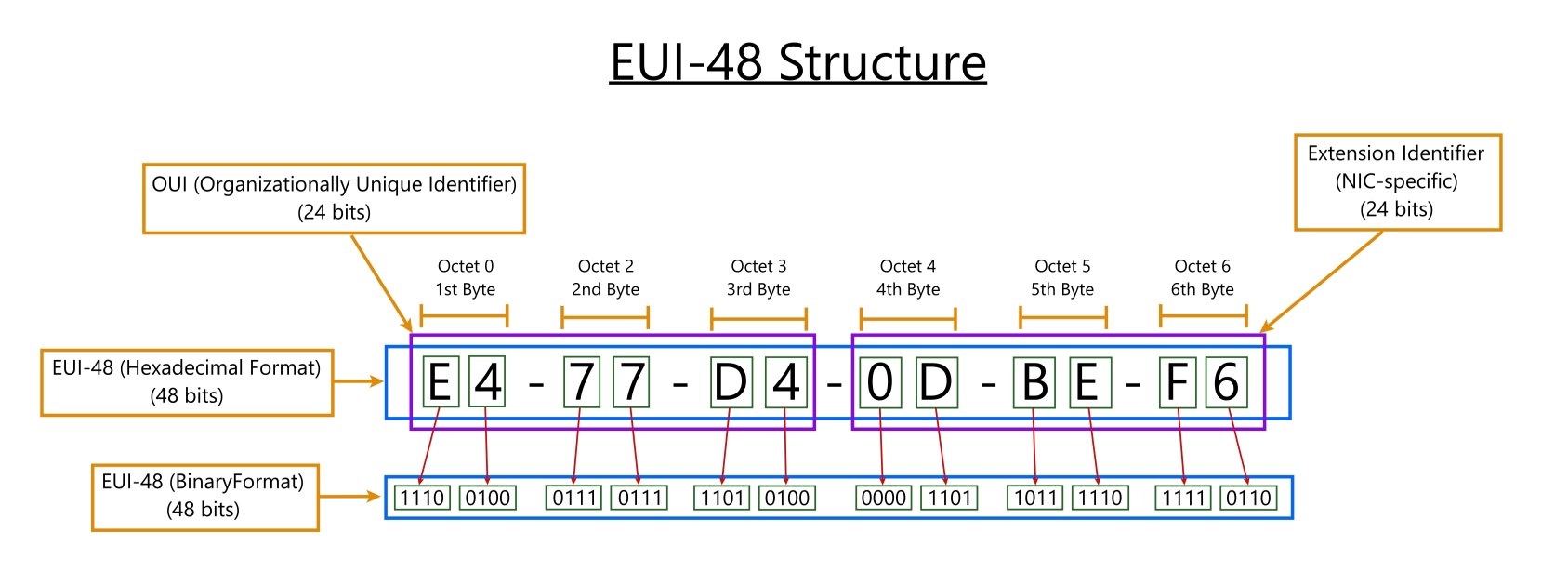
2. Hierarchical Structure: OUI + Extension Identifier
| Part | Size | Octets | Bits | Who Assigns It | Purpose |
|---|---|---|---|---|---|
| OUI (Organizationally Unique Identifier) | 24 bits | 0–2 | 47–24 | IEEE Registration Authority | Identifies the manufacturer / organization |
| Extension Identifier (NIC-specific) | 24 bits | 3–5 | 23–0 | The organization that owns the OUI | Uniquely identifies each individual device / interface |
EUI-48 is built hierarchically to guarantee global uniqueness:
- Organizationally Unique Identifier (OUI): First 24 bits (3 octets).
- Assigned exclusively by the IEEE Registration Authority (RA).
- Identifies the manufacturer, vendor, or organization.
- For MA-L (MAC Address Block Large) assignments — the most common for high-volume production — this is a full 24-bit OUI.
- In practice, this portion allows lookup of the device manufacturer via public registries.
- Extension Identifier (also called NIC-specific or vendor-specific portion): Last 24 bits (3 octets).
- Assigned by the organization that owns the OUI.
- Ensures each individual device or network interface gets a unique value within the manufacturer’s allocation.
- The organization has full control over these bits (subject to IEEE guidelines on uniqueness and proper use).
Example from IEEE official guidelines (Table 6 in the EUI tutorial):
- Base-16 (pure hexadecimal) form: ACDE48234567
- Hex representation (preferred by IEEE): AC-DE-48-23-45-67
Breakdown:
- OUI = AC-DE-48 (assigned to a hypothetical organization).
- Extension Identifier = 23-45-67 (assigned by that organization to a specific interface).
This structure provides 2²⁴ ≈ 16.8 million unique EUI-48 addresses per MA-L OUI assignment.
3. Special Flag Bits in Octet 0 (First Octet)
The two least significant bits (LSBs) of Octet 0 carry critical semantic information used in IEEE 802 networks. These bits are interpreted in the context of the address when used as a MAC address.
| Bit Position (in Octet 0) | Bit Name | Value |
|---|---|---|
| Bit 0 (LSB) | I/G (Individual/Group) or M-bit (Multicast) | 0 = Individual (unicast address — destined for a single interface) 1 = Group (multicast or broadcast address — destined for a group or all interfaces) |
| Bit 1 | U/L (Universal/Local) or X-bit | 0 = Universal (globally unique, administered by IEEE via OUI) 1 = Local (administratively assigned, not globally unique — can be set by software or local admin) |
- Binary view of Octet 0: b7 b6 b5 b4 b3 b2 b1 b0
- b0 = I/G bit
- b1 = U/L bit
- Bits b2–b7 are part of the OUI value (with restrictions in some contexts to avoid conflicting with flag meanings).
Common first-octet examples (hex and binary):
| First Octet (Hex) | Binary (b7..b0) | I/G (b0) | U/L (b1) | Address Type |
|---|---|---|---|---|
| 00 | 00000000 | 0 | 0 | Unicast, Universal (most common “burned-in” factory MAC) |
| 01 | 00000001 | 1 | 0 | Multicast, Universal |
| 02 | 00000010 | 0 | 1 | Unicast, Locally administered |
| 03 | 00000011 | 1 | 1 | Multicast, Locally administered |
| FF | 11111111 | 1 | 1 | Broadcast (all 1s — special case) |
- Universal addresses (U/L = 0) are intended to be globally unique.
- Local addresses (U/L = 1) are useful for virtual machines, software-defined networking, testing, or overriding the burned-in address. They are not guaranteed unique outside the local administrative domain.
- I/G bit controls whether the frame is sent to one specific device (unicast) or multiple devices (multicast). The all-1s address (FF-FF-FF-FF-FF-FF) is the universal broadcast.
Important nuance: When the address is used purely as an EUI-48 identifier (not as a MAC), these bits may still be present but their interpretation depends on the protocol context. IEEE guidelines emphasize that organizations should not arbitrarily set these bits in a way that violates the intended semantics.
4. Representation Formats
EUI-48 can be written in several equivalent ways. IEEE prefers the hyphenated hex form.
| Format | Example | Common Usage |
|---|---|---|
| Hyphenated hex (IEEE preferred) | AC-DE-48-23-45-67 | Documentation, registries, official guidelines |
| Colon-separated | AC:DE:48:23:45:67 | Linux, many OS command outputs (ifconfig, ip addr) |
| No separators (base-16) | ACDE48234567 | Compact storage, some protocols, DNS records |
| Dotted | ACDE.4823.4567 | Some Cisco or older networking tools |
| Bit-reversed / non-canonical | Varies (rare in modern use) | Older token-ring or specific transmission orders |
Transmission order note: In most IEEE 802 networks, octets are transmitted from Octet 0 to Octet 5, and within each octet, bits are sent LSB-first (bit 0 first). This is called canonical format in many tools.
Invalid or reserved values:
- All-zeros (00-00-00-00-00-00) is typically not used as a valid EUI-48.
- All-ones (FF-FF-FF-FF-FF-FF) is reserved as the broadcast address.
5. Relationship to MA-L, MA-M, and MA-S Blocks
While the core 48-bit structure remains the same, the prefix length assigned by IEEE varies:
- MA-L: Full 24-bit OUI + 24-bit extension (true standalone OUI in first three octets).
- MA-M: 28-bit IEEE prefix + 20-bit extension (fourth octet partially fixed).
- MA-S: 36-bit IEEE prefix + 12-bit extension (first four octets largely fixed).
For classic high-volume MA-L assignments, the structure appears as a clean 3-octet OUI + 3-octet extension.
6. Edge Cases, Nuances, and Related Considerations
- Locally Administered Addresses (U/L=1): Useful in virtualization (e.g., VMware, VirtualBox often use 00-05-5D or 08-00-27 ranges) or for privacy/randomization. Modern OSes frequently randomize client MACs to mitigate tracking.
- Multicast Addresses (I/G=1): Used for protocols like IPv4 multicast (01-00-5E-…), IPv6 multicast (33-33-…), Spanning Tree Protocol, etc.
- Mapping to EUI-64 or IPv6: Deprecated direct insertion of FF-FE into EUI-48 for EUI-64 creation due to collision risks with native assignments. In IPv6 SLAAC, the modified EUI-64 process still inserts FF-FE and flips the U/L bit (XOR first octet with 0x02).
- Context-Dependent Identifiers: The same 48 bits can serve as Bluetooth BD_ADDR, Fibre Channel WWNs (with mapping), or other protocol-specific IDs.
- Privacy and Security: Burned-in EUI-48 reveals the manufacturer (via OUI lookup) and can enable tracking. Privacy extensions and MAC randomization are now standard on mobile/client devices.
- Exhaustion and IEEE Recommendations: The 48-bit space is large (~281 trillion addresses), but IEEE strongly encourages EUI-64 for new high-volume or non-Ethernet designs to preserve the 48-bit pool. New EUI-48 usage is ideally limited to legacy compatibility or low-volume needs.
- Structured Local Address Plan (SLAP): Defined in IEEE Std 802c-2017, it further organizes the local (U/L=1) address space into structured blocks for different administrative purposes (e.g., ELI, AAI, SAI).
- Bit Order Variations: Some legacy systems (e.g., Token Ring) used non-canonical (bit-reversed) representation, but modern Ethernet/Wi-Fi use canonical form.
7. Practical Implications
- Network Operation: Enables ARP/Neighbor Discovery, switching, filtering, and QoS at Layer 2.
- Asset Management & Troubleshooting: OUI lookup instantly identifies the vendor (e.g., 00-1A-2B often Apple, 00-07-E9 Intel).
- Development: When burning addresses into hardware or assigning in firmware, respect the I/G and U/L bits and avoid collisions with registered OUIs.
- Future-Proofing: Understand the shift toward 64-bit identifiers and privacy-focused randomization.
In summary, the EUI-48 structure elegantly combines hierarchical assignment (OUI + extension) with semantic flags (I/G and U/L bits) in a compact 48-bit format. This design has powered global networking for decades while providing mechanisms for both universal uniqueness and local flexibility. The official IEEE guidelines (particularly the EUI tutorial PDF) remain the authoritative source, with the example AC-DE-48-23-45-67 illustrating the clean, practical representation.
Special Flag Bits in Octet 0 (First Octet) of EUI-48
Special Flag Bits in Octet 0 (First Octet) of EUI-48 are the two least significant bits (LSBs) of the first byte in the 48-bit EUI-48 structure. These bits provide critical semantic information about how the identifier should be interpreted when used as a MAC address in IEEE 802 networks (Ethernet, Wi-Fi, etc.). They are defined in IEEE standards, including IEEE Std 802-2014 (and amendments like IEEE Std 802c-2017) and the IEEE Registration Authority’s guidelines for EUI, OUI, and CID usage.
These flags enable efficient Layer 2 processing: distinguishing unicast from multicast traffic and universal (globally unique) from local (administratively assigned) addresses. They occupy bits in the most significant octet (Octet 0) of the EUI-48, which is transmitted first on the wire in most IEEE 802 technologies.
Bit Positions and Naming
Within Octet 0 (the first byte, bits 7 to 0, where bit 7 is the MSB and bit 0 is the LSB):
- Bit 0 (LSB): I/G bit (Individual/Group) or M bit (Multicast bit).
- Bit 1: U/L bit (Universal/Local) or X bit.
The remaining bits (2 through 7) form part of the Organizationally Unique Identifier (OUI) value, with the constraint that organizations should generally keep the flag bits consistent with the intended use unless deliberately creating multicast or local addresses.
Binary view of Octet 0:

- I/G (bit 0): Least significant bit.
- U/L (bit 1): Second least significant bit.
IEEE documentation sometimes refers to these as the M bit (for I/G) and X bit (for U/L). In some contexts (e.g., Company ID or CID assignments), additional bits (Y and Z in bits 2 and 3) may be defined under the Structured Local Address Plan (SLAP) from IEEE Std 802c-2017, but the core two flags remain the primary ones for standard EUI-48/MAC usage.
Detailed Meaning of Each Flag
- I/G Bit (Individual/Group or M Bit) — Bit 0
- Value 0: Individual (Unicast) address.
- The address identifies a single specific network interface.
- Frames destined to this address are delivered to one device only.
- This is the default for virtually all “burned-in” factory MAC addresses on network cards, phones, laptops, etc.
- Value 1: Group (Multicast or Broadcast) address.
- The address identifies a group of devices (multicast) or all devices (broadcast).
- Switches and bridges flood or replicate frames to multiple ports based on this.
- Special case: All-ones address (FF-FF-FF-FF-FF-FF) is the universal broadcast (I/G=1).
- Network hardware uses the I/G bit to decide forwarding behavior at Layer 2.
- Multicast addresses (I/G=1) are essential for protocols like IPv4 multicast (often starting with 01-00-5E), IPv6 multicast (often 33-33-…), Spanning Tree Protocol (STP), and many others.
- Manufacturers can create multicast addresses by setting I/G=1 on their assigned OUI (these are not true EUIs for hardware identification but are still derived from the OUI).
- Value 0: Individual (Unicast) address.
- U/L Bit (Universal/Local or X Bit) — Bit 1
- Value 0: Universal (Globally unique / Universally Administered Address — UAA).
- The address is assigned by the manufacturer using an IEEE-registered OUI.
- It is intended to be globally unique worldwide (no two devices should share the same EUI-48 with U/L=0).
- This is the standard for factory-burned MAC addresses on physical hardware.
- Value 1: Local (Administratively assigned / Locally Administered Address — LAA).
- The address is set by software, network administrator, hypervisor, or OS (not by the hardware manufacturer via IEEE).
- It is not guaranteed globally unique — only unique within the local administrative domain (e.g., one network or one virtual environment).
- Common in virtualization (VMware, VirtualBox, Hyper-V often use specific local ranges), MAC address spoofing/randomization, testing, or custom configurations.
- Universal addresses enable reliable global device identification and manufacturer lookup via OUI.
- Local addresses provide flexibility for overriding hardware addresses (e.g., privacy features, conflict resolution, or virtual interfaces).
- Modern operating systems (Windows, macOS, Linux, Android, iOS) frequently use MAC randomization for client devices on Wi-Fi, setting U/L=1 and generating random values to enhance privacy and reduce tracking.
- Value 0: Universal (Globally unique / Universally Administered Address — UAA).
Complete Combinations and Examples
The two bits together yield four primary categories (ignoring higher bits for simplicity):
| First Octet (Hex) | Binary (bits 7..0, simplified last 2 bits) | I/G (bit 0) | U/L (bit 1) | Address Type | Common Examples / Use Cases |
|---|---|---|---|---|---|
| 00 | ……00 | 0 (Individual) | 0 (Universal) | Unicast, Universal (standard burned-in) | Most factory NICs, e.g., 00-1A-2B-… (Apple) |
| 01 | ……01 | 1 (Group) | 0 (Universal) | Multicast, Universal | IPv4 multicast (01-00-5E-…), some protocol groups |
| 02 | ……10 | 0 (Individual) | 1 (Local) | Unicast, Local | Virtual machines, randomized MACs, admin overrides |
| 03 | ……11 | 1 (Group) | 1 (Local) | Multicast, Local | Local multicast groups, custom configurations |
| FF | 11111111 | 1 | 1 | Broadcast (special) | Universal broadcast address |
Realistic full examples:
- Universal unicast (most common): 00-50-56-C0-00-01 (VMware OUI, but if U/L=0 it would be universal; many VMware ranges are local).
- Universal multicast: 01-00-5E-00-00-01 (IPv4 all-hosts multicast).
- Local unicast (randomized): 02-00-00-00-00-01 or a random value with second bit set.
- Broadcast: FF-FF-FF-FF-FF-FF.
Note on OUI constraints: When IEEE assigns an OUI (for MA-L blocks), the U/L and I/G bits in the first octet are typically 0 (resulting in first octet ending in even values like x0, x4, x8, xC in the low nibble). Organizations should not arbitrarily set these bits in a way that violates the meaning unless creating deliberate multicast or local addresses. If they do set them, the hex representation of the first octet changes accordingly (e.g., from 0C to 0D if I/G is set).
Additional Context from IEEE Std 802c-2017 (SLAP)
IEEE Std 802c-2017 introduced the Structured Local Address Plan (SLAP) for better organization of the local address space (U/L=1). It defines additional bits in the first octet for local addresses:
- Bits 0–3 may be interpreted as M (I/G), X (U/L), Y, and Z bits.
- This allows subdividing local space into categories like Extended Local Identifier (ELI), Administratively Assigned Identifier (AAI), etc.
- However, for standard universal EUI-48 (U/L=0), only the core I/G and U/L bits are relevant.
Relationship to IPv6 Modified EUI-64
When deriving a 64-bit IPv6 Interface Identifier (IID) from a 48-bit EUI-48 MAC address (modified EUI-64 process per RFC 4291):
- Insert FF-FE between the OUI and extension.
- Invert (flip) the U/L bit (XOR the first octet with 0x02).
Why the flip?
- In IEEE 802 MAC: U/L=0 means “universal” (globally assigned).
- In IPv6 IID: The “u” bit is defined such that 1 indicates “universal” scope (for consistency with potential future uses).
- Flipping makes derived IIDs from universal MACs have u=1, while making manually configured local IIDs easier (leading zeros often result in local scope).
Example:
- MAC first octet 00 (binary 00000000, U/L=0) → after flip: 02 (binary 00000010, U/L now 1 in IPv6 context).
- Resulting IID starts with 02xx:xxxx:fffe:…
This inversion is a well-known “quirk” but ensures semantic consistency across standards.
Practical Implications, Nuances, and Edge Cases
- Transmission Order: In most Ethernet/Wi-Fi, bits within the octet are transmitted LSB-first (bit 0 first). The flags are still interpreted in the canonical byte value.
- Privacy and Security: Universal addresses (U/L=0) allow manufacturer fingerprinting and long-term tracking. Modern devices mitigate this with randomization (U/L=1 + random bits) or privacy extensions in IPv6.
- Virtualization and Overrides: Hypervisors often force local addresses to avoid conflicts on shared hardware.
- Multicast Management: Switches use I/G=1 to optimize flooding (IGMP/MLD snooping).
- Rare Historical Cases: A very small number of older OUI assignments may have U/L=1; IEEE now avoids this.
- Invalid/Reserved: All-zeros is typically not used as a valid unicast EUI. All-ones is broadcast only.
- Bit-Reversed Representations: Some legacy systems (e.g., older Token Ring) used non-canonical bit order, but modern IEEE 802 uses canonical form.
- OUI Lookup Impact: Tools show the assignee based on the first three octets, but the exact first octet value (affected by flags) must be considered.
These two bits, though small, are foundational to how Ethernet and related networks function efficiently at scale. They balance global uniqueness with operational flexibility while supporting multicast efficiency.
Example 1
- Universally Administered unicast EUI-48 Address: F4-7B-37-EE-34-B8
- The first byte ( in hexadecimal): F4
- The first byte ( in Binary): 11110100
- Least significant bit (LSB) or (M bit): 0 ; It signifies that the MAC address is Individual (Unicast) address.
- Second least significant bit or (X bit): 0 ; It signifies that the MAC address is Globally unique / Universally Administered Address.

Example 2
- Universally Administered multicast EUI-48 Address: 95-0F-46-FE-87-FA
- The first byte ( in hexadecimal): 95
- The first byte ( in Binary): 10010101
- Least significant bit (LSB) or (M bit): 1 ; It signifies that the MAC address is Group (Multicast) address.
- Second least significant bit or (X bit): 0 ; It signifies that the MAC address is Globally unique / Universally Administered Address.

Example 3
- Locally Administered unicast EUI-48 Address: FA-44-AD-FB-F6-F2
- The first byte ( in hexadecimal): FA
- The first byte ( in Binary): 11111010
- Least significant bit (LSB) or (M bit): 0 ; It signifies that the MAC address is Group (Multicast) address.
- Second least significant bit or (X bit): 1 ; It signifies that the MAC address is Globally unique / Universally Administered Address.

Example 4
- Locally Administered unicast EUI-48 Address: DF-03-D2-94-45-60
- The first byte ( in hexadecimal): DF
- The first byte ( in Binary): 11011111
- Least significant bit (LSB) or (M bit): 0 ; It signifies that the MAC address is Group (Multicast) address.
- Second least significant bit or (X bit): 1 ; It signifies that the MAC address is Globally unique / Universally Administered Address.

The Y and Z Bits in the Context of SLAP (Structured Local Address Plan)
The Y and Z bits are the third and fourth least significant bits (bits 2 and 3) of the first octet (Octet 0) in an EUI-48 (or MAC address). They were introduced by IEEE Std 802c-2017 (“IEEE Standard for Local and Metropolitan Area Networks: Overview and Architecture — Amendment 2: Local Medium Access Control (MAC) Address Usage”) as part of the optional Structured Local Address Plan (SLAP).
SLAP provides a standardized way to organize the large pool of locally administered addresses (those with the U/L bit (X bit) = 1). Without SLAP, the entire local address space (half of the 48-bit space, roughly 2⁴⁷ addresses) was unstructured, leading to potential conflicts when multiple independent “administrations” (e.g., different protocols, virtualization hypervisors, IoT self-assignment mechanisms, IEEE 802 standards, or local network administrators) needed to assign addresses on the same local link.
SLAP divides this local space into four disjoint quadrants using the Y and Z bits. This enables coexistence without address collisions, supports automated or semi-automated assignment protocols, and provides dedicated ranges for different types of local identifiers.
Bit Positions in Octet 0 (First Octet)
Recall the full structure of the least significant four bits of Octet 0 (bits 0–3), transmitted LSB-first in most IEEE 802 networks:
- Bit 0 (LSB): M bit (I/G bit) — 0 = Individual/Unicast, 1 = Group/Multicast
- Bit 1: X bit (U/L bit) — 0 = Universal (globally unique via IEEE OUI), 1 = Local (administratively assigned)
- Bit 2: Y bit
- Bit 3: Z bit
Binary layout of the first octet (bits 7 to 0):

- When X = 0 (universal addresses), the Y and Z bits have no special meaning under SLAP. They are simply part of the assigned OUI or extension identifier.
- When X = 1 (local addresses) and SLAP is in effect, Y and Z define the quadrant (also called the “SLAP local identifier type”).
The combination of Y and Z (often referred to as the ZY pair) determines the quadrant. The four bits together (ZYXM) also influence the second hexadecimal digit of the first octet.
The Four SLAP Quadrants Defined by Y and Z Bits
IEEE Std 802c-2017 defines the following quadrants for locally administered addresses (X=1):
| SLAP Quadrant (binary YZ) | Y bit (bit 2) | Z bit (bit 3) | ZYXM binary (example for unicast M=0) | Second Hex Digit (of first octet) | SLAP Local Identifier Type | Abbreviation | Primary Purpose / Usage |
|---|---|---|---|---|---|---|---|
| 01 | 0 | 1 | 1010 (for M=0) | A (or 2 with adjustments) | Extended Local Identifier | ELI | Based on IEEE-assigned Company ID (CID); allows organizations/protocols to create local addresses using a registered 24-bit CID (similar to an OUI but for local use). |
| 11 | 1 | 1 | 1110 | E | Standard Assigned Identifier | SAI | Recommended for IEEE 802 protocols and standards-defined assignments. Provides a large, structured range (~44 bits available for identifiers in some interpretations) for protocol-specific use. |
| 00 | 0 | 0 | 0010 | 2 | Administratively Assigned Identifier | AAI | For local network administrators or manual/centralized assignment (e.g., by a DHCP server, network management system, or hypervisor). Traditional “admin-controlled” local addresses. |
| 10 | 1 | 0 | 0110 | 6 | Reserved | — | Currently reserved; not to be used until future standardization. |
Key observations:
- The most commonly discussed and used quadrants in practice are ELI (YZ=01), SAI (YZ=11), and AAI (YZ=00).
- The second hexadecimal digit of the MAC address (which incorporates bits 0–3) becomes predictable under SLAP:
- AAI → often ends with x2 (unicast) or x3 (multicast).
- ELI → often ends with xA or similar.
- SAI → often ends with xE.
- These patterns make it easy to visually or programmatically identify which quadrant (and thus which assignment authority) a local address belongs to.
Detailed Explanation of Each Quadrant and Identifier Type
- Extended Local Identifier (ELI) — Quadrant 01 (Y=0, Z=1)
- Structure: Local address based on an IEEE Registration Authority (RA)-assigned Company ID (CID).
- The IEEE RA assigns 24-bit CIDs specifically for this purpose (distinct from OUIs, though similar in size).
- An ELI consists of the CID + additional organization-assigned bits, but marked as local (X=1) and in the ELI quadrant.
- Use cases: Organizations or protocols that need a “semi-global” local identifier without consuming a full universal OUI. Useful for entities that already have CIDs or want structured local addressing tied to their identity.
- The IEEE RA assigns CIDs with the specific Y/Z pattern required for ELI.
- This quadrant helps avoid collisions with pure admin-assigned addresses.
- Standard Assigned Identifier (SAI) — Quadrant 11 (Y=1, Z=1)
- Recommended range for IEEE 802 standards and protocols.
- Provides a large, dedicated portion of the local address space (~44 bits of identifier space in the full 48-bit context after fixing the quadrant bits).
- Use cases: Self-assignment by IEEE 802 protocols, bridging standards, or other standardized mechanisms that need predictable local addresses without centralized administration.
- IEEE 802c explicitly recommends this quadrant for IEEE 802 protocol use to standardize behavior across implementations.
- Supports future protocol extensions without conflicting with admin or ELI ranges.
- Administratively Assigned Identifier (AAI) — Quadrant 00 (Y=0, Z=0)
- The “classic” local address space that existed before SLAP.
- Assigned by a local administrator, network management system, DHCP server, hypervisor, or OS configuration.
- Use cases: Traditional virtualization (VMs often use ranges like 02-xx-xx… or similar in this quadrant), manual MAC overrides, testing environments, or centralized local MAC pools.
- This is the most familiar quadrant for network administrators today.
- Reserved Quadrant — 10 (Y=1, Z=0)
- Explicitly reserved by the standard.
- Not to be used for any assignments until a future amendment defines its purpose.
- Prevents premature adoption that could cause future incompatibility.
Practical Implications and Nuances
- Optional Nature of SLAP: SLAP is optional. Devices and networks are not required to follow it. However, when multiple independent address assignment mechanisms coexist on the same Layer 2 segment (common in modern environments with containers, VMs, IoT self-configuration, and protocol-specific mappings), adhering to SLAP greatly reduces collision risk.
- Coexistence of Multiple Administrations: The core goal of IEEE 802c-2017 is to allow:
- IEEE 802 protocols (via SAI)
- Organizations using CIDs (via ELI)
- Local admins (via AAI) to assign addresses independently without overlap.
- DHCPv6 Integration (RFC 8948): The IETF defined extensions to DHCPv6 so clients or relays can request a preferred SLAP quadrant. This enables automated assignment while respecting the structure (e.g., a VM requesting an AAI address).
- Address Space Impact:
- Each quadrant reserves a significant portion of the local 2⁴⁷ space.
- After fixing M, X, Y, Z (4 bits), each quadrant still leaves ~44 bits for the actual identifier in the remaining 44 bits of the 48-bit address.
- Bit Transmission and Representation:
- Bits are transmitted LSB-first in Ethernet/Wi-Fi.
- In hex representation, the effects appear in the second hex digit of the first octet (e.g., addresses starting with x2, xA, xE in the appropriate positions).
- Edge Cases:
- Multicast in SLAP: The M bit (I/G) can still be 1 independently, creating multicast variants in each quadrant (e.g., ending in x3, xB, xF).
- Legacy Devices: Older equipment or software that ignores SLAP may still generate addresses in the AAI quadrant, potentially conflicting if not managed.
- Virtualization and Containers: Hypervisors and container runtimes are increasingly encouraged to respect SLAP for better interoperability.
- Privacy/Randomization: Modern OS MAC randomization typically uses the AAI quadrant (or similar local patterns) with random values.
- Future-Proofing and IEEE Recommendations: IEEE encourages the use of SLAP (especially SAI for standards and ELI for CID-based needs) to make local addressing more predictable and scalable, particularly in dense environments like data centers, IoT networks, or large virtualized infrastructures.
Example Addresses (Unicast, X=1)
- AAI (YZ=00, M=0): First octet binary ending 0010 → often x2 (e.g., 02-00-00-00-00-01).
- ELI (YZ=01, M=0): Ending 1010 → often xA (e.g., 0A-xx-xx… with CID incorporated).
- SAI (YZ=11, M=0): Ending 1110 → often xE (e.g., 0E-xx-xx…).
In summary, the Y and Z bits transform the previously flat local address space into a structured, quadrant-based system. This elegant addition in IEEE Std 802c-2017 addresses real-world collision risks in complex modern networks while preserving backward compatibility. It reflects IEEE’s ongoing effort to make Layer 2 addressing more robust as the number of connected devices and autonomous assignment mechanisms grows.
Examples of EUI-48 Structure with Focus on Octet 0 Flags and SLAP
Below are comprehensive, bit-by-bit examples of EUI-48 addresses. Each example shows:
- Full 48-bit EUI-48 (in hex and binary)
- Detailed breakdown of Octet 0 (first byte) with all 8 bits labeled
- Interpretation of the four key bits (M, X, Y, Z)
- The resulting SLAP quadrant (when applicable)
- Meaning and typical real-world usage
1. Classic Universal Unicast Address (Most Common Case)
Example MAC: 00-1A-2B-3C-4D-5E (Apple OUI)
Full Hex: 00-1A-2B-3C-4D-5E
Octet 0 = 00
Bit-by-bit breakdown of Octet 0:
| Bit Position | Bit Value | Name | Meaning |
|---|---|---|---|
| 7 (MSB) | 0 | OUI bit 7 | Part of Apple OUI |
| 6 | 0 | OUI bit 6 | — |
| 5 | 0 | OUI bit 5 | — |
| 4 | 0 | OUI bit 4 | — |
| 3 | 0 | Z | — (ignored for universal) |
| 2 | 0 | Y | — (ignored for universal) |
| 1 | 0 | X (U/L) | 0 = Universal (IEEE-assigned) |
| 0 (LSB) | 0 | M (I/G) | 0 = Individual (Unicast) |
Binary of Octet 0: 0000 0000
Interpretation:
- Universal unicast burned-in MAC address.
- Globally unique via IEEE MA-L OUI (00-1A-2B).
- SLAP quadrant: Not applicable (X=0).
Common use: Factory-default MAC on physical hardware (laptops, phones, NICs).
2. Universal Multicast Address
Example: 01-00-5E-00-00-01 (IPv4 All-Hosts Multicast)
Octet 0 = 01
Bit-by-bit:
| Bit | Value | Name | Meaning |
|---|---|---|---|
| 7 | 0 | OUI | — |
| 6 | 0 | OUI | — |
| 5 | 0 | OUI | — |
| 4 | 0 | OUI | — |
| 3 | 0 | Z | — |
| 2 | 0 | Y | — |
| 1 | 0 | X | 0 = Universal |
| 0 | 1 | M | 1 = Group (Multicast) |
Binary: 0000 0001
Interpretation: IEEE-assigned multicast range for IPv4. Frames are delivered to multiple devices.
3. Local Unicast — AAI Quadrant (Administratively Assigned)
Example: 02-00-00-00-00-01 (common in virtualization)
Octet 0 = 02
Bit-by-bit:
| Bit | Value | Name | Meaning |
|---|---|---|---|
| 7 | 0 | — | — |
| 6 | 0 | — | — |
| 5 | 0 | — | — |
| 4 | 0 | — | — |
| 3 | 0 | Z | 0 |
| 2 | 0 | Y | 0 |
| 1 | 1 | X | 1 = Local |
| 0 | 0 | M | 0 = Unicast |
Binary: 0000 0010 YZ = 00 → AAI Quadrant
Interpretation:
- Locally administered by admin, hypervisor, or OS.
- Traditional local address space.
- Typical use: Virtual machines (VMware, VirtualBox, KVM), manual overrides, testing.
4. Local Unicast — ELI Quadrant (Extended Local Identifier)
Example: 0A-12-34-56-78-9A (using a hypothetical CID)
Octet 0 = 0A
Bit-by-bit:
| Bit | Value | Name | Meaning |
|---|---|---|---|
| 7 | 0 | — | — |
| 6 | 0 | — | — |
| 5 | 0 | — | — |
| 4 | 0 | — | — |
| 3 | 1 | Z | 1 |
| 2 | 0 | Y | 0 |
| 1 | 1 | X | 1 = Local |
| 0 | 0 | M | 0 = Unicast |
Binary: 0000 1010 YZ = 01 → ELI Quadrant
Interpretation:
- Based on an IEEE-assigned Company ID (CID).
- Allows organizations to create structured local addresses tied to their registered identity.
- Use cases: Protocols or vendors needing semi-permanent local IDs without consuming a full universal OUI.
5. Local Unicast — SAI Quadrant (Standard Assigned Identifier)
Example: 0E-AB-CD-EF-01-23
Octet 0 = 0E
Bit-by-bit:
| Bit | Value | Name | Meaning |
|---|---|---|---|
| 7 | 0 | — | — |
| 6 | 0 | — | — |
| 5 | 0 | — | — |
| 4 | 0 | — | — |
| 3 | 1 | Z | 1 |
| 2 | 1 | Y | 1 |
| 1 | 1 | X | 1 = Local |
| 0 | 0 | M | 0 = Unicast |
Binary: 0000 1110 YZ = 11 → SAI Quadrant
Interpretation:
- Recommended for IEEE 802 protocols and standardized self-assignment.
- Provides a clean, dedicated range for protocol use.
- Use cases: Future IEEE standards, bridging protocols, or automated Layer 2 assignment mechanisms.
6. Local Multicast — AAI Quadrant
Example: 03-00-00-00-00-01
Octet 0 = 03
Bit-by-bit:
| Bit | Value | Name | Meaning |
|---|---|---|---|
| 7–4 | 0 | — | — |
| 3 | 0 | Z | 0 |
| 2 | 0 | Y | 0 |
| 1 | 1 | X | 1 = Local |
| 0 | 1 | M | 1 = Multicast |
Binary: 0000 0011 YZ = 00 → AAI multicast variant.
Use: Locally defined multicast groups within an administrative domain.
7. Reserved Quadrant (Do Not Use)
Example pattern: First octet ending with binary 0110 (hex 06 for unicast)
YZ = 10 → Reserved by IEEE Std 802c-2017.
Binary example: 0000 0110
Interpretation: Explicitly reserved for future standardization. Networks should ignore or reject addresses in this quadrant.
Summary Table of All Quadrants (Unicast, X=1)
| Quadrant | YZ | Binary (last 4 bits, M=0) | First Octet Hex (typical) | Purpose |
|---|---|---|---|---|
| AAI | 00 | 0010 | 02, 12, 22… | Admin / hypervisor / manual |
| ELI | 01 | 1010 | 0A, 1A, 2A… | CID-based local identifiers |
| SAI | 11 | 1110 | 0E, 1E, 2E… | IEEE 802 protocol use |
| Reserved | 10 | 0110 | 06, 16, 26… | Future use only |
Practical Notes
- Hex pattern rule: The second hexadecimal digit of the first octet is largely determined by the four bits M X Y Z (with the high nibble free).
- Transmission: In Ethernet/Wi-Fi, bits are sent LSB-first (bit 0 first), but we interpret them in normal byte order.
- Coexistence: A network can safely have AAI (VMs), ELI (vendor local IDs), and SAI (protocol) addresses simultaneously without collision if SLAP is followed.
- Modern OS behavior: macOS, Windows, Android, and iOS randomization usually lands in the AAI quadrant (x2 style).
These examples illustrate how just four bits in the first octet create powerful semantic distinctions while maintaining full backward compatibility with the classic EUI-48 model.