The 64-bit Extended Unique Identifier (EUI-64) is a standardized identifier defined by the IEEE (Institute of Electrical and Electronics Engineers) to provide a globally unique or locally administered 64-bit (8-byte) value for devices, interfaces, or other entities. It extends the more common 48-bit EUI-48 (often called a MAC address) to support larger address spaces, particularly in scenarios requiring more unique identifiers, such as emerging technologies, IoT devices, or protocols needing 64-bit addressing.
EUI-64 serves purposes beyond simple hardware addressing. It appears in IPv6 as the basis for the 64-bit interface identifier (IID) in Stateless Address Autoconfiguration (SLAAC), in IEEE 1394 (FireWire), Zigbee, IEEE 1588 precision time protocol (as clock identifiers), and other IEEE 802-related standards.
Structure of EUI-64
An EUI-64 consists of:
- 24-bit Company ID (also called Organizationally Unique Identifier or OUI): Assigned by the IEEE Registration Authority to a manufacturer or organization. This occupies the most significant 24 bits (first 3 bytes).
- 40-bit Extension Identifier: Assigned by the organization holding the Company ID. This provides the remaining 40 bits (last 5 bytes) for device-specific uniqueness within the manufacturer’s range.
The full identifier is typically represented as 8 octets in hexadecimal, often with colons or hyphens for readability (e.g., AC-DE-48-23-45-67-01-9F).
The first octet (byte 0) includes two special bits (counting from the least significant bit, LSB):
- Bit 0 (I/G bit — Individual/Group): 0 for individual (unicast) addresses; 1 for group (multicast) addresses.
- Bit 1 (U/L bit — Universal/Local): 0 for universally administered (globally unique, IEEE-assigned OUI); 1 for locally administered (assigned by a local administrator, unique only within a local scope).
This structure yields a theoretical 2^64 unique values, vastly expanding beyond the 2^48 space of EUI-48. For new designs, IEEE recommends preferring EUI-64 over EUI-48 to conserve OUI allocations, especially in high-volume or non-Ethernet applications.
Derivation from 48-bit MAC Address (Modified EUI-64)
Most devices still use 48-bit EUI-48/MAC addresses (24-bit OUI + 24-bit extension). In IPv6 SLAAC and similar contexts, a modified EUI-64 process derives a 64-bit interface identifier from this 48-bit address. This is the most common real-world encounter with EUI-64.
The step-by-step process is as follows:
- Split the 48-bit MAC address into two 24-bit halves:
- Left: Organizationally Unique Identifier (OUI, first 3 bytes).
- Right: Device-specific portion (NIC-specific, last 3 bytes).
- Insert the 16-bit value FFFE (hex) between the two halves. This pads the address to 64 bits while marking it as derived from a 48-bit source (IEEE reserves FFFE for this purpose).
- Invert the Universal/Local (U/L) bit in the first octet (the 7th bit from the left, or bit 1 from the LSB in the first byte).
- For universally administered MAC addresses (U/L = 0), this flips it to 1.
- This “modification” signals that the resulting identifier is treated as locally significant in the IPv6 context, even though it derives from a global MAC. It avoids potential conflicts and aligns with IPv6 semantics for interface identifiers.
Example:
- Original MAC address: 00:1A:2B:3C:4D:5E (hex).
- Step 1: Split → OUI 00:1A:2B | NIC 3C:4D:5E.
- Step 2: Insert FF:FE → 00:1A:2B:FF:FE:3C:4D:5E.
- Step 3: First octet 00 in binary is 00000000. The U/L bit (second from LSB, or 7th from MSB) is 0; invert it → 00000010 (hex 02).
- Resulting modified EUI-64: 02:1A:2B:FF:FE:3C:4D:5E.
In IPv6 colon-hex notation for the interface ID: 021A:2BFF:FE3C:4D5E.
Another common example:
- MAC: 00:15:2B:E4:9B:60.
- After split/insert: 00:15:2B:FF:FE:E4:9B:60.
- Flip U/L bit in first octet (00 → 02).
- Result: 02:15:2B:FF:FE:E4:9B:60 (or 0215:2BFF:FEE4:9B60 as IPv6 IID).
This process is deterministic and reversible in many cases, allowing mapping back to the original MAC (though the bit flip must be accounted for).
Usage in IPv6
In IPv6, a 128-bit address splits into a 64-bit network prefix (from router advertisements) + 64-bit interface identifier. EUI-64 (modified) enables automatic generation of the IID without manual configuration or DHCPv6 in SLAAC:
- The resulting IID is appended to the prefix (e.g., a link-local FE80::/10 or global unicast prefix).
- Example full IPv6 address using the above: If prefix is 2001:db8::/64, the address becomes 2001:db8::021A:2BFF:FE3C:4D5E.
Advantages:
- Leverages existing hardware uniqueness (MAC addresses).
- Enables plug-and-play autoconfiguration.
- No central server needed for address assignment on the link.
Disadvantages and Privacy Concerns:
- The IID embeds the MAC address (with minor modification), making devices trackable across networks. This raises privacy issues, as the OUI reveals the manufacturer and the extension may correlate with specific hardware.
- Modern operating systems often prefer privacy extensions (RFC 4941), generating random or temporary IIDs instead of EUI-64 to mitigate tracking.
- Some security analyses recommend disabling EUI-64 in favor of random IIDs or DHCPv6 for better obfuscation.
Edge cases in IPv6:
- Interfaces without a MAC (e.g., serial, tunnels) may use other methods or set the U/L bit to indicate local scope.
- The I/G bit in the IID is usually 0 for unicast.
Other Applications and Contexts
- Direct EUI-64 assignment: Manufacturers can register a 24-bit Company ID and assign 40-bit extensions directly, without deriving from 48-bit addresses. This is preferred for new non-Ethernet technologies.
- FireWire (IEEE 1394): Uses 64-bit EUI-64 as node identifiers.
- Time synchronization: IEEE 1588 uses EUI-64 for clockIdentity.
- Bridging/mixed environments: Care is needed when bridging 48-bit and 64-bit networks to avoid address collisions.
Nuances and Considerations
- “Modified” vs. Pure EUI-64: The IPv6 version is technically “modified EUI-64” due to the U/L bit inversion and FFFE insertion. Pure IEEE EUI-64 (for direct assignment) may insert FFFF in some legacy mappings, but FFFE is standard for MAC-derived cases.
- Backward compatibility: EUI-48 remains dominant in Ethernet, but IEEE encourages migration to EUI-64 for longevity.
- Locally administered addresses: Setting U/L=1 allows custom identifiers (e.g., for virtualization or testing), but they lose global uniqueness guarantees.
- Security and spoofing: Like MAC addresses, EUI-64 can be spoofed; higher-layer protocols should not rely solely on it for authentication.
- Calculation tools: Many network simulators, OS commands (e.g., ip addr on Linux showing IPv6 with EUI-64), and online calculators demonstrate the conversion.
Related Concepts and Edge Cases
- EUI-48 vs. EUI-64: EUI-48 uses 24-bit OUI + 24-bit extension; EUI-64 expands the extension to 40 bits. Conversion is not always lossless in mixed environments.
- Random vs. EUI-based IIDs: Privacy extensions generate pseudorandom 64-bit IIDs that change periodically.
- Anycast addresses: IPv6 anycast may use similar structures but with specific prefix rules.
- Implementation variations: Some older documentation or non-IEEE contexts might differ slightly in bit-flip interpretation, but the process above follows current IEEE and IETF standards (e.g., RFC 4291, IEEE guidelines).
1) IEEE Registration Authority (RA) blocks of EUI-64 identifiers
The IEEE Registration Authority (RA) is the official body responsible for assigning globally unique blocks of identifiers used in networking hardware and protocols, including EUI-48 (commonly known as MAC addresses) and EUI-64 (64-bit Extended Unique Identifiers). These assignments ensure worldwide uniqueness for devices, interfaces, and other entities across technologies such as Ethernet (IEEE 802.3), Wi-Fi (IEEE 802.11), Bluetooth, IEEE 1394 (FireWire), IEEE 1588 (Precision Time Protocol), and IPv6 interface identifiers.
To address growing demand, address space conservation, and varying organizational needs (from massive manufacturers to small/IoT developers), the IEEE RA introduced a tiered system of MAC Address Blocks in the mid-2010s (formalized around 2014, with ongoing refinements). These blocks—MA-L, MA-M, and MA-S—provide different prefix lengths assigned by the IEEE, with the remaining bits (extension identifier) managed by the assignee. All three block types support both EUI-48 and EUI-64 generation, though the IEEE strongly encourages direct (unmodified) EUI-64 for new designs to conserve space and avoid legacy issues.
Structure and Address Space of IEEE RA Blocks for EUI-64
Each block defines a fixed prefix length controlled by the IEEE RA. The organization then assigns the extension bits to create unique identifiers. The first octet of any resulting identifier retains the standard IEEE flags:
- Bit 0 (I/G): 0 for individual/unicast, 1 for group/multicast.
- Bit 1 (U/L): 0 for universal (IEEE-assigned), 1 for locally administered.
Here is the precise breakdown for EUI-64 (8 octets / 64 bits total):
| Block Type | Full Name | IEEE-Assigned Prefix Length | Organization Extension Bits (for EUI-64) | Number of EUI-64 Identifiers Available | Equivalent Legacy Term | Notes on Structure |
|---|---|---|---|---|---|---|
| MA-L | MAC Address Block Large | 24 bits | 40 bits | 2⁴⁰ ≈ 1.099 trillion | Classic OUI (pre-2014) | Includes a full 24-bit OUI. Most common for high-volume production. Direct EUI-64: 24-bit prefix + 40-bit extension. |
| MA-M | MAC Address Block Medium | 28 bits | 36 bits | 2³⁶ ≈ 68.72 billion | None (newer tier) | 28-bit prefix (no standalone OUI). Suitable for medium-scale needs. |
| MA-S | MAC Address Block Small | 36 bits (OUI-36) | 28 bits | 2²⁸ ≈ 268.44 million | OUI-36 (encompasses old IAB) | Smaller, cost-effective block. Often used for low-volume or specialized devices. |
Key observations:
- The total remains exactly 64 bits in all cases; only the split between IEEE-controlled prefix and organization-controlled extension changes.
- For comparison, EUI-48 (6 octets) within the same blocks uses fewer extension bits: 24 bits (MA-L), 20 bits (MA-M), and 12 bits (MA-S).
- Restrictions on direct EUI-64 assignments: To avoid ambiguity with legacy mappings, organizations should not use patterns where bytes 3–4 are FFFE or FFFF in direct assignments. This preserves distinguishability (though general mapping of EUI-48 into EUI-64 is now deprecated by IEEE to prevent potential collisions in mixed MA-L/MA-M/MA-S environments).

The IEEE offers three block sizes for organizations to acquire EUI-64 addresses, each suited to different needs based on the number of devices they produce:
- MA-L (MAC Address Block Large)
- 24-bit MA-L prefix: Previously called an OUI (Organizationally Unique Identifier) block. MA-L provides a 24-bit identifier. The IEEE assigns a unique 24-bit (3-byte) prefix to an organization.
- 40-bit Extension identifier: The organization holding the MA-L can assign the remaining 40 bits of the 64-bit EUI-64 address. Features a 40-bit Extension identifier, allowing up to approximately 1.099 trillion MAC addresses(2^40) for each MA-L prefix.
- Ideal for large manufacturers or companies producing a high volume of devices, like major tech firms.
- Comes with a full OUI, giving the organization complete control over the first 24 bits of the MAC address, ensuring maximum flexibility and uniqueness.
- Example: If an organization assigned 00-1A-2B, they control 00-1A-2B-xx-xx-xx-xx-xx (where x is hex).
- MA-M (MAC Address Block Medium)
- 28-bit MA-M prefix: The IEEE assigns a unique 28-bit prefix to an organization. MA-M provides a 28-bit identifier.
- 36-bit Extension identifier: The organization holding the MA-M can assign the remaining 36 bits of the EUI-64 address. This gives the organization 2^36 (approximately 68.7 billion) unique EUI-64 addresses.
- Suited for medium-sized organizations needing a significant but not massive number of addresses.
- The first 24 bits still correspond to an MA-L/OUI registry block, but the assignment is more specific. Does not include a full OUI; instead, the first 24 bits are shared with other organizations, but the additional 4 bits (28-bit total) ensure unique addresses within the block.
- Example: If an organization is assigned 00-1A-2B-Cxxx, they control 00-1A-2B-Cx-xx-xx-xx-xx (where x is hex).
- MA-S (MAC Address Block Small)
- 36-bit MA-S prefix: The IEEE assigns a unique 36-bit prefix to an organization. MA-S provides a 36-bit identifier.
- 28-bit Extension identifier: The organization holding the MA-S can assign the remaining 28 bits of the EUI-64 address. This gives the organization 2^28 (approximately 268.4 million) unique EUI-64 addresses.
- Perfect for small organizations, startups, or niche manufacturers with limited device production.
- Again, the first 24 bits correspond to an MA-L/OUI registry block. Does not include a full OUI; instead, the first 24 bits are shared with other organizations, but the additional 12 bits (36-bit total) ensure unique addresses within the block.
- Example: If an organization is assigned 00-1A-2B-CDE-xxx, they control 00-1A-2B-CD-Ex-xx-xx-xx (where x is hex).
Example (conceptual, not real assignment):
- MA-L: IEEE prefix AC-DE-48 (24 bits) + organization extension 23-45-67-89-AB-CD (40 bits) → full EUI-64: AC-DE-48-23-45-67-89-AB-CD.
- MA-M: 28-bit prefix (e.g., spanning parts of what looks like an OUI plus extra bits) + 36-bit extension.
- MA-S: 36-bit OUI-36 prefix + 28-bit extension.
In practice, the resulting EUI-64 is represented in colon- or hyphen-separated hex (e.g., AC-DE-48-23-45-67-89-AB-CD).
Relationship to EUI-64:
The relationship primarily hinges on the 24-bit OUI (the MA-L block definition) and the common method of deriving EUI-64 from EUI-48.
- Foundation is the 24-bit OUI (MA-L):
- The fundamental structure of an EUI-64 identifier uses the first 24 bits as the OUI, identifying the manufacturer or organization. This OUI is identical to an MA-L assignment.
- An organization holding an MA-L (OUI) is implicitly capable of creating EUI-64 identifiers under that OUI. They manage the 40-bit extension identifier space (xx-xx-xx-xx-xx) associated with their 24-bit OUI (OO-OO-OO) to create unique EUI-64s like OO-OO-OO-xx-xx-xx-xx-xx.
- Derivation from EUI-48 (MA-L, MA-M, MA-S):
- The most common way EUI-64 identifiers are encountered in practice (especially for IPv6 Interface IDs) is through derivation from an existing EUI-48 MAC address.
- Crucially, this derivation process works identically regardless of whether the EUI-48 address was created under an MA-L, MA-M, or MA-S block.
- When you convert any valid EUI-48 address to an EUI-64 by inserting
FFFEin the middle:- EUI-48 = (OUI Part – 24 bits) + (Device ID Part – 24 bits)
- Derived EUI-64 = (OUI Part – 24 bits) + FF:FE + (Device ID Part – 24 bits)
- The resulting EUI-64 will always contain the original 24-bit OUI in its first 3 bytes. The specific block size (MA-L, MA-M, MA-S) under which the original EUI-48 was assigned doesn’t change this EUI-64 structure or the derivation method.
Example:
- Organization A holds MA-L 00-1A-2B. They create EUI-48 00-1A-2B-11-22-33.
- Derived EUI-64: 00-1A-2B-FF-FE-11-22-33.
- Organization B holds MA-S 00-1A-2B-CDE-xxx. They create EUI-48 00-1A-2B-CDE-F01.
- Derived EUI-64: 00-1A-2B-FF-FE-DE-F01. (Notice the split happens within the MA-S assigned portion when forming the EUI-64, but the OUI
00-1A-2Bremains at the start).
- Derived EUI-64: 00-1A-2B-FF-FE-DE-F01. (Notice the split happens within the MA-S assigned portion when forming the EUI-64, but the OUI
Application Process and Policies
The IEEE RA manages assignments through its public portal. Organizations must:
- Search the public listings first (to check for existing assignments within the company or subsidiaries).
- Apply via the IEEE RA website (requires account creation).
- Provide justification of need and usage plans.
Fees (one-time, approximate/publicly listed values; subject to change):
- MA-L: ~US $3,585 (public registration).
- MA-M: ~US $2,155.
- MA-S: Lower (often the entry point for first-time or small applicants).
Conservation policies:
- First-time applicants typically start with MA-M or MA-S (MA-L may not be available initially).
- Additional MA-L or MA-M blocks require proof of ≥95% utilization of existing assignments.
- Assignments are not per-product or per-location; parent/subsidiary companies are encouraged to share blocks.
- Public vs. private registration: Public lists the company name/address; private shows “PRIVATE” (extra annual fee possible for confidentiality).
Public registries are downloadable as CSV or text files:
- MA-L: standards-oui.ieee.org/oui/
- MA-M: standards-oui.ieee.org/oui28/
- MA-S: standards-oui.ieee.org/oui36/
A web search interface allows querying all MAC blocks together.
Relation to Direct vs. Modified EUI-64 and IPv6
The IEEE Registration Authority (RA) blocks—MA-L, MA-M, and MA-S—directly influence how EUI-64 identifiers are assigned and structured, with important distinctions between direct (unmodified) EUI-64 and modified EUI-64 in the context of IPv6. These blocks provide varying prefix lengths assigned by the IEEE, while the organization controls the extension bits. This tiered system supports both EUI-48 (MAC addresses) and EUI-64 within the same assignment, but it introduces nuances for uniqueness, collision risks, and IPv6 usage.
Direct (Unmodified) EUI-64 and IEEE RA Blocks
Direct EUI-64 is the native IEEE-defined format for 64-bit identifiers, consisting of the IEEE-assigned prefix concatenated with the organization’s extension identifier. No forced middle values (such as FFFE) are inserted, and the structure follows the block’s prefix length exactly.
- MA-L (24-bit prefix): Provides the classic full OUI (24 bits) + 40-bit extension. This is the largest block and equivalent to pre-2014 OUI assignments. It offers the most extension space (2⁴⁰ ≈ 1.1 trillion EUI-64 identifiers) and is ideal for high-volume manufacturers.
- MA-M (28-bit prefix): 28-bit IEEE prefix + 36-bit extension (2³⁶ ≈ 68.7 billion identifiers). No standalone 24-bit OUI is granted.
- MA-S (36-bit prefix, OUI-36): 36-bit IEEE prefix + 28-bit extension (2²⁸ ≈ 268 million identifiers). This is the smallest, most economical block and subsumes the deprecated Individual Address Block (IAB).
In all cases:
- The first octet retains the I/G (Individual/Group, bit 0) and U/L (Universal/Local, bit 1) flags per IEEE 802 rules.
- Organizations must avoid placing FFFE or FFFF in bytes 3–4 of direct EUI-64 assignments. This reservation historically supported legacy encapsulation but now helps maintain distinguishability.
- The IEEE strongly encourages direct EUI-64 for new designs, especially non-Ethernet or high-volume applications (e.g., IEEE 1394 node IDs, IEEE 1588 clockIdentity, industrial/IoT protocols). This conserves the global pool and avoids reliance on 48-bit space. Guidelines state that new applications with significant volume expectations should use EUI-64 rather than EUI-48.
Direct EUI-64 from any MA block provides clean, globally unique 64-bit values without derivation artifacts. In IPv6, if a link layer natively supplies a direct EUI-64 (from any block size), RFC 4291 requires inverting the U/L bit when forming the 64-bit interface identifier (IID), similar to the modified process.
Modified EUI-64 and Its Relation to IEEE RA Blocks
Modified EUI-64 is an IETF-specific transformation (defined in RFC 4291, Appendix A) used primarily to generate 64-bit IPv6 IIDs from a 48-bit EUI-48/MAC address. It is not the native IEEE EUI-64 format.
The process (identical regardless of the underlying MA block):
- Split the 48-bit MAC (from MA-L, MA-M, or MA-S) into two 24-bit halves.
- Insert the fixed 16-bit value FF:FE in the middle.
- Invert the U/L bit (bit 1, or 7th bit from the left) in the first octet (equivalent to XOR with 0x02).
Example (MAC from any block): 00:1A:2B:3C:4D:5E → 02:1A:2B:FF:FE:3C:4D:5E (as IPv6 IID: 021A:2BFF:FE3C:4D5E).
Key point: The derivation algorithm treats the source MAC the same way whether it comes from an MA-L (full OUI), MA-M, or MA-S block. However, the visible prefix bits in the resulting IID will reflect the underlying block’s longer prefix in MA-M/MA-S cases.
This mapping is deprecated by the IEEE for general use. The reason: Mapping an EUI-48 assigned under an MA-M or MA-S block to an EUI-64 can potentially collide with a directly assigned EUI-64 under a different MA-M or MA-S block (due to overlapping prefix structures). The IEEE RA has implemented mitigations to reduce duplicates, but the mapping remains deprecated to protect the long-term integrity of the EUI-64 namespace. The deprecation is documented in IEEE guidelines for historical reasons only.
Despite this, the specific modified EUI-64 algorithm remains codified in IPv6 standards (RFC 4291 and updates like RFC 9542) for backward compatibility. It continues to be used in SLAAC for generating IIDs from existing 48-bit hardware addresses.
Nuances, Edge Cases, and Implications
- Vendor identification: Lookup tools must query all three registries (MA-L, MA-M, MA-S) for complete results. Older tools may miss MA-M/MA-S entries.
- Collision risks: Deprecated EUI-48-to-EUI-64 mapping can theoretically collide across different block types. IEEE has mitigations, but avoidance is recommended.
- Locally administered addresses: Any organization (or individual) can set U/L=1 and assign custom identifiers without IEEE involvement; these are not globally unique.
- Multicast/group use: All blocks support I/G=1, but specific multicast OUIs have dedicated rules.
- CID (Company ID): A separate 24-bit assignment (no EUI-48/EUI-64 space) used for other purposes (e.g., object identifiers). Not interchangeable with MA blocks.
- Historical context: Pre-2014, only full OUIs (now MA-L) and Individual Address Blocks (IAB, now subsumed in MA-S) existed. The tiered system was introduced to prevent exhaustion while supporting diverse scales (IoT, embedded, high-volume hardware).
- Privacy and security: Hardware-derived EUI-64 (especially from MA blocks) can leak manufacturer information. Combine with IPv6 privacy mechanisms in network deployments.
- New designs: IEEE guidelines emphasize native EUI-64 (direct from any MA block) over EUI-48 derivation for future-proofing and conservation.
- Verification and troubleshooting: Use Wireshark, ip addr (Linux), or official IEEE search tools. Absence of FF:FE in the middle bytes indicates direct (not modified) EUI-64.
Practical Recommendations
- Large manufacturers (e.g., network equipment, consumer electronics): Pursue MA-L for maximum capacity.
- Medium or growing companies: Start with MA-M.
- Small/IoT/specialized developers: Use MA-S for affordability and sufficiency.
- Network operators and IPv6 deployers: Recognize variable prefixes in address analysis; prefer RFC 7217/RFC 8981 over legacy modified EUI-64 for privacy.
- For applications: Always check the latest IEEE RA guidelines and public listings before assuming uniqueness.
In summary, the IEEE RA’s MA-L, MA-M, and MA-S blocks provide a scalable, conservation-oriented framework for distributing EUI-64 (and EUI-48) identifiers. MA-L offers the largest space with a classic OUI, MA-M a balanced medium tier, and MA-S an economical small block via OUI-36. This structure supports global uniqueness while adapting to modern device proliferation, with strong encouragement toward direct EUI-64 usage in new systems. For the most current assignments, fees, or application details, consult the official IEEE Registration Authority website and its public registries. Understanding these blocks is essential for accurate vendor identification, collision avoidance, IPv6 address planning, and compliance with IEEE standards.
1.1) Primary Applications of Direct EUI-64 from MA-L
Common Applications of MA-L in EUI-64 center on scenarios requiring massive scale of globally unique 64-bit identifiers. An MA-L assignment provides a full 24-bit Organizationally Unique Identifier (OUI) plus a 40-bit extension identifier, yielding approximately 1.1 trillion (2⁴⁰) unique EUI-64 values per block. This enormous capacity makes MA-L the preferred choice for high-volume manufacturers and applications where smaller blocks (MA-M or MA-S) would be exhausted too quickly.
IEEE guidelines explicitly recommend direct (unmodified) EUI-64 (native concatenation of the 24-bit OUI prefix + 40-bit organization-assigned extension) for new high-volume or non-Ethernet designs. This approach conserves the global identifier pool, avoids deprecated EUI-48-to-EUI-64 mapping issues, and supports future-proofing. MA-L is particularly suited because it grants a standalone OUI while providing the largest EUI-64 extension space among the three block types.
Primary Applications of Direct EUI-64 from MA-L
MA-L-based direct EUI-64 is used when a device or system needs a clean, native 64-bit unique identifier without relying on 48-bit MAC derivation. Common real-world uses include:
- High-Volume Hardware Instance Identification (Non-Networking or Mixed)
- Identifying individual physical hardware instances in products produced in tens or hundreds of millions of units (e.g., “computerized toasters,” wireless sensors, smart home devices, or consumer electronics).
- IEEE explicitly designed EUI-64 for this purpose to prevent rapid exhaustion of OUI space in high-volume scenarios. A single MA-L block supports over a trillion unique devices without needing frequent re-assignments.
- IEEE 1588 Precision Time Protocol (PTP) – Clock Identity
- EUI-64 serves as the clockIdentity field in IEEE 1588 (and its profiles such as IEEE 802.1AS / gPTP for Time-Sensitive Networking).
- Used in industrial automation, data centers, audio/video broadcasting (AVB/TSN), telecommunications, and power utilities for accurate clock synchronization across networks.
- A device may use one EUI-48 for its Ethernet/Wi-Fi MAC and a separate direct EUI-64 (from the same MA-L) for its PTP clock identity. This dual-use is explicitly supported and common in high-end networking and industrial equipment.
- IEEE 1394 (FireWire) Node Identifiers
- Direct EUI-64 as the unique node ID on FireWire buses.
- Although FireWire is legacy in consumer markets, it persists in professional audio/video equipment, industrial control, and certain embedded systems where reliable isochronous data transfer is required.
- IoT, Wireless Sensor Networks, and Emerging Protocols
- Native EUI-64 in technologies such as Zigbee (in some implementations), Thread, 6LoWPAN, and other IEEE 802.15.4-based or industrial IoT stacks.
- High-volume smart home, building automation, and industrial IoT manufacturers use MA-L-derived direct EUI-64 for device addressing where 64-bit space provides longevity without EUI-48 constraints.
- Other Protocol and Object Identifiers
- Certain protocol identifiers, SNAP (Subnetwork Access Protocol) extensions, or context-specific uses where a large pool of unique 64-bit values is needed.
- Some implementations in Fibre Channel or EDID extensions may leverage related OUI-based structures, though EUI-64 proper is less common here.
Contrast with Modified EUI-64 Usage from MA-L
While MA-L provides the underlying OUI for many modified EUI-64 derivations (especially in IPv6 SLAAC), this is not the preferred or “direct” application of the EUI-64 block:
- Modified EUI-64 takes a 48-bit EUI-48/MAC (often from the same MA-L) → inserts FF:FE → flips the U/L bit → produces a 64-bit IPv6 interface identifier.
- This remains common in legacy IPv6 deployments for automatic address generation on Ethernet/Wi-Fi interfaces.
- However, IEEE has deprecated general EUI-48-to-EUI-64 mapping due to potential collisions in mixed MA-L/MA-M/MA-S environments. Modern IPv6 best practices (RFC 8064, RFC 7217, RFC 8981) strongly favor stable privacy addresses or temporary addresses over hardware-derived modified EUI-64, even when sourced from MA-L.
Key distinction:
- Direct EUI-64 from MA-L: Clean 24-bit OUI + 40-bit extension; no FF:FE marker; recommended for new native 64-bit applications.
- Modified EUI-64 from MA-L MAC: Legacy derivation for IPv6 compatibility; still seen in routers, servers, and infrastructure for predictable link-local/global addresses, but increasingly supplemented or replaced by privacy mechanisms.
Why MA-L Specifically for These EUI-64 Applications?
- Scale: High-volume production (smartphones, networking gear, IoT fleets, industrial sensors) can consume millions to billions of identifiers. MA-L’s 40-bit extension comfortably supports this without rapid depletion.
- Dual EUI-48/EUI-64 Support: Organizations get both a full OUI for traditional MAC addresses (Ethernet, Wi-Fi, Bluetooth) and massive EUI-64 space in one assignment.
- Conservation and Policy: IEEE requires high utilization (often ≥95%) before granting additional MA-L blocks. This encourages efficient use and pushes new high-volume designs toward direct EUI-64 rather than EUI-48.
- Global Uniqueness and Reliability: Critical for protocols like PTP where clock identities must remain unique across the entire network lifetime, or for hardware that may operate in large-scale deployments (data centers, smart grids, automotive fleets).
Nuances and Edge Cases:
- A single device may consume multiple identifiers (e.g., one EUI-48 for Wi-Fi MAC + one direct EUI-64 for PTP clockIdentity).
- Virtualization and software-defined systems often fall back to locally administered addresses (U/L=1) to conserve global MA-L space.
- Privacy concerns: Direct EUI-64 still embeds the manufacturer’s OUI, so IPv6 deployments on client devices typically combine it with RFC 7217 (opaque stable IIDs) or RFC 8981 (temporary random IIDs).
- Legacy vs. New Designs: Older equipment may rely on modified EUI-64 from MA-L MACs; new industrial/IoT designs are encouraged to use direct EUI-64.
- Collision Avoidance: Organizations must respect IEEE reservations (avoid FFFE/FFFF in bytes 3–4 of direct assignments) and follow deprecation guidance on EUI-48 mapping.
Practical Implications and Recommendations
- For Manufacturers: Choose MA-L when projecting needs exceed the capacity of MA-M (~68 billion EUI-64) or when a full OUI is beneficial alongside EUI-64. Use direct EUI-64 for new non-Ethernet or high-volume hardware identification.
- For Network Operators: In IPv6 environments, recognize that infrastructure (routers, switches) may still use modified EUI-64 from MA-L for predictability, while clients should prioritize privacy extensions. Use comprehensive OUI databases (covering all MA blocks) for troubleshooting.
- For Protocol Designers: Follow IEEE recommendations — prefer native direct EUI-64 from MA-L for new 64-bit identifier needs in time-sensitive, industrial, or embedded applications.
- Verification: Check the public IEEE MA-L registry (CSV downloads or search tools) for specific assignments. Tools like Wireshark can distinguish direct EUI-64 (no FF:FE marker) from modified versions.
In summary, MA-L in EUI-64 excels in high-volume, large-scale applications requiring native 64-bit uniqueness, most notably for hardware instance identification, IEEE 1588 PTP clockIdentity, IEEE 1394, and certain IoT/industrial protocols. Its massive 40-bit extension space makes it indispensable where smaller blocks fall short, while aligning with IEEE’s push toward direct EUI-64 for conservation and future-proofing. Although modified EUI-64 (derived from MA-L MACs) remains visible in legacy IPv6 SLAAC, modern deployments increasingly decouple from hardware-derived identifiers in favor of privacy-preserving alternatives. This tiered approach—MA-L for giants of industry, with direct EUI-64 as the forward-looking format—balances scalability, uniqueness, and efficient use of the global identifier namespace.
2) EUI-64 Structure
The structure of an EUI-64 (Extended Unique Identifier, 64-bit) follows a standardized format defined by the IEEE Registration Authority (IEEE RA) and detailed in IEEE 802 specifications. It provides a 64-bit (8-octet) identifier designed for global uniqueness or local administration in networking, hardware addressing, and protocols like IPv6.
Overall Structure
An EUI-64 consists of 64 bits, organized as 8 octets (bytes), transmitted in network byte order (big-endian, with Octet 0 being the most significant byte).
- Octet 0 (most significant byte) to Octet 7 (least significant byte).
The identifier is logically divided into two main parts:
- Company ID / Organizationally Unique Identifier (OUI) portion (first 24, 28, or 36 bits, depending on the assignment block): Assigned centrally by the IEEE Registration Authority (IEEE RA) to a manufacturer or organization. This prefix ensures global uniqueness when properly managed.
- Extension Identifier (the remaining bits): Assigned locally by the organization holding the Company ID. This provides the device-, instance-, or function-specific uniqueness within the assignee’s allocated range.
This hierarchical design allows the IEEE RA to manage a limited pool of prefixes while letting organizations handle the bulk of the numbering internally.
Representation Formats
EUI-64 values are commonly shown in these ways for readability and protocol use:
- Hexadecimal with separators: AC-DE-48-23-45-67-01-9F (hyphens) or AC:DE:48:23:45:67:01:9F (colons). This is the most frequent format in documentation and debugging.
- Continuous hex: ACDE48234567019F (16 hexadecimal digits).
- IPv6-style (for interface identifiers): ACDE:4823:4567:019F (grouped as 16-bit words with colons, often used in IPv6 contexts).
Example (from IEEE guidelines):
- Value: AC-DE-48-23-45-67-01-9F
- Octet breakdown:
- Octet 0: AC
- Octet 1: DE
- Octet 2: 48
- Octet 3: 23
- Octet 4: 45
- Octet 5: 67
- Octet 6: 01
- Octet 7: 9F
The structure is hierarchical: the OUI identifies the assignee, while the extension provides device-level granularity.
MA-L (MAC Address Block Large — classic/full OUI) EUI-64 Structure
The MA-L EUI-64 structure refers to the native (direct/unmodified) 64-bit Extended Unique Identifier constructed from a MAC Address Block Large (MA-L) assignment. MA-L is the largest block type offered by the IEEE Registration Authority (IEEE RA) and is the modern equivalent of the classic Organizationally Unique Identifier (OUI) assignment (pre-2014 terminology). It is specifically designed to support high-volume manufacturers and provides the greatest extension space for EUI-64 identifiers.
Definition and Scope of MA-L
An MA-L assignment includes:
- A 24-bit OUI (also called the 24-bit Company ID or MA-L prefix), assigned exclusively by the IEEE RA to an organization.
- The right to generate:
- Up to 2²⁴ (≈16.78 million) EUI-48 identifiers.
- Up to 2⁴⁰ (≈1.0995 trillion) EUI-64 identifiers.
This makes MA-L the preferred choice for large-scale production of networking hardware, consumer electronics, IoT devices, or any application requiring massive numbers of globally unique identifiers. Unlike smaller blocks (MA-M or MA-S), MA-L explicitly includes a standalone, traditional 24-bit OUI that can be used independently for various purposes beyond EUI-48/64 (e.g., multicast address generation per IEEE Std 802, context-dependent identifiers, etc.).
IEEE strongly encourages organizations to use native/direct EUI-64 based on MA-L for new designs rather than deriving from 48-bit MAC addresses. This conserves resources and avoids legacy mapping complexities.
Overall Structure of MA-L EUI-64
The MA-L EUI-64 is a flat 64-bit (8-octet) value with a clear hierarchical split:
- First 24 bits (Octets 0–2): The IEEE-assigned 24-bit OUI / MA-L prefix. Company ID, also known as the Organizationally Unique Identifier (OUI) or 24-bit Company_ID. This portion is assigned by the IEEE RA to a manufacturer or organization. This portion identifies the organization globally.
- Last 40 bits (Octets 3–7): The Extension Identifier, assigned and managed internally by the organization. This provides device-, interface-, or instance-specific uniqueness within the assignee’s block. This is assigned by the organization that owns the OUI, ensuring uniqueness within their allocated block.
Byte Layout (Big-Endian/Network Order):
| Octet | Bits Covered | Description | Example (hex) |
|---|---|---|---|
| 0 | 0–7 | Part of 24-bit OUI (MSB) | 7C |
| 1 | 8–15 | Part of 24-bit OUI | D3 |
| 2 | 16–23 | Part of 24-bit OUI (LSB of OUI) | E5 |
| 3 | 24–31 | Start of 40-bit Extension | C6 |
| 4 | 32–39 | Extension | 49 |
| 5 | 40–47 | Extension | B4 |
| 6 | 48–55 | Extension | ED |
| 7 | 56–63 | Extension (LSB) | CE |
Full Example EUI-64 (from IEEE tutorial):
- Hex with separators: 7C-D3-E5-C6-49-B4-ED-CE
- Continuous hex: 7CD3E5C649B4EDCE
- As 16-bit groups (IPv6-style): 7CD3:E5C6:49B4:EDCE
The first 24 bits (7C-D3-E5) are fixed by the IEEE RA for that assignee. The organization freely chooses the remaining 40 bits (C6-49-B4-ED-CE), ensuring no internal duplicates.

Detailed Byte/Bit Allocation:
- Bytes 1, 2, 3 (Bits 0-23): Company ID / OUI
- This 24-bit segment is assigned by the IEEE Registration Authority to a specific manufacturer or organization.
- It’s the exact same 24-bit OUI used in EUI-48 (MAC addresses) and MA-L assignments. This ensures that the identifier can be traced back to the responsible organization.
- Special Bits within Byte 1: Just like in EUI-48, the first byte contains two bits with specific meanings that apply to the EUI-64 identifier itself:
- Bit 0 (Least Significant Bit – LSB): I/G (Individual/Group) : M bit
- 0: Represents an Individual address (unicast).
- 1: Represents a Group address (multicast/broadcast).
- Bit 1 (Second LSB): U/L (Universal/Local): X bit
- 0: Represents a Universally Administered identifier (globally unique, assigned by the organization holding the Organizationally Unique Identifier (OUI) according to IEEE rules). Is a globally unique, permanent 64-bit identifier.
- 1: Represents a Locally Administered identifier (assigned by a local administrator, only guaranteed unique within the local scope, overrides any universal identifier).
- Bit 0 (Least Significant Bit – LSB): I/G (Individual/Group) : M bit
- Bytes 4, 5, 6, 7, 8 (Bits 24-63): Extension Identifier
- This 40-bit segment is assigned by the organization that holds the OUI specified in the first 24 bits.
- The organization is responsible for ensuring that every Extension Identifier they assign within their OUI block is unique.
- It is assigned to Network Interface Card or the device.
- This combination of an IEEE-assigned OUI and a unique organization-assigned Extension Identifier guarantees the global uniqueness of the entire 64-bit EUI-64 (when the U/L bit is 0).
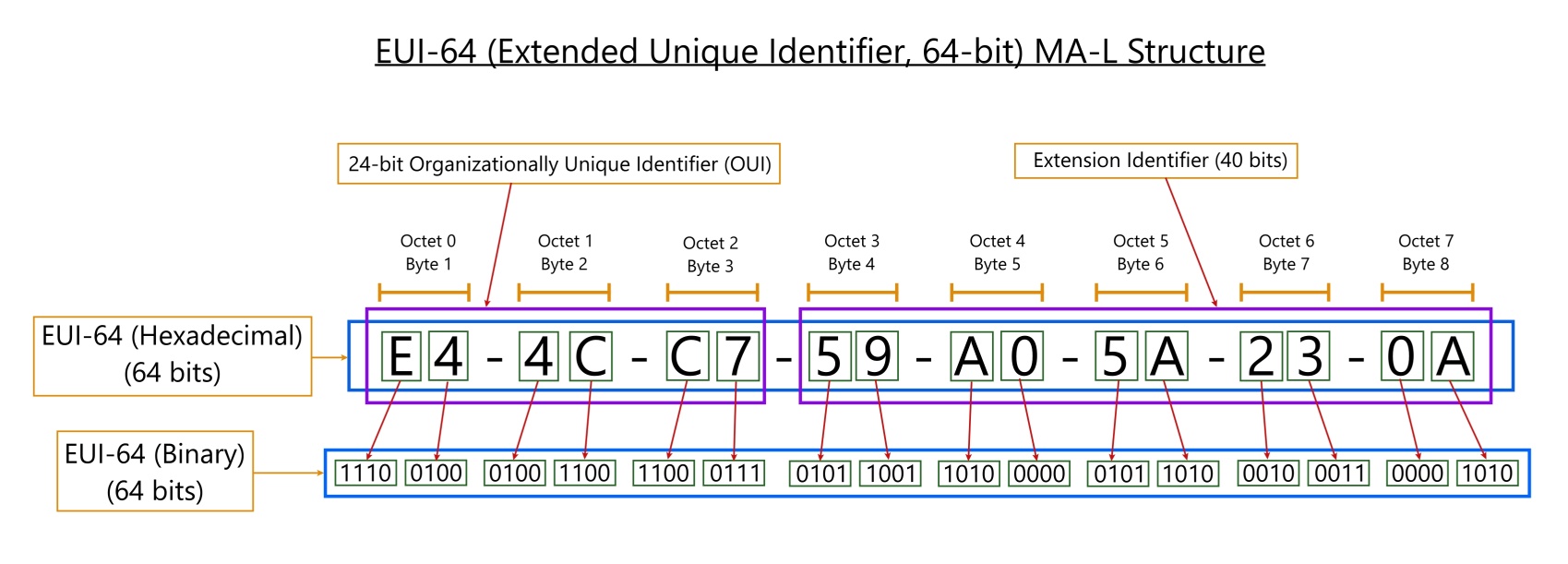
Special Bits in the First Octet

The first octet (Octet 0) contains two critical flag bits, interpreted with the least significant bit (LSB) as bit 0. These bits apply to the entire EUI-64 when used as an address:
- Bit 0 (I/G bit — Individual/Group, sometimes called M bit):
- 0: Individual/Unicast address (standard for most hardware identifiers) — identifies a single interface or entity.
- 1: Group/Multicast address (allowed but not considered a true unique EUI for single-entity identification)— identifies a group of interfaces.
- Bit 1 (U/L bit — Universal/Local, sometimes called X or u bit):
- 0: Universal (globally unique via IEEE OUI assignment) — the default for MA-L assignments. Derived from an IEEE-assigned OUI, intended to be unique worldwide.
- 1: Local (locally administered; loses global uniqueness guarantee) — assigned by a local administrator or through modification; uniqueness is only guaranteed within a local scope.
For standard manufacturer-assigned MA-L EUI-64 values, both bits are typically 0 in Octet 0, resulting in a universal unicast identifier.
Key Characteristics and Comparison
- Uniqueness Scope: Universal EUI-64 (U/L=0) aims for global uniqueness across all time and space, enforced by the IEEE RA’s centralized OUI management combined with the assignee’s careful extension management. Locally administered (U/L=1) values are only unique within a local administrative domain (common in virtualization, testing, or privacy scenarios).
- Capacity: 40-bit extension yields 1,099,511,627,776 possible values per MA-L — ideal for massive deployments (e.g., billions of IoT sensors from one vendor).
- Reservation Rules: In direct MA-L EUI-64 assignments, the organization should avoid placing FFFE or FFFF in the positions corresponding to Octets 3–4 (the start of the extension). This prevents ambiguity with legacy modified EUI-64 values derived from 48-bit MAC addresses.
- Relation to Modified EUI-64: MA-L EUI-64 is the native/direct form. It is unrelated to the IPv6 “modified EUI-64” process (which starts from a 48-bit MAC, inserts FF:FE, and flips the U/L bit). Direct MA-L usage is preferred for new non-Ethernet or high-volume technologies.
Example of bit positions (first octet in binary):
- Binary: b7 b6 b5 b4 b3 b2 b1 b0
- Where b0 = I/G bit, b1 = U/L bit.
- Hex example: 00 (binary 00000000) → I/G=0 (unicast), U/L=0 (universal).
These bits allow classification into four categories (unicast universal, unicast local, multicast universal, multicast local), though multicast universal addresses are rare and typically not used as true EUIs.
Direct (Unmodified) EUI-64 vs. Modified EUI-64
There are two closely related but distinct forms:
- Pure/Direct EUI-64 (IEEE-defined for new designs):
- 24-bit OUI (Octets 0–2) + 40-bit extension (Octets 3–7).
- No forced insertion of specific values.
- IEEE recommends this for new technologies to conserve address space and avoid legacy mappings.
- The extension identifier must avoid certain reserved patterns (e.g., starting with FFFF or FFFE in some contexts) to prevent ambiguity with encapsulated legacy addresses.
- Modified EUI-64 (most common in IPv6 SLAAC):
- Derived from a 48-bit EUI-48/MAC address.
- Process:
- Split the 48-bit MAC into two 24-bit halves (OUI + NIC-specific).
- Insert the fixed 16-bit value FFFE (hex) between them → temporary 64-bit value.
- Invert (flip) the U/L bit (bit 1) in the first octet.
- This “modification” signals the derivation process and aligns semantics between MAC addressing (where U/L=0 means universal) and IPv6 interface identifiers (where the flipped bit has adjusted meaning).
- The inserted FFFE serves as a marker: IEEE reserves it specifically for addresses derived from 48-bit sources, helping avoid collisions in mixed environments.
Variations and Extensions (MA-L, MA-M, MA-S)
The IEEE RA now assigns blocks in different sizes beyond the classic 24-bit OUI:
- MA-L (formerly standard OUI): 24-bit base + 40-bit extension for EUI-64.
- MA-M: 28-bit base + 36-bit extension.
- MA-S: 36-bit base (OUI-36) + 28-bit extension.
In all cases, the total remains 64 bits, but the split between assigned prefix and organization-controlled extension varies. The first 24 bits of MA-M/MA-S may include an OUI-36 prefix managed differently.
Representation and Transmission Considerations
- Byte order: Octet 0 (MSB) to Octet 7 (LSB).
- Bit order within octet: Transmission often uses LSB-first on the wire in many IEEE 802 networks (canonical format), but the logical structure treats the first octet with defined bit positions.
- Encapsulation rules: To avoid collisions, direct EUI-64 values should not use patterns like xx:xx:xx:FF:FE:xx:xx:xx or xx:xx:xx:FF:FF:xx:xx:xx for the middle bytes unless intentionally encapsulating a 48-bit address.
Edge Cases and Related Considerations
- Locally administered EUI-64: Set U/L=1 and assign the entire 64 bits (or remaining bits) manually. Common in virtualization, testing, or when no IEEE OUI is desired. These lose global uniqueness guarantees.
- No MAC address available: Interfaces without a hardware MAC (e.g., tunnels, virtual interfaces) may use other generation methods, random values, or set U/L appropriately.
- Privacy and security: Modified EUI-64 embeds manufacturer and potentially device-specific information, enabling tracking. IPv6 privacy extensions (RFC 4941/7217) often replace it with stable or temporary random IIDs.
- Bridging 48-bit and 64-bit environments: Mapping requires care; direct mapping of EUI-48 into EUI-64 is largely deprecated in favor of new 64-bit assignments.
- Multicast and group addresses: Setting I/G=1 with U/L=0 is possible but results in non-EUI values in some contexts (not guaranteed unique hardware identifiers).
- Reserved values: Patterns with FFFE or FFFF in the middle are restricted in direct assignments to preserve encapsulation semantics.
Implications and Usage Contexts
- IPv6 SLAAC: The modified form enables automatic, stateless generation of the 64-bit interface identifier, appended to a 64-bit network prefix.
- Other protocols: Used in IEEE 1394 (FireWire) node IDs, IEEE 1588 clock identities, Zigbee, and certain industrial/embedded systems.
- Future-proofing: IEEE strongly encourages new designs to use native 64-bit EUI-64 rather than deriving from 48-bit addresses to preserve OUI allocations and support larger-scale deployments.
- Uniqueness scope: Universal EUI-64 aims for global uniqueness across all time and space; local variants are scoped to a network or administrative domain.
In summary, the core structure is a simple concatenation of a 24-bit IEEE-assigned Company ID and a 40-bit extension, with critical signaling bits in the first octet. The “modified” variant introduces the FFFE insertion and U/L bit inversion specifically for compatibility with legacy 48-bit hardware in IPv6 and similar environments. This design balances backward compatibility, uniqueness, and extensibility while introducing nuances in bit semantics and privacy that implementers must address depending on the deployment scenario.
2.1) Special Bits in the First Octet
The special bits in the first octet of an EUI-64 (whether direct/unmodified or modified) are the two least significant bits of Octet 0 (the most significant byte of the 64-bit identifier). These bits, inherited from IEEE 802 MAC address conventions, provide critical signaling for address type and administration scope. They apply uniformly to EUI-64 structures and enable classification of the identifier into four broad categories.
Bit Numbering and Positioning
- Octet 0 is the first (leftmost) byte in the EUI-64, represented in hexadecimal (e.g., the leading 00 in 00:1A:2B:FF:FE:3C:4D:5E).
- Within this octet, bits are numbered starting from the least significant bit (LSB) as bit 0. This is the canonical IEEE convention for transmission and interpretation in most IEEE 802 networks (where bits are sent LSB-first within each octet, but the logical structure uses LSB numbering for flags).
- Binary representation of Octet 0: b7 b6 b5 b4 b3 b2 b1 b0
- b0 (rightmost, value 2^0): I/G bit
- b1 (next, value 2^1): U/L bit
- b2 to b7 (leftmost): Part of the Company ID / OUI value
- Binary representation of Octet 0: b7 b6 b5 b4 b3 b2 b1 b0
- Equivalent view from the left (MSB-first): The U/L bit is the 7th bit from the left (or 2nd from the right in the byte). This is why many networking texts and IPv6 documentation refer to “flipping the 7th bit.”
Practical impact on hex value:
- Adding or removing the U/L bit typically changes the first hex digit by ±2 (or the second nibble accordingly).
- Common mapping for universal MACs (U/L flip in modified EUI-64):
- 0x00 → 0x02
- 0x10 → 0x12
- 0x20 → 0x22
- … up to patterns like 0xC0 → 0xC2, etc.

The Two Special Bits
- Bit 0: I/G Bit (Individual/Group bit, also called M bit)
- 0: Individual address (unicast) — identifies a single, specific interface or entity. This is the default and overwhelmingly common case for hardware-assigned EUI-64 values.
- 1: Group address (multicast or broadcast-like) — identifies a group of interfaces. When I/G=1 and U/L=0, the address is not considered a true EUI (it does not uniquely identify a single hardware instance). The assignee of the OUI can create such group addresses by setting this bit.
- In most practical EUI-64 usage (e.g., IPv6 interface identifiers, FireWire node IDs), I/G remains 0.
- Setting I/G=1 with U/L=0 allows an organization to define multicast addresses within their OUI block, but these lose the “unique hardware identifier” property.
- In IPv6 modified EUI-64, the I/G bit is typically preserved as 0 (unicast IID); it is not flipped.
- Bit 1: U/L Bit (Universal/Local bit, also called X bit or “u” bit in IPv6 contexts)
- 0: Universal (universally administered / globally unique) — the identifier derives from an IEEE-assigned Company ID (OUI). It is intended to be unique across all devices worldwide and all time, enforced by the IEEE Registration Authority.
- 1: Local (locally administered) — the identifier is assigned by a local administrator, organization, or through a derivation process. Uniqueness is guaranteed only within the local scope (e.g., a single network, virtual environment, or administrative domain). No global uniqueness is implied.
- In standard MAC/EUI-48 and direct EUI-64 (IEEE 802 convention): U/L = 0 means universal/global; U/L = 1 means local.
- In modified EUI-64 for IPv6 Interface Identifiers (IID): The bit is inverted during construction. After inversion:
- U/L = 1 indicates universal scope (derived from a globally unique MAC/OUI).
- U/L = 0 indicates local scope.
- This inversion (defined in RFC 4291 and clarified in RFC 7136) was a deliberate design choice to make hand-configured local-scope IPv6 IIDs easier (administrators can simply set the bit to 0 for local) and to distinguish derived identifiers. However, modern guidance (RFC 7136) recommends treating the entire 64-bit IID as an opaque value with no semantic meaning attached to the “u” or “g” bits.

Four Possible Combinations and Their Meanings
The two bits create a 2×2 matrix of address types:
- I/G=0, U/L=0: Unicast + Universal (standard manufacturer-assigned EUI-64 or MAC). Globally unique hardware identifier.
- The four possible values of the 2nd most significant Hexadecimal of EUI-64 address.
- 0
- 4
- 8
- C
- The four possible values of the 2nd most significant Hexadecimal of EUI-64 address.
- I/G=0, U/L=1: Unicast + Local. Locally administered unicast address (common in virtualization, testing, spoofing, or manual configuration). No global uniqueness.
- The four possible values of the 2nd most significant Hexadecimal of EUI-64 address.
- 2
- 6
- A
- E
- The four possible values of the 2nd most significant Hexadecimal of EUI-64 address.
- I/G=1, U/L=0: Multicast + Universal. Group address derived from an OUI (organization can define these). Not a true EUI for unique identification.
- The four possible values of the 2nd most significant Hexadecimal of EUI-64 address.
- 1
- 5
- 9
- D
- The four possible values of the 2nd most significant Hexadecimal of EUI-64 address.
- I/G=1, U/L=1: Multicast + Local. Locally defined group address.
- The four possible values of the 2nd most significant Hexadecimal of EUI-64 address.
- 3
- 7
- B
- F
- The four possible values of the 2nd most significant Hexadecimal of EUI-64 address.
In practice, true EUI-64 identifiers assigned by manufacturers almost always use I/G=0 and U/L=0. Group addresses (I/G=1) are handled separately and are not considered EUIs when used for multicast.
Edge Case: If the original MAC is already locally administered (U/L=1, e.g., first octet 02), flipping makes U/L=0 in the IID.
Nuances, Edge Cases, and Implications
- Transmission Order: On the wire in IEEE 802 networks, the octet is sent with LSB first, but the logical flag interpretation remains based on the LSB numbering defined above.
- Locally Administered Addresses: Setting U/L=1 (and keeping I/G=0) is fully allowed and common for:
- Virtual machines / hypervisors
- Privacy or security (MAC randomization/spoofing)
- Testing or custom network setups
- These lose IEEE global uniqueness guarantees and may collide if not managed carefully.
- Privacy and Security: The U/L bit (and the overall OUI) can leak manufacturer information or enable device tracking in IPv6. This is why privacy extensions (RFC 4941/7217) prefer random IIDs over modified EUI-64.
- RFC 7136 Clarification: IPv6 IIDs should be treated as opaque 64-bit values. The “u” and “g” bits have no required semantic meaning in modern IPv6; their historical role is largely legacy.
- Direct vs. Modified EUI-64:
- Direct: Bits reflect raw IEEE assignment (usually 0/0).
- Modified: U/L is inverted to align with IPv6 conventions.
- Reserved Patterns: Direct EUI-64 assignments avoid middle bytes starting with FFFE or FFFF to prevent confusion with encapsulated 48-bit addresses.
- Implementation Variations: Some older tools or documentation may describe the U/L bit differently (e.g., “7th bit from left” without clarifying numbering). Always verify with binary representation for accuracy.
- Multicast Considerations: I/G=1 addresses are rare in pure EUI-64 contexts and are typically generated by the OUI assignee rather than used as unique identifiers.
Practical Verification
- Hex-to-Binary Check: For any first octet, convert to 8-bit binary and inspect bits 0 and 1.
- Tools/Commands:
- Linux: ip -6 addr (shows IPv6 addresses with EUI-64 IIDs).
- Cisco: show ipv6 interface or ipv6 address … eui-64 in config.
- Packet analyzers (Wireshark): Filter on IPv6 and inspect the interface ID bytes.
- Calculation Tip: Flipping the U/L bit is equivalent to XORing the first byte with 0x02. This works regardless of the original value.
These two bits, though only 2 out of 64, carry significant semantic weight for classification, scope, and compatibility between hardware addressing (MAC/EUI) and higher-layer protocols like IPv6. In modern network design, their importance has diminished somewhat due to the preference for opaque or privacy-enhanced identifiers, but they remain essential for understanding legacy derivation processes, address administration, and potential interoperability issues in mixed 48-bit/64-bit environments.
Understanding the precise numbering (LSB=0) and the inversion rule in modified EUI-64 prevents common configuration or troubleshooting errors, especially when manually crafting addresses or debugging SLAAC behavior.
3) Direct (Unmodified/Pure) EUI-64
Direct (Unmodified/Pure) EUI-64 is the native 64-bit identifier format defined by the IEEE Registration Authority (IEEE RA) for direct assignment by organizations. Unlike the modified EUI-64 used in IPv6 (which derives from 48-bit MAC addresses via FFFE insertion and U/L bit inversion), the pure form involves no transformations, fixed padding values, or bit flips. It provides a clean, extensible way to create globally unique 64-bit identifiers for hardware instances, nodes, or other entities.
IEEE has long recommended this native EUI-64 for new designs requiring worldwide-unique addresses, particularly in non-Ethernet or high-volume applications, to conserve the limited 48-bit address space and support larger-scale deployments.
Core Structure of Direct EUI-64
A pure EUI-64 consists of exactly 64 bits (8 octets/bytes), formed by simple concatenation:
- Octets 0–2 (24 bits): Company ID, also known as the Organizationally Unique Identifier (OUI) or base identifier assigned by the IEEE RA to a manufacturer or organization.
- Octets 3–7 (40 bits): Extension Identifier, assigned by the organization itself to ensure uniqueness within their allocated block.
This structure yields 2^40 ≈ 1.1 trillion unique extensions per 24-bit OUI, far exceeding the 2^24 (≈16.7 million) extensions available in traditional EUI-48/MAC-48 addresses.
Modern variations (due to IEEE’s tiered assignment blocks):
- MA-L (formerly standard OUI, “Large”): 24-bit base + 40-bit extension (classic structure).
- MA-M (“Medium”): 28-bit base + 36-bit extension.
- MA-S (“Small”, based on OUI-36): 36-bit base + 28-bit extension.
In all cases, the total remains 64 bits. The IEEE RA assigns the prefix (base), and the organization controls the remaining extension bits. The first three octets in a classic MA-L EUI-64 correspond to the OUI, but in MA-M/MA-S the split shifts slightly while preserving the overall 64-bit length.
Example (classic MA-L structure):
- OUI (Company ID): AC-DE-48 (24 bits)
- Extension Identifier: 23-45-67-01-9F (40 bits)
- Full direct EUI-64: AC-DE-48-23-45-67-01-9F
In IPv6-style colon-hex notation (for readability when used as an identifier): ACDE:4823:4567:019F
Special Bits in the First Octet
As with all IEEE EUI formats, the first octet (Octet 0) includes two signaling bits, counted with the least significant bit (LSB) as bit 0:
- Bit 0 (I/G bit — Individual/Group):
- 0 = Individual (unicast) address — identifies a single entity (standard for most EUI-64 assignments).
- 1 = Group (multicast) address — not typically used for true EUI identifiers.
- Bit 1 (U/L bit — Universal/Local):
- 0 = Universal (globally unique) — derived from an IEEE-assigned Company ID/OUI (the default for manufacturer-assigned EUI-64).
- 1 = Local (locally administered) — assigned by a local administrator; uniqueness is only local in scope.
Manufacturer-assigned direct EUI-64 values almost always have I/G = 0 and U/L = 0 in the first octet, making them unicast and globally unique. IEEE assignments ensure the U/L bit starts as 0 for universal addresses.
Binary view of first octet (example AC hex = 10101100 binary):
- Bit 0 (LSB, rightmost): I/G = 0
- Bit 1: U/L = 0
- Remaining bits: part of the Company ID.

Key Characteristics and Assignment Rules
- No reserved middle values: Unlike mappings from 48-bit addresses, there is no forced insertion of FF:FE or FF:FF. However, to support historical encapsulation of EUI-48 values and avoid collisions, organizations must avoid setting the first four hex digits of the extension identifier (bytes 3–4) to FFFE or FFFF in new direct assignments. This reserves patterns like xx-xx-xx-FF-FE-xx-xx-xx and xx-xx-xx-FF-FF-xx-xx-xx for legacy mapping purposes.
- Global uniqueness: When U/L = 0 and properly assigned, the identifier is intended to be unique across all space and time.
- Transmission and bit ordering: Octets are in network byte order (big-endian). Bit ordering within octets (canonical vs. non-canonical) depends on the specific protocol (e.g., LSB-first on many IEEE 802 links). The logical structure treats the first octet with defined flag bits.
- Assignment process: Organizations purchase a Company ID (OUI or larger block) from the IEEE RA, then freely assign the extension bits to individual devices, interfaces, or instances. This can tie to hardware serial numbers, model numbers, or other unique attributes.
Primary Applications and Contexts
Direct EUI-64 is preferred where a native 64-bit identifier is needed without reliance on 48-bit MAC derivation:
- IEEE 1394 (FireWire): Uses EUI-64 as the node unique identifier for devices on the bus.
- IEEE 1588 (Precision Time Protocol — PTP): Employs EUI-64 as the clockIdentity field for grandmaster clocks, switches, and other time-aware devices. This provides a stable, globally unique reference independent of IP addressing.
- Industrial, embedded, and IoT protocols: Especially in non-Ethernet environments (e.g., certain wireless, sensor networks, or industrial buses) where 64-bit addressing offers better scalability.
- Other IEEE standards: Some bridging, management, or context-dependent identifiers.
- IPv6 (rarely): If a link layer natively provides a 64-bit EUI-64 (not a 48-bit MAC), RFC 4291 specifies inverting the U/L bit to form the interface identifier (IID). This is the only “modification” applied in IPv6 contexts for native EUI-64.
IEEE guidelines explicitly state that new designs requiring worldwide-unique addresses shall use EUI-64 rather than EUI-48, especially for high-volume hardware identification. The mapping of EUI-48 into EUI-64 spaces is now considered deprecated in general to prevent collisions with modern variable-size assignments (MA-M, MA-S).
Comparison with Modified EUI-64 (Quick Reference)
- Direct/Unmodified: Native concatenation (OUI + extension); no FFFE; no bit flip; clean for new tech.
- Modified (IPv6 SLAAC): Derived from 48-bit MAC → split + insert FF:FE + invert U/L bit; used specifically for generating 64-bit IIDs from legacy Ethernet hardware.
- Semantics: In pure EUI-64, U/L=0 consistently means universal. In IPv6 modified form, the inversion adjusts semantics for interface identifier use.
Nuances, Edge Cases, and Considerations
- Locally administered EUI-64: Set U/L=1 and assign the full (or remaining) 64 bits manually. These are useful in virtualization, testing, or private networks but sacrifice global uniqueness.
- Reserved/encapsulated patterns: Direct assignments must not use the forbidden middle patterns to preserve space for historical EUI-48 encapsulation (e.g., ccccccFFFEeeeeee).
- Privacy and tracking: Like any hardware-derived identifier, a direct EUI-64 reveals the manufacturer (via OUI) and can enable correlation if exposed. In protocols like PTP, this is often acceptable for management purposes.
- Bridging/mixed environments: Care is required when translating between 48-bit and 64-bit address spaces; deprecated mappings increase collision risk.
- Implementation details: Some protocols (e.g., Thread in 802.15.4) explicitly prohibit using IEEE EUI-64 directly as an extended address, preferring other formats.
- Future-proofing: With the growth of IoT and connected devices, native EUI-64 helps avoid exhaustion issues that plagued 48-bit space. IEEE continues to encourage its adoption for non-802 technologies.
- Verification: Tools like Wireshark can decode EUI-64 in protocol fields (e.g., PTP clockIdentity). IEEE RA maintains public OUI databases for lookup.
Real-World and Protocol-Specific Examples
Direct EUI-64 appears in technologies that natively support or require 64-bit identifiers:
- IEEE 1588 Precision Time Protocol (PTP) – ClockIdentity:
- Used as a globally unique 64-bit clock identifier.
- Example from Allied Telesis PTP documentation: 00-0C-25-FF-FE-26-95-BF (some implementations blend forms; true direct avoids forced FF:FE).
- Another conceptual/real pattern in PTP devices often starts with a manufacturer’s prefix (e.g., from an MA-L block) + unique extension, such as 00-1A-2B-00-00-00-00-01 (hypothetical for a specific clock).
- In practice, many PTP clocks derive from hardware but use direct EUI-64 semantics for the clockIdentity field.
- IEEE 1394 (FireWire) Node Identifiers:
- Direct EUI-64 as the unique node ID on the bus.
- Example pattern: Devices often use values like 00-11-22-33-44-55-66-77 (manufacturer prefix + extension). Real captures show clean 64-bit values without middle FF:FE, e.g., starting with vendor OUIs extended to 64 bits.
- Zigbee / IEEE 802.15.4 Extended Addresses:
- Long (extended) 64-bit address, typically a direct EUI-64.
- Real example from device logs: C6:4C:DE:48:24:36:CE:F4 (manufacturer-assigned, no FF:FE marker).
- Another common pattern: E3-95-44-9C-A3-7A-65-3B (direct form in IoT sensors).
- NVMe (Non-Volatile Memory Express) Namespace Identifiers:
- EUI-64 format for namespace identification: eui:AC-DE-48-23-45-67-01-9F (using the IEEE canonical example).
- Other Industrial / Embedded / IoT:
- 1-Wire / DS2502-E64 chips: Pre-programmed with direct EUI-64 (e.g., family code + unique 48-bit serial + CRC, extended to full 64-bit).
- InfiniBand GUIDs: Native 64-bit identifiers, often direct EUI-64 (with U/L bit handling per RFC 4391).
- 5G/Telecom Equipment: PEI (Permanent Equipment Identifier) may reference EUI-64 forms, e.g., eui-AC-DE-48-23-45-67-01-9F.
Hypothetical but Realistic MA-Block Examples
- MA-L (24-bit prefix + 40-bit extension): 00-1A-2B-00-00-00-00-01 (e.g., a high-volume manufacturer).
- MA-M (28-bit prefix + 36-bit extension): AC-DE-48-2X-YY-ZZ-AA-BB (where the extra 4 bits are part of the prefix).
- MA-S (36-bit OUI-36 + 28-bit extension): AC-DE-48-23-4X-YY-ZZ-WW (smaller organizations).
In summary, direct (unmodified) EUI-64 represents the forward-looking, native IEEE format: a straightforward 24/28/36-bit Company ID prefix + organization-controlled extension, with standard I/G and U/L flag bits. It eliminates the legacy accommodations (FFFE insertion and bit inversion) required for IPv6 compatibility with 48-bit MACs. This makes it ideal for new protocols and technologies where a clean 64-bit globally unique identifier is needed—such as FireWire node IDs or PTP clock identities—while supporting massive scalability per assignee. Network designers and protocol developers should prefer this form over derived mappings for longevity and reduced collision risk, though understanding both variants remains essential for troubleshooting mixed or legacy environments. For practical examples in specific standards, refer to IEEE 1394 or IEEE 1588 documentation, where the pure EUI-64 structure appears directly in packet fields.
4) Modified EUI-64
Modified EUI-64 (also called Modified Extended Unique Identifier) is the specific algorithm defined in RFC 4291 (IP Version 6 Addressing Architecture, Appendix A) for generating a 64-bit interface identifier (IID) in IPv6 from a device’s 48-bit IEEE 802 MAC address (EUI-48). It is the foundational mechanism that enabled the original Stateless Address Autoconfiguration (SLAAC) process in IPv6 by providing a deterministic, hardware-based way to create the lower 64 bits of an IPv6 address.
Although commonly referred to simply as “EUI-64” in networking contexts and vendor documentation (e.g., Cisco commands), the technically precise term is modified EUI-64 because it includes two deliberate changes compared to the native IEEE EUI-64 format: insertion of a fixed marker and inversion of a specific bit.
Why “Modified”?
- The pure direct/unmodified EUI-64 (IEEE-defined) is a straightforward 24-bit Company ID (OUI) + 40-bit extension identifier, with no forced middle values.
- Modified EUI-64 adapts the common 48-bit MAC address to fit the 64-bit IID requirement in IPv6 while preserving as much uniqueness as possible. The modifications serve practical purposes:
- FF:FE insertion expands the address and acts as a recognizable marker.
- U/L bit inversion aligns semantic differences between IEEE MAC addressing and IPv6 IID interpretation, and simplifies manual configuration of local-scope IIDs (e.g., ::1 or ::2 on tunnels/serial links).
This design was chosen for backward compatibility with the vast installed base of 48-bit Ethernet hardware while supporting the /64 subnet model that dominates IPv6 deployments.
Detailed Step-by-Step Algorithm (per RFC 4291)
The process is deterministic and reversible in most cases:
- Start with the 48-bit MAC address (e.g., 00:1A:2B:3C:4D:5E in colon-hex notation).
- Split into two 24-bit halves:
- Left: Organizationally Unique Identifier (OUI) — first 3 octets (00:1A:2B).
- Right: Node-specific (NIC/vendor-assigned) portion — last 3 octets (3C:4D:5E).
- Insert the fixed 16-bit value FF:FE between the two halves:
- Temporary result: 00:1A:2B:FF:FE:3C:4D:5E (now 64 bits / 8 octets).
- Invert the Universal/Local (U/L) bit in the first octet:
- The U/L bit is bit 1 (second-least-significant bit, counting LSB as bit 0) or equivalently the 7th bit from the left (MSB side) in the first octet.
- In IEEE MAC/EUI semantics: U/L = 0 means universally administered (global, IEEE-assigned OUI); U/L = 1 means locally administered.
- In IPv6 modified EUI-64: The bit is inverted so that a universal MAC produces an IID with U/L = 1 (signaling “universal scope” for the IID), and a local MAC produces U/L = 0.
- Practical shortcut: XOR the first octet with 0x02 (binary 00000010).

Full Example 1:
- MAC: 00:1A:2B:3C:4D:5E
- First octet 00 binary: 00000000 → U/L bit (bit 1) = 0 → invert to 1 → 00000010 (hex 02)
- Modified EUI-64: 02:1A:2B:FF:FE:3C:4D:5E
- As 64-bit IPv6 IID (16-bit hextets): 021A:2BFF:FE3C:4D5E
Full Example 2 (with non-zero first octet):
- MAC: AC:DE:48:23:45:67
- First octet AC hex = 10101100 binary → U/L bit (bit 1 from LSB) = 0 → invert → 10101110 (hex AE)
- After insertion: AE:DE:48:FF:FE:23:45:67
- IID: AEDE:48FF:FE23:4567
Reversing the Process (for troubleshooting):
- Take the IID, remove the middle FF:FE, and flip the U/L bit back in the first octet to recover the original MAC.
Role in IPv6 SLAAC and Address Formation
- Link-local address: Always starts with FE80::/10 + modified EUI-64 IID (e.g., FE80::021A:2BFF:FE3C:4D5E).
- Global unicast address: Combines a 64-bit prefix from Router Advertisement (RA) Prefix Information Option (with Autonomous flag set) + the 64-bit IID.
- The process occurs automatically when an interface enables SLAAC.
- Duplicate Address Detection (DAD) follows to ensure uniqueness on the link.
RFC 4291 requires that, for most unicast IPv6 addresses (except those starting with binary 000), the IID must be 64 bits long and constructed in modified EUI-64 format if derived from an IEEE link-layer address.
Bit Semantics and Rationale for Inversion
The U/L bit inversion often causes confusion:
- In a standard MAC: U/L = 0 → global/universal (IEEE OUI).
- In the resulting IPv6 IID: U/L = 1 → indicates universal scope (derived from a global token).
- Rationale (from RFC 4291 and related discussions): It makes manual configuration of simple local-scope IIDs easier (e.g., ::1, ::2 instead of awkward patterns like 0200:0000:0000:0001). It also allows future technologies to potentially use IIDs with true universal scope.
The I/G (Individual/Group) bit (bit 0) is typically left as 0 for unicast IIDs and is not inverted.
RFC 7136 later clarified that IPv6 interface identifiers should generally be treated as opaque values with no inherent meaning in most modern contexts, reducing reliance on these bits.
Advantages of Modified EUI-64
- Simplicity and automation: True plug-and-play — no DHCPv6 server or manual configuration needed for basic connectivity.
- Uniqueness guarantee: Leverages the global uniqueness of MAC addresses (assuming no spoofing or collisions).
- Predictability: Stable addresses across reboots on the same interface; useful for servers, routers, and management (e.g., consistent logging, firewall rules, DNS entries).
- Widely supported: Default or configurable on most network equipment (Cisco ipv6 address prefix/64 eui-64, Linux addrgenmode=eui64).
Disadvantages, Privacy Concerns, and Modern Status
The primary drawback is privacy leakage:
- The IID embeds the manufacturer’s OUI (revealing vendor) and often device-specific details.
- The address remains constant when moving between networks, enabling long-term tracking, correlation of user activity, and fingerprinting.
As a result:
- RFC 8064 (2017) recommends against using hardware-derived IIDs (including modified EUI-64) where possible, favoring stable privacy addresses (RFC 7217).
- RFC 8981 (obsoleting RFC 4941) defines temporary addresses with randomized IIDs that rotate periodically.
- Most client operating systems (Windows, macOS, iOS, Android, modern Linux distributions) now default to privacy extensions or RFC 7217 stable-privacy mode instead of modified EUI-64 for global addresses. Link-local addresses may still use it in some implementations (e.g., certain Cisco devices or older Linux configs).
- IEEE perspective: Mapping EUI-48 to EUI-64 is deprecated in general due to potential collisions with modern variable-size OUI assignments (MA-M, MA-S/OUI-36). However, the specific modified EUI-64 algorithm remains codified in IPv6 standards for compatibility.
Current best practices :
- Client devices (laptops, phones): Prefer temporary (RFC 8981) + stable privacy (RFC 7217) addresses.
- Infrastructure/servers/routers: Modified EUI-64 or manual/DHCPv6 stable addresses for predictability; disable privacy extensions if needed for management.
Edge Cases and Considerations
- Non-48-bit interfaces: RFC 4291 Appendix A covers native 64-bit EUI-64 (invert U/L bit) or other tokens.
- Locally administered MACs (U/L=1 originally): The flip produces U/L=0 in the IID.
- Multicast/group addresses: I/G bit usually remains 0 for IIDs.
- /64 boundary: Modified EUI-64 assumes a 64-bit IID and works best with standard /64 prefixes (RFC 7421 discusses the strong recommendation for this boundary).
- Security: Addresses can be spoofed; higher-layer authentication is still required. Weak randomness in early temporary implementations has been improved.
- Reversibility and debugging: Easy to map back to MAC, which aids troubleshooting but also aids tracking.
- Mixed environments: Care needed when bridging or translating between 48-bit and 64-bit contexts.
Practical Verification and Configuration Examples
- Linux: ip -6 addr show — look for ff:fe in the IID or “temporary” flags.
- Cisco: ipv6 address 2001:db8::/64 eui-64 (forces modified EUI-64); show ipv6 interface.
- Wireshark: Filter for IPv6 and inspect the lower 64 bits for FFFE pattern.
In summary, modified EUI-64 was a clever, hardware-leveraging solution that made early IPv6 deployment simple and reliable. It remains relevant for controlled environments needing stable, predictable addressing (especially infrastructure) and for understanding legacy behavior or link-local addresses. However, evolving privacy requirements have largely shifted modern client deployments toward randomized or opaque IIDs. Network designers must weigh the trade-offs between ease of management, uniqueness, and privacy protection when deciding whether to enable or disable it. Understanding the exact algorithm, bit semantics, and its relationship to direct EUI-64 and privacy extensions provides a complete foundation for IPv6 address planning, troubleshooting, and secure deployment.
Deriving Modified EUI-64 from EUI-48 (48-bit MAC Address) creating the IPv6 Addressing (Interface Identifiers)
A very common way to obtain an EUI-64 identifier is by converting an existing 48-bit MAC address (EUI-48). This method is widely used, particularly in creating the IPv6 Addressing (Interface Identifiers). IPv6 uses a 64-bit Modified Extended Unique Identifier (Modified EUI-64).
Example 1
- Start with the 48-bit MAC address: Let’s use the example 70-B3-D5-DA-A9-54.
- Split the 48-bit MAC address to two 24-bit(3 bytes) halves:
- OUI (first 3 bytes): 70-B3-D5
- NIC Specific part (last 3 bytes): DA-A9-54
- Split the 48-bit MAC address to two 24-bit(3 bytes) halves:
- Step 2: Insert the 16-bit(2-byte) hexadecimal value FF-FE between the halves (between the 3rd and 4th bytes).
- 70-B3-D5 + FF-FE + DA-A9-54
- Combine: This forms the 64-bit EUI-64 address: 70-B3-D5-FF-FE-DA-A9-54
- Step 3: When this EUI-64 is used to automatically generate the Interface ID (the host portion) of an IPv6 address (using SLAAC – Stateless Address Autoconfiguration), one small but important change is made: The U/L (Universal/Local) bit or X bit is flipped: This is the 2nd least significant bit of the very first byte. This flipping signifies that the address was generated using this mechanism.
- In our example 70-B3-D5-FF-FE-DA-A9-54, the first byte is 70. In binary, this is 0111 0000. The 2nd least significant bit (the U/L bit) is 0.
- To create the Modified EUI-64 Interface ID for IPv6, this bit is flipped to
1. - So, the first byte 70 (binary 0111 0000) becomes 72 (binary 0111 0010).
- Modified EUI-64 Interface ID is 72-B3-D5-FF-FE-DA-A9-54
- The resulting IPv6 Interface Identifier would be 72B3:D5FF:FEDA:A954.

Example 2
Here’s how it works:
- Start with the 48-bit MAC address: Let’s use the example FC:99:47:75:CE:E0.
- Split the 48-bit MAC address to two 24-bit(3 bytes) halves:
- OUI (first 3 bytes): FC:99:47
- NIC Specific part (last 3 bytes):
75:CE:E0
- Split the 48-bit MAC address to two 24-bit(3 bytes) halves:
- Step 2: Insert the 16-bit(2-byte) hexadecimal value FF:FE between the halves (between the 3rd and 4th bytes).
- FC:99:47+ FF:FE + 75:CE:E0
- Combine: This forms the 64-bit EUI-64 address: FC:99:47:FF:FE:75:CE:E0
- Step 3 (Create the Modified EUI-64): Toggle the 7th bit (universal/local bit) of the first byte from 0 to 1. For FC (binary 11111100), the 7th bit is 0 so flipping makes it 10111110 (hex FE),
- The Modified EUI-64 is, FE:99:47:FF:FE:75:CE:E0. It can be used as IPv6 Interface Identifier.
- The resulting IPv6 Interface Identifier would be FE99:47FF:FE75:CEE0.

Example 3: Classic Universal MAC (Most Common Case)
MAC Address: 00:1A:2B:3C:4D:5E (first octet 00 → universal)
Step-by-Step:
- Split: 00:1A:2B | 3C:4D:5E
- Insert FF:FE: 00:1A:2B:FF:FE:3C:4D:5E
- First octet 00 (binary 00000000):
- U/L bit (bit 1) = 0 → invert to 1 → 00000010 (hex 02)
- Modified EUI-64: 02:1A:2B:FF:FE:3C:4D:5E
As IPv6 IID: 021A:2BFF:FE3C:4D5E
Full IPv6 Addresses:
- Link-local: FE80::021A:2BFF:FE3C:4D5E
- Global (example prefix 2001:DB8:1234:5678::/64): 2001:DB8:1234:5678:021A:2BFF:FE3C:4D5E
Example 4: Non-Zero First Octet (U/L Bit Flip Visible)
MAC Address: AC:DE:48:23:45:67 (first octet AC)
Step-by-Step:
- Split: AC:DE:48 | 23:45:67
- Insert FF:FE: AC:DE:48:FF:FE:23:45:67
- First octet AC hex = 10101100 binary:
- Bits: b7=1, b6=0, b5=1, b4=0, b3=1, b2=1, b1=0 (U/L), b0=0 (I/G)
- Invert U/L (bit 1): 10101110 = AE hex
- Modified EUI-64: AE:DE:48:FF:FE:23:45:67
As IPv6 IID: AEDE:48FF:FE23:4567
Full Addresses:
- Link-local: FE80::AEDE:48FF:FE23:4567
- Global: 2001:DB8:ABCD:EF01:AEDE:48FF:FE23:4567
Example 5: Locally Administered MAC (U/L = 1 originally)
MAC Address: 02:00:00:00:00:01 (first octet already has U/L=1)
Step-by-Step:
- Split: 02:00:00 | 00:00:01
- Insert FF:FE: 02:00:00:FF:FE:00:00:01
- First octet 02 (binary 00000010):
- U/L bit (bit 1) = 1 → invert to 0 → 00000000 (hex 00)
- Modified EUI-64: 00:00:00:FF:FE:00:00:01
As IPv6 IID: 0000:00FF:FE00:0001
Note: The inversion makes the resulting IID look like a universal one in IPv6 semantics (U/L=0 after flip indicates local origin in some interpretations).
Example 6: Modern OUI with High Bits Set
MAC Address: F8:2C:3F:12:34:56 (common in recent hardware)
Step-by-Step:
- Split: F8:2C:3F | 12:34:56
- Insert FF:FE: F8:2C:3F:FF:FE:12:34:56
- First octet F8 hex = 11111000 binary:
- U/L bit (bit 1) = 0 → invert to 1 → 11111010 = FA hex
- Modified EUI-64: FA:2C:3F:FF:FE:12:34:56
As IPv6 IID: FA2C:3FFF:FE12:3456
Example 7: All-Zeros MAC (Test/Illustration Only)
MAC Address: 00:00:00:00:00:00
Result:
- After process: 02:00:00:FF:FE:00:00:00
- IID: 0200:00FF:FE00:0000
Note: Real devices never use all-zero MACs; this is for lab/testing.
Example8: Multicast MAC (I/G = 1) – Rare for IIDs
MAC Address: 01:00:5E:00:00:01 (multicast)
Result:
- First octet 01 (binary 00000001, I/G=1, U/L=0)
- After insertion and U/L flip: 03:00:5E:FF:FE:00:00:01
- IID: 0300:5EFF:FE00:0001
Note: IPv6 IIDs are almost always unicast (I/G=0), so this is uncommon in practice.
Summary Table of Examples
| Original MAC | First Octet (Before) | First Octet (After Flip) | Modified EUI-64 | IPv6 IID |
|---|---|---|---|---|
| 00:1A:2B:3C:4D:5E | 00 | 02 | 02:1A:2B:FF:FE:3C:4D:5E | 021A:2BFF:FE3C:4D5E |
| AC:DE:48:23:45:67 | AC | AE | AE:DE:48:FF:FE:23:45:67 | AEDE:48FF:FE23:4567 |
| 02:00:00:00:00:01 | 02 | 00 | 00:00:00:FF:FE:00:00:01 | 0000:00FF:FE00:0001 |
| F8:2C:3F:12:34:56 | F8 | FA | FA:2C:3F:FF:FE:12:34:56 | FA2C:3FFF:FE12:3456 |
| 00:00:00:00:00:00 | 00 | 02 | 02:00:00:FF:FE:00:00:00 | 0200:00FF:FE00:0000 |
Side-by-Side Comparison
| Aspect | Direct (Unmodified) EUI-64 | Modified EUI-64 (IPv6 IID) |
|---|---|---|
| Primary Purpose | Native 64-bit hardware/protocol identifier | Derived 64-bit IPv6 Interface Identifier from 48-bit MAC |
| Construction | Direct: 24-bit Company ID + 40-bit extension | Derived: Split 48-bit MAC + insert FF:FE + flip U/L bit |
| Middle Bytes | Organization-assigned (avoid FFFE/FFFF for clarity) | Fixed FF:FE marker |
| U/L Bit | Usually 0 (universal) as assigned | Flipped from original MAC (0→1 for universal MACs) |
| I/G Bit | Usually 0 (unicast) | Usually 0 (unicast) |
| IEEE Recommendation | Preferred for all new designs | Legacy compatibility mechanism for IPv6 SLAAC |
| Uniqueness Scope | Global (if U/L=0) | Treated as opaque in modern IPv6 (RFC 7136) |
| Collision Avoidance | Reserved patterns prevent overlap with derived | FFFE signals derivation |
| Common Use Cases | FireWire, IEEE 1588, new embedded/IoT protocols | IPv6 SLAAC (link-local and global addresses) |
| Privacy/Security | Can embed manufacturer info | Same issue + tracking risk across networks |
4.1) Modified EUI-64 Role in IPv6 SLAAC and Address Formation
Modified EUI-64 plays a foundational role in IPv6 Stateless Address Autoconfiguration (SLAAC), as defined primarily in RFC 4862 (IPv6 Stateless Address Autoconfiguration) and RFC 4291 (IP Version 6 Addressing Architecture). It provides a deterministic method for a host to generate its own 64-bit interface identifier (IID) from the device’s 48-bit link-layer address (typically an Ethernet MAC address). This IID is then combined with a network prefix to form complete IPv6 addresses without requiring a central server like DHCPv6.
SLAAC enables true plug-and-play connectivity: devices automatically configure usable IPv6 addresses upon connecting to a network, leveraging the large 128-bit address space and the common /64 prefix length.
The SLAAC Process Overview (with Modified EUI-64)
SLAAC follows a well-defined sequence (per RFC 4862). Modified EUI-64 is central to generating the IID in steps involving link-local and global address formation:
- Interface Initialization and Link-Local Address Generation:
- When an IPv6 interface becomes active (e.g., link comes up), the host immediately generates a link-local address.
- Prefix: FE80::/10 (effectively FE80::/64 for the IID portion).
- IID: Generated using modified EUI-64 from the interface’s MAC address.
- Example:
- MAC: 00:1A:2B:3C:4D:5E
- Modified EUI-64 IID: 021A:2BFF:FE3C:4D5E (after splitting, inserting FF:FE, and inverting the U/L bit).
- Link-local address: FE80::021A:2BFF:FE3C:4D5E.
- This address is used for local link communication (e.g., Neighbor Discovery) before any global address exists. It is scoped to the link and not routable.
- Duplicate Address Detection (DAD) for Link-Local:
- The host performs DAD by sending a Neighbor Solicitation (NS) message to check if the tentative link-local address is already in use.
- If no conflict, the address is assigned and marked as preferred/valid.
- Router Discovery:
- The host sends a Router Solicitation (RS) message to the all-routers multicast address (FF02::2).
- Routers respond with Router Advertisement (RA) messages (to FF02::1), containing:
- Prefix Information Options (PIO) with the network prefix (e.g., 2001:DB8:1234:5678::/64).
- Flags: A-flag (Autonomous) set to 1 to enable SLAAC for this prefix.
- Other parameters: lifetimes, M-flag (Managed, for DHCPv6), O-flag (Other configuration).
- Global Unicast Address Formation:
- For each prefix where the A-flag is set, the host generates a global unicast address by concatenating:
- 64-bit prefix (from RA) + 64-bit IID (from modified EUI-64).
- Example:
- Prefix: 2001:DB8:1234:5678::/64
- IID: 021A:2BFF:FE3C:4D5E
- Full address: 2001:DB8:1234:5678:021A:2BFF:FE3C:4D5E/64.
- The host again performs DAD on this tentative global address.
- For each prefix where the A-flag is set, the host generates a global unicast address by concatenating:
- Address Lifetimes and Maintenance:
- Addresses have preferred and valid lifetimes (from RA).
- The host periodically refreshes via new RAs.
- If the prefix changes (e.g., renumbering), new addresses are formed.
Modified EUI-64 ensures the IID is stable and unique (assuming unique MACs), making the resulting addresses deterministic and persistent across reboots on the same interface.
Why Modified EUI-64 in SLAAC?
- Uniqueness: Leverages the global uniqueness of IEEE-assigned MAC addresses (OUI + extension).
- Simplicity: No stateful server needed; hosts self-configure using only link-layer information and RA messages.
- /64 Boundary Alignment: IPv6 strongly recommends /64 subnets (RFC 7421). The 64-bit IID fits perfectly, enabling SLAAC while leaving ample space for subnets.
- Backward Compatibility: Works with the enormous installed base of 48-bit Ethernet hardware. For native 64-bit link-layer identifiers, RFC 4291 specifies a similar process (invert the U/L bit).
- Administrative Convenience: The U/L bit inversion (making universal MACs appear with U/L=1 in the IID) allows easy manual configuration of simple local IIDs (e.g., ::1, ::2 on tunnels or serial links) without collision risks.
Bit Semantics Note (RFC 4291, Section 2.5.1):
- In the resulting modified EUI-64 IID, the U/L bit set to 1 indicates “global scope” (derived from universal token), while 0 indicates local scope. This reversal from IEEE MAC semantics supports future extensibility for truly universal-scope IIDs.
RFC 7136 clarifies that IPv6 IIDs should generally be treated as opaque values, with no deep semantic reliance on individual bits in modern practice.
Address Formation Details
An IPv6 address = Network Prefix (variable length, typically 64 bits in SLAAC) + Interface Identifier (64 bits).
- Link-local: Fixed FE80::/64 + modified EUI-64 IID.
- Global Unicast: RA-provided prefix (with A=1) + modified EUI-64 IID.
- Other Addresses: SLAAC can also generate addresses for Unique Local Addresses (ULA, FC00::/7) if advertised, though privacy considerations often apply.
The formation is purely concatenative after IID generation—no complex math beyond the initial MAC-to-IID transformation.
Current Role, Nuances, and Modern Considerations
While modified EUI-64 was the original and default IID method in early IPv6 deployments, its role has evolved due to privacy and security concerns:
- Privacy Leakage: The IID embeds the MAC address (revealing manufacturer via OUI and potentially device details). This enables tracking across networks because the IID remains constant even when the prefix changes.
- RFC Recommendations:
- RFC 8064 (2017) advises against hardware-derived IIDs like modified EUI-64 where privacy matters.
- RFC 7217 (Semantically Opaque IIDs): Preferred for generating stable but random-looking IIDs using a hash (e.g., based on prefix, interface, and secret). These change across networks but remain stable on the same subnet.
- RFC 8981 (Temporary Addresses, obsoleting RFC 4941): Generates short-lived, randomized temporary IIDs alongside stable ones. Hosts prefer temporary addresses for outbound connections.
- Modern OS Behavior:
- Client devices (phones, laptops): Default to RFC 7217 stable privacy + RFC 8981 temporary addresses. Modified EUI-64 is often disabled or deprioritized for global addresses (while link-local may still use it in some cases).
- Servers, routers, infrastructure: Often retain modified EUI-64 or manual/DHCPv6 for predictability (consistent DNS entries, firewall rules, logging).
- Many systems allow explicit configuration (e.g., Linux addrgenmode=eui64 vs. stable-privacy; Windows/macOS privacy settings).
Edge Cases and Considerations:
- Non-/64 Prefixes: SLAAC is designed around 64-bit IIDs; other lengths can break compatibility or cause issues (RFC 7421 analyzes the strong preference for /64).
- Interfaces without MAC: Fall back to other tokens, random IIDs, or manual local-scope values.
- DAD Failures: Rare with unique MACs, but if collision occurs, the address is not assigned (or alternative IID generation may trigger).
- Mixed Environments: Virtual machines, MAC spoofing, or bridging can lead to duplicates or unexpected behavior.
- Security: Modified EUI-64 makes address scanning or correlation easier in some scenarios but simplifies management. Privacy extensions mitigate tracking but can complicate logging and operations.
- Router/Enterprise Use: Cisco devices often support explicit ipv6 address prefix/64 eui-64 for predictable addressing. Many networks combine SLAAC with stateless DHCPv6 (for DNS, etc.) via RA O/M flags.
- IoT/Embedded Devices: Some still default to EUI-64; this can pose privacy risks in large deployments.
Practical Implications and Best Practices
- For Clients: Enable privacy extensions (temporary + stable opaque IIDs) to protect against tracking.
- For Infrastructure: Use modified EUI-64, RFC 7217, or static addresses for stability and operational ease.
- Verification:
- Linux: ip -6 addr show (look for ff:fe in IIDs indicating EUI-64, or “temporary” flags).
- Cisco: show ipv6 interface or configure with eui-64 keyword.
- Packet captures (Wireshark): Observe RS/RA exchanges and resulting addresses.
- Configuration Examples:
- Cisco router: ipv6 address 2001:db8::/64 eui-64 (manual with modified EUI-64).
- Linux sysctl: Control temporary addresses and address generation mode.
In summary, modified EUI-64 was instrumental in making SLAAC simple, automatic, and reliable by providing a hardware-based, unique 64-bit IID for both link-local and global address formation. It remains a core part of the original SLAAC design and is still used in controlled environments where predictability is valued. However, privacy-driven alternatives (RFC 7217 and RFC 8981) have become the de facto standard for most end-user devices, reflecting a shift toward opaque and temporary IIDs. Network architects must balance the original benefits of modified EUI-64—simplicity, stability, and uniqueness—against modern requirements for privacy, security, and operational manageability when designing IPv6 deployments.
5) IPv6 Privacy Extensions
IPv6 Privacy Extensions are mechanisms designed to mitigate privacy risks inherent in the original Stateless Address Autoconfiguration (SLAAC) process, particularly when it relies on hardware-derived interface identifiers like modified EUI-64 from a device’s MAC address. By generating randomized or semantically opaque 64-bit interface identifiers (IIDs), these extensions prevent long-term tracking of devices across different networks based on predictable, hardware-linked IPv6 addresses.
Core Problem Addressed by Privacy Extensions
In basic SLAAC (RFC 4862):
- A device combines a 64-bit network prefix (from Router Advertisements) with a 64-bit IID.
- The traditional IID uses modified EUI-64, embedding the device’s 48-bit MAC address (with FF:FE insertion and U/L bit flip).
- This creates a stable, globally identifiable address: the OUI reveals the manufacturer, and the full IID can correlate activity across networks, time, and locations (e.g., via web server logs, DNS queries, or passive monitoring).
Privacy implications:
- Device fingerprinting and tracking (even without cookies or logins).
- Correlation of user behavior when moving between home Wi-Fi, public networks, cellular, etc.
- Exposure of hardware details (vendor, sometimes model).
Privacy extensions solve this by introducing additional addresses or alternative IID generation methods that obscure or rotate the identifier.
Main Types of IPv6 Privacy Mechanisms
- Temporary Addresses (RFC 8981 — “Temporary Address Extensions for Stateless Address Autoconfiguration”)
- This is the classic “Privacy Extensions,” obsoleting the earlier RFC 4941 (which itself obsoleted RFC 3041).
- How it works:
- In addition to a stable (permanent) address, the host generates one or more temporary addresses.
- The IID for temporary addresses is generated using a strong pseudorandom number generator (PRNG), typically based on SHA-256 in RFC 8981 (improved from weaker methods in RFC 4941).
- Temporary addresses have short lifetimes:
- Preferred lifetime: typically 1 day (after which new connections prefer a newer address).
- Valid lifetime: typically 7 days (after which the old address is removed).
- When a temporary address becomes deprecated, a new one is generated.
- For outgoing connections, the system prefers the temporary address (per source address selection rules in RFC 6724).
- The stable address remains available for incoming connections (e.g., servers, peer-to-peer).
- Key improvements in RFC 8981 (2021):
- Stronger cryptographic randomness.
- Better handling of address regeneration and lifecycle.
- Clarifications on when to generate new addresses (e.g., on link changes).
- No longer assumes a stable EUI-64 address must exist; implementations can use temporary-only or combine with other stable methods.
- Stable Privacy Addresses / Semantically Opaque Interface Identifiers (RFC 7217)
- Generates a stable but random-looking IID for each prefix/interface combination.
- Algorithm: Uses a hash (e.g., HMAC-SHA-256) of inputs like the prefix, interface identifier (e.g., name or MAC), and a secret value (stable_secret).
- The resulting IID is:
- Stable on the same subnet/prefix (same address after reboot or reconnection to the same network).
- Opaque (does not reveal MAC or manufacturer).
- Different when the device moves to a new network (different prefix → different hash → different IID).
- Recommended by RFC 8064 (2017) as the preferred method for generating stable addresses instead of modified EUI-64.
- Often used as the “permanent” address alongside temporary addresses from RFC 8981.
Comparison of Approaches:
| Aspect | Modified EUI-64 (Original SLAAC) | Temporary Addresses (RFC 8981) | Stable Privacy (RFC 7217) |
|---|---|---|---|
| IID Stability | Permanent (hardware-based) | Short-lived (rotates daily) | Stable per prefix/subnet |
| Privacy Level | Low (tracks device globally) | High (rotates, hard to correlate) | Medium-High (no hardware leak, changes across networks) |
| Use Case | Legacy/predictable addressing | Outbound client connections | Servers, incoming services, roaming clients |
| Tracking Risk | High across networks | Low (temporary) | Low across networks, higher within one network |
| Operational Impact | Predictable for management | May complicate logging/firewalls | Good balance for stability + privacy |
| RFC Recommendation | Discouraged (RFC 8064) | Preferred for clients | Preferred for stable IIDs |
Many modern systems combine both: RFC 7217 for the stable address + RFC 8981 temporary addresses (with preference for temporary on outbound traffic).
Implementation in Modern Operating Systems
Privacy extensions are widely supported and enabled by default on client devices:
- Windows: Enabled by default. Windows 11+ implements RFC 7217 for stable addresses and temporary addresses (though some temporary generation may still reference older algorithms in certain scenarios).
- macOS / iOS / iPadOS: Enabled by default. Combines RFC 7217 stable privacy with temporary addresses. Additional protection via “Private Wi-Fi Address” (MAC randomization), which prevents EUI-64 derivation altogether.
- Android: Enabled by default since early versions; uses privacy extensions and MAC randomization on Wi-Fi.
- Linux: Configurable via sysctl (net.ipv6.conf.all.use_tempaddr and net.ipv6.conf.default.use_tempaddr):
- 0: Disabled.
- 1: Generate temporary addresses.
- 2: Generate and prefer temporary addresses (common default on desktops).
- Many distributions (Ubuntu, etc.) enable it by default via /etc/sysctl.d/ files.
- For RFC 7217: Use addr_gen_mode=1 (stable-privacy) or 2 (random) in NetworkManager/systemd-networkd.
- Routers and Servers: Often disabled or set to use stable addresses only, as predictability aids management, DNS, firewall rules, and logging.
Verification examples:
- Linux: ip -6 addr show (look for “temporary” or “mngtmpaddr” flags; check for ff:fe in IIDs to detect EUI-64).
- Windows: ipconfig /all.
- macOS: ifconfig or networksetup.
Advantages and Benefits
- Enhanced User Privacy: Breaks long-term correlation of device activity across networks and time.
- Reduces Fingerprinting: Temporary addresses make passive tracking significantly harder.
- Compliance with Privacy Regulations: Helps align with data protection goals (e.g., GDPR considerations around unique identifiers).
- No Impact on Core Functionality: Outbound connections work seamlessly; incoming services can still use stable addresses.
- Complements Other Features: Works with MAC randomization, prefix rotation by ISPs, and DHCPv6 temporary addressing.
Disadvantages, Nuances, and Edge Cases
- Operational Challenges:
- Frequent address changes complicate server-side logging, firewall rules, rate-limiting, and abuse detection.
- DNS updates or dynamic DNS may be needed if using temporary addresses for services.
- Debugging and troubleshooting become harder (addresses “disappear”).
- Server vs. Client Trade-off:
- Clients (laptops, phones): Enable and prefer temporary addresses.
- Servers/Infrastructure: Prefer stable RFC 7217 or manually configured addresses for consistency.
- Incomplete Protection:
- Does not hide higher-layer identifiers (cookies, TLS fingerprints, browser headers).
- If an ISP rotates prefixes frequently, even stable addresses change, but poor CPE implementations can still leak EUI-64.
- Temporary addresses still exist alongside stable ones; some applications may bypass source selection.
- Implementation Variations:
- Not all devices strictly follow RFC 8981 lifetimes or regeneration triggers.
- Some embedded/IoT devices may lack support or default to EUI-64.
- ULAs (Unique Local Addresses) may or may not inherit privacy behavior depending on configuration.
- Security Considerations (RFC 7721):
- Random IIDs can make address scanning slightly harder but do not eliminate it entirely.
- Predictable temporary generation (weak randomness) was a past issue, largely addressed in RFC 8981.
- Over-reliance on privacy addresses without proper DAD (Duplicate Address Detection) or monitoring can introduce minor risks.
- Other Edge Cases:
- Mobile networks or VPNs: Address changes during handoffs.
- Dual-stack environments: IPv4 may still provide tracking vectors.
- Enterprise policy: Some organizations disable privacy extensions for centralized management and monitoring.
Best Practices and Recommendations
- For Client Devices: Enable privacy extensions (RFC 8981) and RFC 7217 by default. Prefer temporary addresses for outbound traffic.
- For Servers/Routers: Use RFC 7217 stable privacy or manual/DHCPv6 addresses. Disable or deprioritize temporary addresses unless needed.
- Network Operators:
- Encourage or enforce privacy-friendly defaults in CPE.
- Combine with prefix delegation and rotation where appropriate.
- Monitor for legacy EUI-64 usage and update policies.
- RFC Guidance: RFC 8064 strongly recommends against hardware-based IIDs. RFC 8981 is the current standard for temporary addresses.
In summary, IPv6 privacy extensions evolved from a simple response to EUI-64 tracking risks into a mature set of tools (temporary rotating addresses + stable opaque IIDs) that balance privacy, usability, and operational needs. While they introduce some management complexity, they are a critical best practice for modern IPv6 deployments—especially on client devices—where the benefits for user privacy far outweigh the drawbacks in most scenarios. For controlled environments like data centers or enterprise servers, selective application or stable alternatives ensure both privacy and manageability. Understanding the interplay between RFC 8981, RFC 7217, and source address selection is essential for effective IPv6 network design and troubleshooting.
5.1) IPv6 Temporary Addresses (RFC 8981)
Temporary Addresses in IPv6, as defined in RFC 8981 (“Temporary Address Extensions for Stateless Address Autoconfiguration in IPv6”, published February 2021), represent the current standard for IPv6 privacy extensions. This RFC formally obsoletes the earlier RFC 4941 (2007) and introduces a more robust, privacy-focused mechanism for generating randomized, short-lived interface identifiers (IIDs) during Stateless Address Autoconfiguration (SLAAC).
The primary goal is to limit the window of time during which a single IPv6 address can be used to correlate network activity, thereby reducing the risk of long-term device tracking, eavesdropping, and address-based fingerprinting—issues that arise when hosts rely solely on stable identifiers like modified EUI-64 (derived from a MAC address) or even stable privacy addresses (RFC 7217).
Core Concept and Purpose
In standard SLAAC (RFC 4862):
- A host combines a 64-bit network prefix (from Router Advertisements) with a 64-bit interface identifier (IID).
- Without privacy extensions, the IID is often deterministic and hardware-linked (modified EUI-64), making the resulting global unicast address stable and trackable across networks and over time.
RFC 8981 extends SLAAC so that hosts generate additional temporary addresses with randomized IIDs for each advertised prefix where autonomous configuration is enabled. These temporary addresses are intended primarily for outbound-initiated communications (client-style traffic), while a stable address (if present) handles incoming connections or long-lived sessions.
Key privacy benefit: By periodically deprecating old temporary addresses and generating new ones with fresh random IIDs, the mechanism breaks long-term correlation. An observer seeing traffic from one temporary address today cannot easily link it to the same device tomorrow on a different network.
How Temporary Addresses Work (High-Level Flow)
- The host receives a Router Advertisement (RA) with a prefix where the Autonomous (A) flag is set.
- It generates (or updates) a stable address for the prefix (using modified EUI-64, RFC 7217 stable privacy, or manual configuration).
- In parallel, it generates one or more temporary addresses using a randomized IID for the same prefix.
- Source address selection rules (RFC 6724, updated) prefer temporary addresses for most outbound connections.
- Temporary addresses have limited lifetimes:
- Preferred lifetime: After this expires, the address is deprecated (new connections should avoid it, though existing sessions may continue).
- Valid lifetime: After this expires, the address is removed entirely.
- New temporary addresses are generated before old ones expire, ensuring continuity.
- The process repeats, with randomization in both IID generation and lifetime values to avoid predictable patterns.
RFC 8981 explicitly allows hosts to operate with only temporary addresses (no stable address required), which was not the case in RFC 4941. It also recommends enabling temporary addresses by default on client devices.
IID Generation Algorithm
RFC 8981 improves randomness and security over RFC 4941:
- Uses a strong pseudorandom number generator (PRNG) based on SHA-256 (instead of the weaker MD5 used in RFC 4941).
- Generates a fresh random IID for each temporary address (IIDs are not reused across addresses or prefixes in problematic ways).
- Addresses known cryptographic weaknesses identified in research (e.g., RAID2015 and RFC 7721 analyses of earlier flaws).
- The exact algorithm incorporates inputs like the prefix, a secret key or entropy source, and other parameters to produce a high-quality 64-bit random-looking IID (with the “u” bit typically set appropriately, though treated as opaque).
This results in IIDs that do not embed hardware information (no OUI leakage) and resist prediction or collision attacks better than previous methods.
Lifetimes and Randomization (Default Values)
RFC 8981 shortens lifetimes compared to RFC 4941 and introduces desynchronization:
- TEMP_PREFERRED_LIFETIME: Default 1 day (24 hours).
- TEMP_VALID_LIFETIME: Default 2 days (previously up to 7 days in RFC 4941).
- Maximum number of concurrent temporary addresses per prefix is reduced (typically to 3 in implementations).
- Lifetime randomization: New addresses are created at randomized intervals within a window (e.g., [0.6 × Preferred Lifetime, Preferred Lifetime]) to avoid synchronized regeneration across devices.
- A desynchronization factor helps stagger lifetimes even among hosts on the same link.
These shorter, variable lifetimes further reduce the tracking window while balancing operational overhead.
Significant Changes from RFC 4941
RFC 8981 was a substantial revision that fixed multiple issues:
| Aspect | RFC 4941 (2007, Obsolete) | RFC 8981 (2021, Current) |
|---|---|---|
| Hash/PRNG for IID | MD5-based (cryptographically weak) | SHA-256-based PRNG (stronger) |
| Stable Address Requirement | Assumed stable (often EUI-64) + temporary | Stable optional; temporary-only allowed |
| Default Behavior | Not enabled by default in many specs | Enabled by default recommended for clients |
| Max Valid Lifetime | Up to 7 days | Reduced to 2 days (configurable) |
| Concurrent Temps | Up to 7 | Reduced (e.g., 3 in practice) |
| IID Reuse Across Prefixes | Possible (privacy flaw) | Avoided; per-prefix separation improved |
| Lifecycle Management | Basic state machine | Improved rules for regeneration, interface changes, network handoffs |
| Research Fixes | Several known flaws unaddressed | Addresses MD5 weaknesses, reuse issues, etc. |
Other enhancements include clearer handling when interfaces are re-enabled or networks change, and better alignment with modern stable privacy addresses (RFC 7217).
Interaction with Other IPv6 Mechanisms
- Stable Privacy Addresses (RFC 7217): The recommended stable IID when a permanent address is needed. Temporary addresses complement it—RFC 7217 provides stability per prefix without hardware leakage, while RFC 8981 adds rotation for outbound privacy.
- Modified EUI-64: Discouraged as the stable base (per RFC 8064); temporary addresses hide it for client traffic.
- Source Address Selection (RFC 6724): Temporary addresses are preferred for outbound sessions when available.
- Duplicate Address Detection (DAD): Applies to temporary addresses as well.
- Unique Local Addresses (ULAs): Behavior may vary by implementation; some systems apply temporary generation selectively.
- DHCPv6: Can provide temporary-like addresses, but RFC 8981 focuses on SLAAC.
Implementation Status and OS Behavior
Most modern operating systems have adopted or fully align with RFC 8981:
- Windows: Enabled by default; strong support in Windows 10/11+.
- macOS / iOS: Enabled by default (macOS 12+ and later versions align closely).
- Android: Uses privacy extensions with temporary addresses.
- Linux: Configurable via sysctl (net.ipv6.conf.all.use_tempaddr and net.ipv6.conf.default.use_tempaddr):
- Value 0: Disabled.
- Value 1: Enabled but prefer stable.
- Value 2: Enabled and prefer temporary (common default for desktops).
- Kernel support for RFC 8981 behaviors since around 5.7+; distributions often set defaults via /etc/sysctl.d/.
- Routers and Servers: Often disabled or configured to prefer stable addresses for predictability in logging, firewalls, and DNS.
Verification commands:
- Linux: ip -6 addr show (look for “temporary” or “mngtmpaddr” flags; absence of ff:fe in IIDs for temps).
- Check lifetimes and regeneration behavior.
Advantages
- Strong Privacy Protection: Limits tracking windows to hours/days instead of indefinite.
- No Hardware Leakage: Randomized IIDs hide MAC/OUI information for outbound traffic.
- Flexibility: Supports temporary-only operation; works with RFC 7217 stable addresses.
- Improved Security: Stronger randomness reduces predictability and collision risks.
- User-Centric: Ideal for mobile/client devices that frequently change networks.
Disadvantages, Nuances, and Edge Cases
- Operational Challenges:
- Frequent address changes complicate server-side logging, intrusion detection, rate-limiting, and abuse tracking.
- Long-lived TCP/UDP sessions may break or require handling (deprecated addresses can linger for existing flows, but new connections shift).
- Debugging and troubleshooting harder due to “rotating” addresses.
- Server vs. Client Trade-offs:
- Clients (laptops, phones): Enable and prefer temporary addresses.
- Servers/Infrastructure: Prefer stable RFC 7217 or manual/DHCPv6 addresses for consistent DNS, ACLs, and monitoring.
- Incomplete Coverage:
- Does not protect higher-layer identifiers (TLS fingerprints, cookies, etc.).
- If all devices regenerate at similar times, minor correlation risks remain (mitigated by randomization).
- Some implementations may still fall back to weaker behaviors on legacy systems.
- Edge Cases:
- High-mobility scenarios (e.g., cellular handoffs) or frequent prefix changes.
- ULAs vs. global prefixes: Selective application varies.
- Embedded/IoT devices: Support may lag; some still default to EUI-64.
- Enterprise policies: Centralized management often disables temporary addresses on managed clients.
- Very short lifetimes can increase DAD overhead or cause brief connectivity gaps.
Concrete Numerical Examples
Assume a router advertisement provides the following global unicast prefix: 2001:db8:1234:5678::/64 (a documentation prefix commonly used in examples).
Temporary Address Examples (RFC 8981)
Temporary addresses use a fresh pseudorandom IID (strong SHA-256-based PRNG) for the same prefix. Multiple temporary addresses may exist briefly during transition, but typically 1–3 are active.
Example Temporary Address 1 (current active temporary):
2001:db8:1234:5678:7c37:e7d1:fc9c:d2cb/64
- IID = 7c37:e7d1:fc9c:d2cb (completely random-looking, no FF:FE pattern, no MAC correlation)
- Flags in ip addr output: scope global temporary dynamic
- Lifetimes (typical defaults or close):
- Preferred lifetime: ~86,394 seconds (~24 hours) — after this, it becomes deprecated.
- Valid lifetime: ~172,800–604,800 seconds (~2–7 days, often ~2 days in RFC 8981 implementations) — after this, the address is removed.
Example Temporary Address 2 (newly generated, about to replace the old one): 2001:db8:1234:5678:a1b2:c3d4:e5f6:7890/64
- IID = a1b2:c3d4:e5f6:7890 (another independent random value)
- This might appear while the previous temporary is still valid but deprecated, allowing smooth transition.
The link-local address (fe80::…) usually remains based on modified EUI-64 or a stable privacy variant and is not affected by temporary address rotation.
Lifecycle and Behavior of Temporary Addresses
- Generation: Triggered when a new prefix appears in a Router Advertisement (RA) with the Autonomous (A) flag set. A new random IID is computed using a strong PRNG.
- Rotation: Before the preferred lifetime expires, a new temporary address is generated. The old one becomes deprecated (existing sessions may continue, but new outbound connections prefer the fresh address).
- Source Address Selection (RFC 6724): Outbound connections strongly prefer a temporary address when one is available and not deprecated.
- Desynchronization: Lifetimes include randomization to prevent all devices on a network from regenerating simultaneously.
- Maximum concurrent temporaries: Typically limited (e.g., 3 in many implementations) to control overhead.
In summary, RFC 8981 temporary addresses provide a mature, cryptographically sound evolution of IPv6 privacy extensions. By introducing strong randomization, shorter variable lifetimes, and flexibility (including temporary-only operation), they effectively mitigate the tracking risks of hardware-derived or long-lived stable IIDs in SLAAC. While they introduce some operational complexity—particularly in managed or server environments—the privacy gains make them a recommended default for client devices in modern IPv6 deployments. Understanding the differences from RFC 4941, the interplay with RFC 7217, and source address selection rules is essential for balancing privacy, usability, and network manageability.
6.1) IPv6 Stable Privacy Addresses (RFC 7217)
IPv6 Stable Privacy Addresses, formally defined in RFC 7217 (“A Method for Generating Semantically Opaque Interface Identifiers with IPv6 Stateless Address Autoconfiguration (SLAAC)”, April 2014), provide a balanced approach to IPv6 address generation. They create stable yet privacy-preserving 64-bit interface identifiers (IIDs) for use with SLAAC, serving as a modern replacement for the hardware-derived modified EUI-64 method.
Unlike modified EUI-64 (which embeds the device’s MAC address, enabling long-term global tracking) or temporary addresses (RFC 8981, which rotate frequently for maximum outbound privacy but lack stability), RFC 7217 generates IIDs that are:
- Stable within the same subnet/prefix on a given interface (the address remains consistent across reboots or reconnections to the same network).
- Opaque/semantically meaningless (no embedded hardware information like manufacturer OUI or device-specific details).
- Different when the host moves to a different network (different prefix or Network_ID leads to a new IID).
This design achieves the operational benefits of stable addressing (easier logging, firewall rules, DNS entries, incoming connections, and troubleshooting) while mitigating cross-network tracking and address-scanning attacks.
Core Purpose and Rationale
Traditional SLAAC using modified EUI-64 exposes the MAC address in the IID, allowing observers to correlate a device’s activity across different networks, locations, and time periods. RFC 7217 addresses this by making the IID appear random from an external perspective, while remaining deterministic for the same inputs.
Key properties (per RFC 7217):
- Addresses are stable per interface + prefix combination.
- They change when the host connects to a new network (different prefix).
- No relationship to the underlying link-layer address (e.g., MAC).
- Resistant to brute-force guessing or reverse-engineering (when a proper secret is used).
- Applicable to all prefix types: link-local, global unicast, and Unique Local Addresses (ULAs).
RFC 8064 (2017) strongly recommends RFC 7217 as the default method for generating stable IPv6 IIDs, explicitly discouraging the embedding of stable link-layer addresses (such as modified EUI-64) in IIDs. It updates multiple IPv6 standards to reflect this preference.
RFC 7136 further clarifies that IPv6 IIDs should generally be treated as opaque values with no inherent semantic meaning.
Algorithm for Generating the Interface Identifier
RFC 7217 defines a pseudorandom function (PRF) to compute a stable but opaque IID:
RID = F(Prefix, Net_Iface, Network_ID, DAD_Counter, secret_key)
Where:
- RID: The resulting 64-bit Random but stable Identifier (the IID).
- F(): A cryptographically strong pseudorandom function (PRF) that is:
- Non-reversible (hard to recover the secret_key from outputs).
- Not computable by outsiders without the secret_key.
- Examples in practice often use HMAC-SHA-256 or similar (the RFC does not mandate a specific hash but requires strong properties; implementations may vary).
- Prefix: The 64-bit network prefix from the Router Advertisement.
- Net_Iface: A stable identifier for the network interface (e.g., interface name, MAC address as a token, or other persistent value). It ensures different interfaces on the same host get different IIDs.
- Network_ID (optional): An additional identifier for the network, such as SSID for Wi-Fi, to further differentiate networks even with the same prefix in some scenarios.
- DAD_Counter: A counter incremented if Duplicate Address Detection (DAD) fails, allowing regeneration without changing the core inputs.
- secret_key: A per-host (or per-namespace) secret value, typically a random 128-bit or larger value stored persistently. It must remain confidential. Many implementations generate a random secret automatically if none is set.
The resulting IID is combined with the prefix to form the full IPv6 address. Because the function is deterministic for fixed inputs, the same address is regenerated on the same network. Changing any significant input (especially the prefix or secret) produces a different IID.
Important properties:
- Same inputs (especially same prefix + secret) → same IID (stable on that network).
- Different prefix (new network) → completely different IID.
- No ff:fe marker, no OUI/manufacturer information.
- Opaque from the outside: appears random, making address scanning harder.
Example conceptual output:
- On Network A (prefix 2001:db8:1234:5678::/64) → Address might be 2001:db8:1234:5678:9abc:def0:1234:5678 (opaque-looking).
- On Network B (different prefix) → Completely different IID, even on the same device.
The algorithm applies to link-local addresses as well, though some implementations handle link-local separately.
Comparison with Other IPv6 IID Generation Methods
| Method | Stability | Privacy Level | Tracks Across Networks? | Best For | RFC(s) |
|---|---|---|---|---|---|
| Modified EUI-64 | Permanent (hardware-based) | Low (exposes MAC/OUI) | Yes | Legacy predictability | RFC 4291 |
| Temporary Addresses | Short-lived (rotates daily) | High (random, frequent change) | No | Outbound client connections | RFC 8981 |
| Stable Privacy | Stable per prefix/network | Medium-High (opaque, changes on network change) | No (within same network only) | Servers, incoming services, balanced use | RFC 7217 + 8064 |
| Manual / DHCPv6 | Fully stable (admin-controlled) | Depends on assignment | Depends | Infrastructure management | Various |
Typical modern combination (recommended):
- RFC 7217 stable privacy address → For incoming connections, servers, or long-lived sessions.
- RFC 8981 temporary addresses → For outbound client traffic (preferred by source address selection rules in RFC 6724).
This hybrid provides both stability where needed and strong privacy for day-to-day browsing/connections.
Advantages
- Privacy without instability: Prevents global device tracking while keeping addresses consistent on a given network (useful for SSH, servers, logging, firewalls, and DNS).
- Resistance to scanning: Opaque IIDs make brute-force address discovery harder than predictable EUI-64 patterns.
- Operational friendliness: Stable within a subnet, reducing administrative burden compared to fully rotating temporary addresses.
- Backward-compatible: Works with standard SLAAC; no changes needed on routers (as long as /64 prefixes are used).
- Applies broadly: Covers link-local, global, and ULA addresses.
Disadvantages, Nuances, and Edge Cases
- On-network correlation: Within the same subnet, the stable IID can still allow local observers (or logs) to correlate activity over time. It does not protect against temporal correlation on a single network (temporary addresses or higher-layer mitigations are needed for that).
- Secret key management: If the secret is compromised or changes (e.g., during major OS upgrades or resets), all stable addresses regenerate, potentially breaking DNS entries or firewall rules. Some implementations regenerate on OS upgrades.
- Implementation variations:
- The exact PRF and secret generation are not strictly mandated, so quality depends on the OS/vendor.
- DAD failures increment the counter and regenerate.
- Multiple prefixes: If a subnet advertises multiple prefixes, each gets its own stable IID (per RFC 7217 behavior).
- Server vs. Client:
- Clients: Often combine with temporary addresses.
- Servers/Infrastructure: RFC 7217 (or manual) is preferred for predictability.
- Edge cases:
- Frequent network changes (e.g., mobile devices) cause address changes, which is intended for privacy.
- Virtual machines or containers: Interface identifiers must be handled carefully.
- Legacy systems or embedded devices may still default to EUI-64.
- If no stable_secret is configured, some implementations fall back or generate randomly.
- Security considerations (cross-referenced in RFC 7721): Strong secret and PRF are critical to prevent prediction or reversal.
Implementation Status
- Linux: Supported in kernel since ~4.6+. Use addr_gen_mode=1 (stable-privacy) or 2/3 (with stable_secret). NetworkManager and systemd-networkd support it via addr-gen-mode=stable-privacy or Token=prefixstable. Many desktop distributions enable it by default; servers may default to EUI-64. Set a stable_secret for consistency.
- Windows: Windows 11 implements RFC 7217 / RFC 8064 (stable privacy as the default stable address). Earlier versions used other methods; major upgrades may trigger regeneration.
- macOS / iOS: Enabled by default since macOS Sierra / iOS 10 (stable privacy alongside temporary addresses).
- Android: Supports similar opaque stable addressing combined with privacy extensions.
- Routers / Embedded: Varies; many still use EUI-64 unless configured otherwise.
Best Practices and Recommendations
- Default for new deployments: Follow RFC 8064 — prefer RFC 7217 for stable IIDs over modified EUI-64.
- Clients: Enable both RFC 7217 (stable) + RFC 8981 (temporary), with preference for temporary on outbound traffic.
- Servers/Infrastructure: Use RFC 7217 or manual/DHCPv6 for stable, manageable addresses; disable temporary if unnecessary.
- Network operators: Encourage privacy-friendly defaults in CPE; monitor for legacy EUI-64 usage. Combine with prefix rotation where appropriate, but note that poor CPE can still leak EUI-64.
Practical Examples
Here are realistic examples based on common implementations (Linux, Windows, etc.):
Example 1: Global Unicast Address on a Home Network
- Advertised Prefix: 2001:db8:abcd:1234::/64 (documentation prefix; real deployments use global or ULA prefixes).
- Interface: eth0 (Net_Iface might use “eth0” or a derived stable value).
- Resulting Stable Privacy Address (typical output):
- 2001:db8:abcd:1234:9abc:def0:1234:5678/64
- IID: 9abc:def0:1234:5678 (looks random/opaque; no relation to MAC).
- This address remains the same every time the device connects to this exact prefix (same home network), even after reboots.
- 2001:db8:abcd:1234:9abc:def0:1234:5678/64
Example 2: Same Device on Different Networks
Same laptop, different prefixes (e.g., home vs. work vs. public Wi-Fi):
- Home network (2001:db8:a::/64):
- 2001:db8:a::9c23:5f1a:b2e4:7d30
- Work network (2001:db8:b::/64):
- 2001:db8:b::3f91:28ac:e654:102b
- Coffee shop / Guest network (2001:db8:c::/64):
- 2001:db8:c::7b4e:91f2:3a58:cd67
The IIDs differ because the Prefix input changes. Returning to the home network restores the original address.
Example 3: Link-Local Address (fe80::/64)
Many implementations also generate the link-local using RFC 7217:
- Typical output: fe80::6f6d:80e:ab6c:65a0/64 (or similar opaque IID).
- This can remain constant for the lifetime of the interface if Net_Iface is based on interface name rather than MAC.
In summary, RFC 7217 Stable Privacy Addresses represent a pragmatic evolution in IPv6 addressing. They resolve the privacy and security shortcomings of modified EUI-64 while preserving the stability benefits that temporary addresses (RFC 8981) sacrifice for maximum short-term privacy. Together with temporary addresses and RFC 8064 recommendations, they form the modern best-practice foundation for SLAAC in IPv6 deployments. This approach balances user privacy, network operability, and security in a way that supports both mobile clients and fixed infrastructure. For full details, refer to the RFC 7217 text, along with related documents like RFC 8064, RFC 8981, and RFC 7721 for security/privacy analysis. Understanding these mechanisms is essential for designing, deploying, or troubleshooting privacy-conscious IPv6 networks.
Example 1: Locally Administered Unicast Address
- The EUI-64 address is 8A:3C:3A:7B:83:25:51:A2
- The first byte ( in hexadecimal): 8A
- The first byte ( in Binary): 10001010
- Least significant bit (LSB) or (M bit): 0. It signifies that the MAC address is Unicast address.
- Second least significant bit or (X bit): 1. It signifies that the MAC address is Locally administered address.

Locally Administered Unicast EUI-64 Addresses:
- E2-0C-E6-81-C8-00-F9-32
- 66-22-6D-0C-03-58-1F-41
- BA-A2-AD-39-17-B7-2D-96
- 4E-0C-A2-9E-1E-F4-6F-A6
Example 2: Locally Administered Multicast Address
- The EUI-64 address is E3-95-44-9C-A3-7A-65-3B
- The first byte ( in hexadecimal): E3
- The first byte ( in Binary): 11100011
- Least significant bit (LSB) or (M bit): 1. It signifies that the MAC address is Multicast address.
- Second least significant bit or (X bit): 1. It signifies that the MAC address is Locally administered address.

Locally Administered Multicast EUI-64 Addresses:
- D3-D0-30-7A-BC-9A-58-71
- B7-E0-A1-83-1B-B6-16-D7
- 5B-34-A7-EB-09-83-67-76
- 4F-F5-19-2F-42-66-44-35
Example 3: Universally Administered Unicast Address
- The EUI-64 address is A4-2B-8C-B6-17-89-15-5A
- The first byte ( in hexadecimal): A4
- The first byte ( in Binary): 10100100
- Least significant bit (LSB) or (M bit): 0. It signifies that the MAC address is Unicast address.
- Second least significant bit or (X bit): 0. It signifies that the MAC address is Universally administered address.

Universally Administered Unicast EUI-64 Addresses:
- 40-01-C6-D2-6D-30-4F-05
- 44-AE-44-81-E2-C7-97-0E
- D8-F3-DB-EF-1B-6B-62-2F
- 1C-0B-8B-AC-29-C1-AC-0F
Example 4: Universally Administered Multicast Address
- The EUI-64 address is 8D-6A-49-70-92-72-75-EC
- The first byte ( in hexadecimal): 8D
- The first byte ( in Binary): 10001101
- Least significant bit (LSB) or (M bit): 1. It signifies that the MAC address is Multicast address.
- Second least significant bit or (X bit): 0. It signifies that the MAC address is Universally administered address.

Universally Administered Multicast EUI-64 Addresses:
- C1-09-73-CF-EA-94-26-12
- 05-33-08-D0-2B-FF-29-1A
- B9-09-C7-97-DD-80-B4-13
- AD-F3-5C-47-60-75-06-AA
Applications of EUI-64
EUI-64 (64-bit Extended Unique Identifier) serves as a globally (or locally) unique identifier for hardware instances, interfaces, functions, or objects in a wide range of networking, communication, and identification protocols. Defined and administered by the IEEE Registration Authority (RA) through its tiered MAC Address Blocks (MA-L, MA-M, MA-S), it provides a 64-bit address space that significantly expands upon the 48-bit EUI-48 (traditional MAC address), offering approximately 1.1 trillion unique extensions per 24-bit OUI in MA-L assignments (with proportionally large spaces in MA-M and MA-S).
IEEE guidelines strongly encourage the use of direct (unmodified) EUI-64 for new designs—especially high-volume or non-Ethernet applications—to conserve OUI allocations and future-proof against exhaustion. While the mapping from EUI-48 to EUI-64 (via FF:FE insertion and U/L bit inversion) remains supported for backward compatibility in IPv6, the IEEE has deprecated general EUI-48-to-EUI-64 mapping due to potential collisions in variable-prefix blocks (MA-M/MA-S). In practice, EUI-64 appears in both direct form (native 64-bit assignment) and modified form (derived for IPv6).
1. IPv6 Stateless Address Autoconfiguration (SLAAC)
This remains the most widely encountered application of EUI-64.
- Mechanism: Hosts derive a 64-bit interface identifier (IID) from a 48-bit MAC address using the modified EUI-64 process (split MAC, insert FF:FE, invert U/L bit in the first octet). The IID combines with a 64-bit prefix from Router Advertisements to form full IPv6 addresses.
- Key uses:
- Link-local addresses (FE80::/10 + IID).
- Global unicast addresses when the Autonomous (A) flag is set in Prefix Information Options.
- Advantages: Enables true plug-and-play autoconfiguration without DHCPv6 or manual setup; deterministic and leverages existing hardware uniqueness.
- Nuances and edge cases:
- Often still defaults on routers and infrastructure devices for predictability (e.g., Cisco link-local addresses).
- Privacy concerns (embeds manufacturer OUI and enables tracking) have led to widespread replacement by RFC 8981 temporary addresses (randomized, short-lived IIDs) for client outbound traffic and RFC 7217 stable privacy addresses (opaque but stable per prefix) for servers.
- Many modern OSes (Windows, macOS, Linux desktops, Android, iOS) prefer privacy extensions, while servers/routers may retain modified EUI-64 or RFC 7217.
- Non-/64 prefixes or interfaces without MACs (tunnels, virtual) require alternative IID generation.
- Implications: Critical for understanding legacy IPv6 behavior and troubleshooting; still useful in controlled environments where stability outweighs privacy (e.g., enterprise management, logging, firewall rules).
2. IEEE 1394 (FireWire)
- Role: EUI-64 serves as the unique node identifier for devices on a FireWire bus.
- Context: Provides global uniqueness for hot-pluggable devices in high-speed serial bus environments (e.g., older audio/video equipment, external storage, cameras).
- Nuances: Direct EUI-64 assignment (not modified) ensures reliable enumeration and communication on the bus.
- Current status: Legacy technology (largely superseded by USB and Thunderbolt), but EUI-64 usage illustrates its early application beyond Ethernet.
3. Time Synchronization Protocols (IEEE 1588 / PTP)
- Role: EUI-64 is used as the clockIdentity field in the Precision Time Protocol (PTP).
- Context: Identifies clocks uniquely in distributed time synchronization systems for industrial automation, telecommunications, audio/video networks (e.g., AES67, SMPTE ST 2110), and power systems.
- Advantages: Provides a stable, hardware-bound identifier independent of IP addressing.
- Nuances: A device may use one EUI-64 for its network interface (MAC-like) and another for its clock function.
- Implications: Remains relevant in high-precision environments (e.g., 5G networks, smart grids, professional AV) where sub-microsecond accuracy is required.
4. Wireless and Low-Power Personal Area Networks (e.g., Zigbee, IEEE 802.15.4)
- Role: EUI-64 acts as a long (extended) address for device identification in addition to (or instead of) short 16-bit addresses.
- Context: Used in Zigbee networks for unique device addressing in smart homes, industrial IoT, sensor networks, and building automation. The first 6 octets of an EUI-64 can sometimes relate to a MAC address, but they are not identical.
- Nuances: Supports both universal and local administration; helps in large-scale deployments where short addresses are reused.
- Implications: Valuable in resource-constrained IoT environments, though modern stacks may combine it with other identifiers for security.
5. Other IEEE 802 and Related Standards
- General network addressing: IEEE 802 specifies EUI-64 for 64-bit globally unique addresses where bridging or larger spaces are needed.
- Bridging/mixed environments: Care is required when mapping between 48-bit and 64-bit identifiers to avoid collisions.
- Protocol identifiers and object identification: Used in some cases for functions or model numbers, though EUI-48 is more common for low-volume protocol IDs.
- DNS Resource Records: RFC 7043 defines EUI48 and EUI64 RR types for encoding these identifiers in DNS.
6. Broader and Emerging Applications
- High-volume hardware identification: IEEE explicitly recommends EUI-64 (direct form) for new designs identifying distinct hardware instances, especially non-networking or high-volume products (e.g., “computerized toasters,” sensors, embedded devices). This avoids rapid consumption of EUI-48/OUI space.
- Industrial automation and IoT: Appears in protocols for unique device addressing in smart factories, predictive maintenance, and sensor networks. While privacy extensions dominate in general IPv6 IoT, EUI-64 (or derived forms) persists in controlled industrial segments for stability.
- Bluetooth and other PANs: Some interfaces or combined devices use separate EUI-64 alongside EUI-48.
- Virtualization and locally administered addresses: U/L bit set to 1 allows custom EUI-64 in VMs, containers, or testing without IEEE assignment.
- Documentation and reserved values: Certain patterns (e.g., with FFFE/FFFF) are reserved or used in examples to avoid real-device conflicts.
Trade-offs, Privacy, Security, and Modern Considerations
- Stability vs. Privacy: Hardware-derived EUI-64 (especially modified) enables predictable addressing beneficial for infrastructure but facilitates tracking. Modern best practices favor RFC 7217 (stable opaque) + RFC 8981 (temporary) for clients, while retaining stable identifiers for servers/routers.
- Security: EUI-64 can be spoofed like MAC addresses; it should not be relied upon alone for authentication. In PTP or industrial contexts, combine with higher-layer security.
- Edge cases:
- Interfaces without hardware tokens (tunnels, point-to-point) use alternative or manual IIDs.
- Mixed MA-L/MA-M/MA-S environments require careful lookup and mapping.
- Backward compatibility in bridging 48-bit and 64-bit networks.
- IEEE Recommendations (ongoing): Prefer EUI-64 over EUI-48 for new standards and high-volume applications. Selective 48-bit use is allowed only where bridging to legacy IEEE 802 networks is necessary.
- Operational implications (2026): In enterprise networks, EUI-64-derived addresses aid troubleshooting and management but are often supplemented by privacy mechanisms. In IoT/industrial deployments, direct EUI-64 supports massive scale without exhaustion risks.
In summary, EUI-64’s core strength lies in providing a scalable, standardized mechanism for unique identification across diverse technologies—from foundational IPv6 autoconfiguration and time synchronization to IoT sensor networks and future high-volume embedded systems. While privacy extensions have reduced its dominance in client-facing IPv6, it remains indispensable for infrastructure stability, precision protocols, and new designs emphasizing direct 64-bit assignment. Its hierarchical structure (via MA blocks) and bit-level semantics (I/G and U/L flags) ensure flexibility, but implementers must weigh uniqueness guarantees against privacy, collision risks in mixed environments, and evolving IEEE/IETF guidance.
Reference
- EUI-64
- Understanding IPv6 EUI-64 Bit Address
- Use of EUI-64 for New Designs | ieee802.org
- What is the IPv6 EUI-64 address and how to convert the EUI-64 address and EUI-64 interface ID?
- EUI-64 address
- MAC Address Converter
- Guidelines for Use of Extended Unique Identifier (EUI), Organizationally Unique Identifier (OUI), and Company ID (CID)
- MAC Address Vendor Lookup